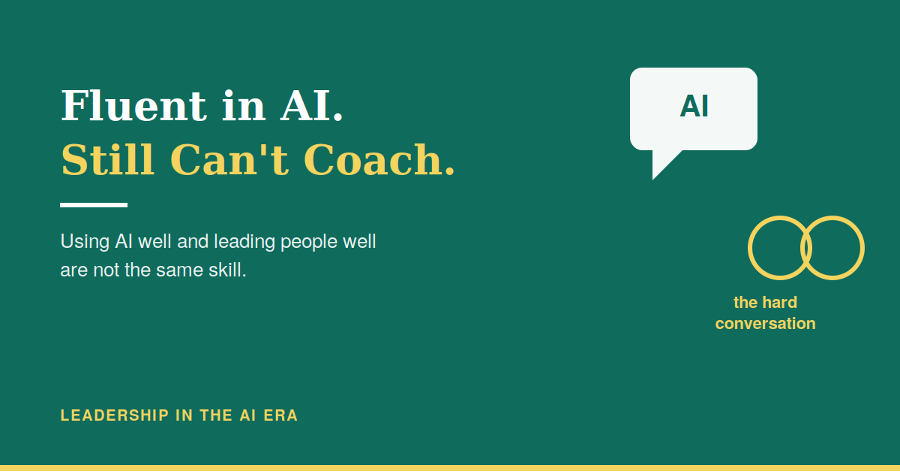
Here’s an uncomfortable fact: being good at AI and being good at leading people are not the same skill, and most companies are accidentally training only one of them.
A manager who can write a flawless prompt, automate a report, and summarize a meeting with AI in seconds can still freeze up the moment a direct report needs honest, difficult feedback. The tool got smarter. The manager’s hardest job didn’t get any easier — and in some ways, it got harder, because now there’s a new layer of decisions about when to trust AI and when to trust their own judgment.
AI fluency is necessary. It is not sufficient.
There’s no debate that managers need to understand AI now. It touches hiring, performance reviews, planning, and daily output. A manager who doesn’t understand what these tools can and can’t do will either avoid them entirely or trust them too blindly — both are costly mistakes.
But AI fluency answers the question “what can this tool do.” It says nothing about “how do I lead a human being who is anxious, defensive, or disengaged.” Those are two entirely different muscles, and building one does not automatically build the other.
Where this shows up in real teams
Picture a manager using AI to draft fair, well-structured performance feedback for an underperforming employee. The document is excellent — clear, specific, professional. Then the manager has to deliver it in person, watch the employee’s face fall, and navigate the conversation that follows without becoming defensive or backing down on accountability.
No AI tool does that part. That conversation is still entirely human, and it’s exactly the kind of skill that most companies have under-trained for years — long before AI ever entered the picture. Add a new technology layer on top of an existing leadership skills gap, and the gap doesn’t shrink. It just becomes more visible, faster.
Why companies keep solving the wrong half of the problem
Most corporate AI rollouts focus almost entirely on tool literacy: how to prompt, how to automate, how to save time. That’s the easier half to teach, because it’s mechanical and demonstrable in an afternoon.
The harder half — delegation, coaching, hard conversations, accountability without damaging trust — takes longer to build and is harder to put on a slide. So it quietly gets skipped, and companies end up with managers who are AI-fluent but no more capable of leading their teams than they were a year ago.
This is backwards. AI was supposed to free up time for the human parts of management. Instead, in many companies, it’s just compressing the mechanical work and leaving the human work exactly as under-resourced as before.
What actually works: train both, on purpose
The fix is treating AI fluency and leadership behavior as two connected skills that need to be built together, not one as a substitute for the other. Managers need real practice with AI tools, yes — but tied directly to the leadership moments where it matters: using AI to prep for a hard conversation, not to avoid having it; using AI to spot a coaching opportunity, not to skip the coaching itself.
This only works through repeated application on real situations, not a one-time demo. A manager who tries this once in a workshop and never practices it again will default right back to the conversations they were already avoiding before AI showed up.
The business case
A team led by an AI-fluent manager who still can’t coach, delegate, or hold a hard conversation will hit a ceiling fast — the tools will speed up the easy work and leave the hard work, the work that actually drives engagement and retention, untouched. A team led by a manager who’s built both skills together gets the full value: faster execution and stronger leadership, at the same time.
So the real question isn’t whether your managers can use AI. It’s whether AI training is making them better leaders, or just better typists.
Recommended reading from jordanimutan.com:
2. Your Managers Keep Talking About Accountability — But No One Feels It
3. Shared Responsibility Is Usually a Leadership Shortcut
4. Why Your Leadership Training Isn’t Working (And What To Do Instead)

 Most leadership training is forgotten after the seminar.