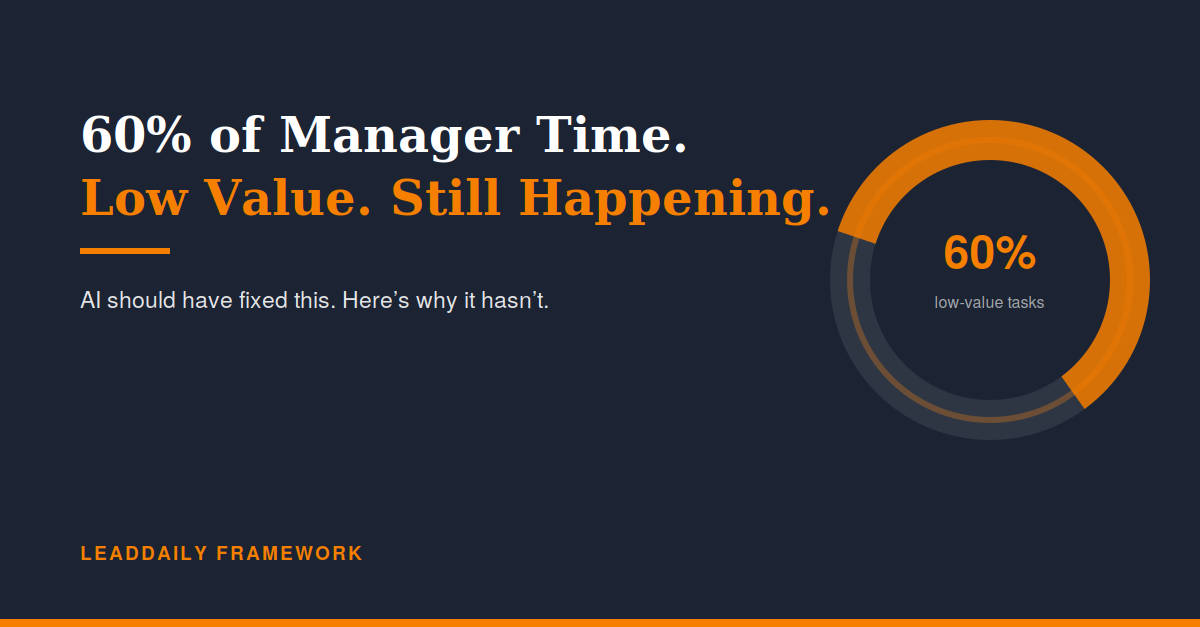
McKinsey’s 2025 Leadership Report found that executives spend nearly 60 percent of their time on low-value tasks: meetings without outcomes, redundant reports, and reactive firefighting. A 2024 JobStreet study found that 76 percent of Filipino employees feel their leaders are too busy to connect. And a 2026 Deloitte survey found that while 85 percent of leaders say building organizational agility is critical, only 7 percent believe they are actually leading on it.
Three separate research streams, same conclusion: leaders are drowning in low-value activity while the high-value work — connecting with people, making strategic decisions, developing the team — consistently gets squeezed out by the urgent and the administrative.
AI was supposed to fix this. And in organizations that have deployed it thoughtfully and developed their managers to use it, it has. In most organizations, it hasn’t — because the manager’s calendar did not change.
The busyness that ate the strategy
Here is the pattern that plays out in organization after organization. AI automates a report that used to take three hours. The manager recovers three hours. Those three hours are not protected, redirected, or deliberately used for the high-value work that was previously crowded out. They are absorbed, within days, by the next urgent request, the next fire, the next meeting that was already in the calendar from before the AI existed.
The busyness expands to fill the space. The high-value work remains unscheduled. And six months after the AI deployment, the manager is just as overloaded as before — with different tasks filling the same amount of time, and the organization wondering why AI did not deliver the productivity gains it promised.
The missing piece: intention
AI frees time. Intention fills it with something better. And intention — the deliberate decision about what to do with recovered time — is a leadership behavior, not a technology feature. No AI system will tell a manager to use the recovered hour for a development conversation with a struggling direct report rather than clearing the inbox. That decision requires a manager who has been developed to make it, repeatedly, until it becomes the default.
This is the leadership behavior that separates organizations where AI delivers measurable value from organizations where AI delivers measurable savings that never appear in business outcomes. The savings are real. The behavior change is missing.
What the Law of Priorities says about this
John Maxwell’s Law of Priorities is blunt: activity is not accomplishment. A busy manager and a high-performing manager are not the same thing. The high-performing manager has made a deliberate choice about what deserves their best energy — and said no, actively and repeatedly, to everything else. In 2026, AI makes that choice easier than ever. But the manager still has to make it.
The specific behaviors are simple but require practice: blocking strategic time before administrative time fills the calendar; asking weekly “what high-value work am I not doing because I am busy”; using AI to handle the administrative load and then actually using the recovered time for the coaching, the thinking, and the connecting that only a human manager can do.
The LEADdaily application
A manager who builds the daily habit of protecting one high-value hour and filling it with deliberate leadership work — not firefighting, not email, not meetings that could have been a message — compounds over a quarter into a fundamentally different leadership profile. The team feels it. The outcomes reflect it.
The business case
The return on AI investment is not hidden in the technology. It is hidden in the manager’s calendar. The organization that deploys AI and also develops its managers to use recovered time intentionally will see the ROI. The organization that deploys AI and leaves manager time allocation unchanged will have spent significantly more than it needed to for marginal efficiency gains.
So the simple question: in your organization, does every manager know what they will do with the time AI gives back — and does their calendar actually show it?
Recommended reading from jordanimutan.com:
1. The Law of Priorities: Why Great Leaders Do Less — and Achieve More
2. Why Your Best People Are Always Busy — but the Business Still Feels Stuck
3. Your Company Isn’t Slow — Your Decisions Are Trapped in Manual Processes

 Most leadership training is forgotten after the seminar.