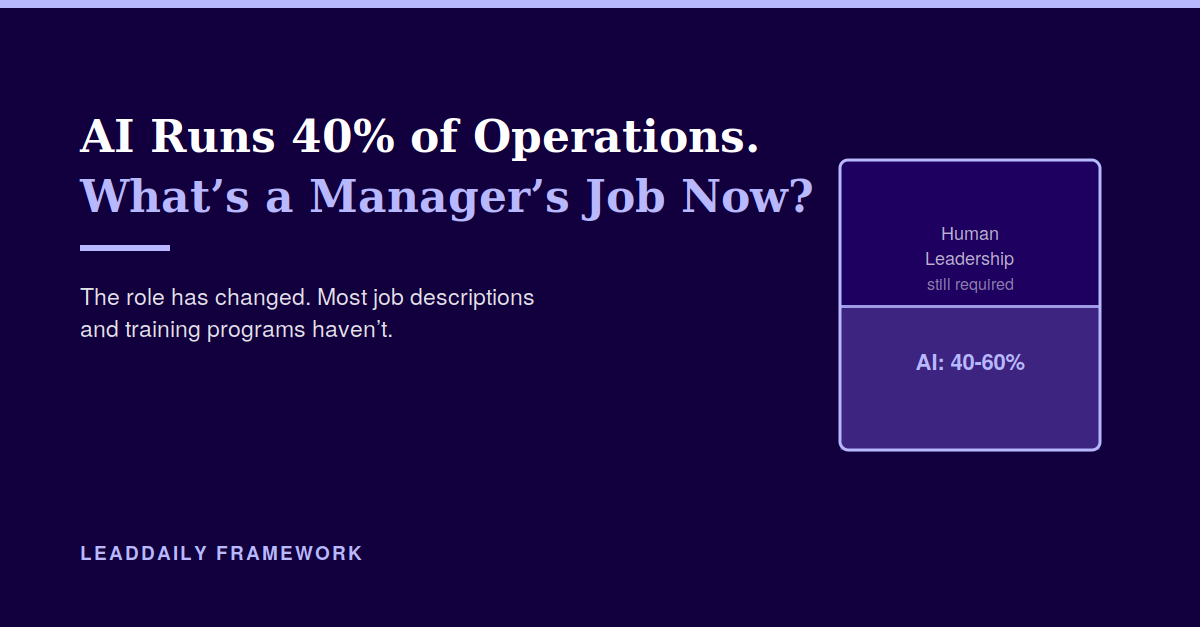
This is not a hypothetical question for 2030. IMD research from 2026 estimates that in HR, procurement, and customer operations — functions where agentic AI has deployed fastest — 40 to 60 percent of day-to-day activities are now being executed autonomously by AI systems. The humans step in for interpretation, escalation, and the interpersonal elements.
Which raises the question that most job descriptions, management training programs, and performance review systems have not yet answered: when AI is doing nearly half the work, what is a manager’s job, exactly?
What AI has taken
AI agents are now handling the work that used to require manager bandwidth: scheduling, reporting, performance monitoring, candidate screening, meeting summarization, data analysis, workflow routing, and first-draft communication. These are not peripheral tasks. They are the tasks that occupied large portions of the average manager’s day.
Their removal from the manager’s plate is not a subtraction. It is a redistribution. The time that was spent on these tasks must go somewhere — and the organizations that have not deliberately decided where it goes are watching it disappear into an expanded version of the work that remains, producing busier managers with no better outcomes.
What AI cannot take
The tasks that AI cannot automate are, without exception, the tasks that most determine whether a team succeeds over time. Sensing that a team member’s engagement is dropping before any metric confirms it. Holding a conversation that requires both honesty and care, delivered at exactly the right moment. Making a judgment call in ambiguous circumstances where the data is incomplete and the stakes are real. Building the kind of trust that makes a team willing to tell their manager what is actually going wrong, rather than what looks good on a report.
These are human leadership behaviors. They cannot be prompted, generated, or automated. And in a world where 40 to 60 percent of operational work is AI-executed, they are the primary value the manager adds.
The job redefinition most organizations have not done
Most management job descriptions, performance frameworks, and development programs were written for a world where managers spent significant time on coordination, reporting, and operational oversight. That world is ending. The new job is almost entirely about people: developing capability, building trust, making judgment calls, creating the psychological safety that unlocks team performance, and translating organizational direction into human motivation.
This is a more demanding job than the one it replaces. Not more time-consuming — but requiring deeper human skill, higher emotional intelligence, and more consistent daily practice of behaviors that are harder to develop than any technical skill.
What this means for training
The leadership development programs that serve this new reality are not the ones teaching managers to understand AI tools (though that matters). They are the ones building the specifically human capabilities that AI cannot replicate: deep coaching, courageous communication, influence without authority, accountability that does not damage trust, judgment under ambiguity.
And they must build these capabilities not through events, but through daily practice, because these are behavioral skills that only stick through repetition. A manager who practices one human leadership behavior every day, in real situations, over sixty days develops the capability the new job demands. A manager who attends a workshop and returns to unchanged habits does not.
The business case
The organizations that understand what a manager’s job is in an AI-augmented world and develop their managers accordingly will have a measurable advantage: a leadership layer that adds the value AI cannot add, while allowing AI to handle the rest. Organizations that do not will have managers who are confused about their role, underperforming on the human dimensions of it, and quietly being made redundant by the technology they were supposed to be leading.
So the question every business leader needs to answer before the next management development investment: in a world where AI runs 40 percent of operations, what specifically are you developing your managers to do — and does your training program match that answer?
Recommended reading from jordanimutan.com:
2. The “Invisible” CEO: Building a Startup Structure That Doesn’t Break When You Step Away
3. Lead with Context, Not Control: How Modern Leaders Inspire Performance Without Micromanagement
4. Why Your Leadership Training Isn’t Working (And What To Do Instead)

 Most leadership training is forgotten after the seminar.