Microsoft’s 2026 Work Trend Index analyzed 20,000 AI users across ten countries and found something that should change how every organization thinks about AI adoption. The employees who got the most value from agentic AI — the ones using it frequently, confidently, and in high-impact ways — had one thing in common that had nothing to do with technology.
Their manager had made it safe to experiment with it.
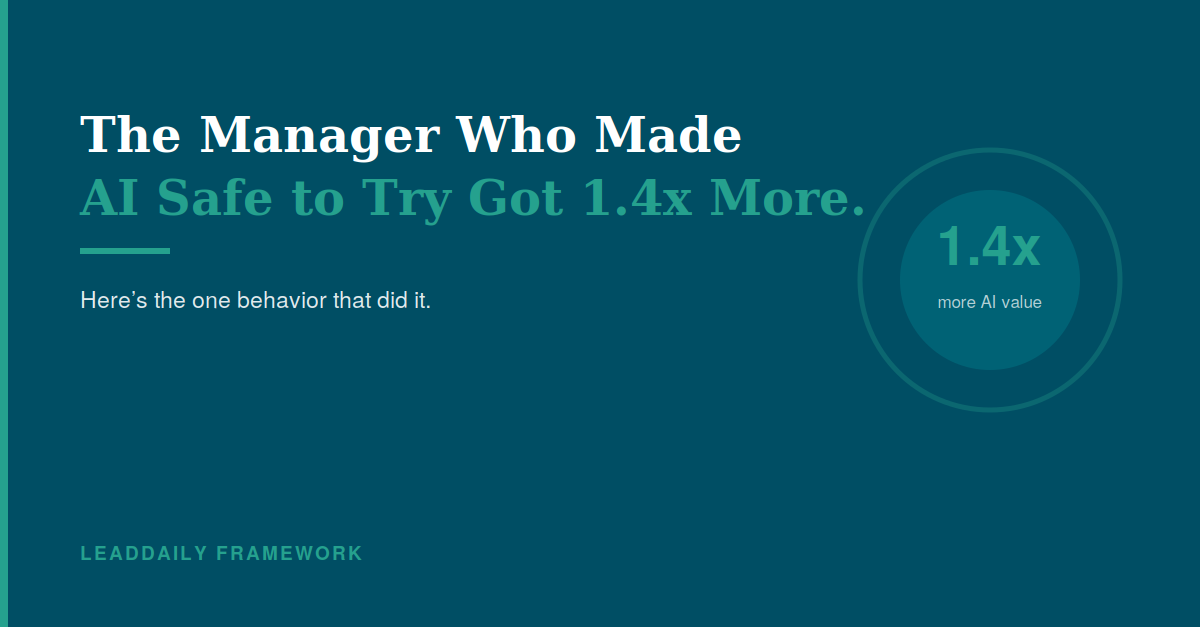
When managers created psychological safety around AI experimentation, employees reported up to 20 points higher AI readiness and value. They were 1.4 times more likely to be high-frequency users of agentic AI. Not because the AI was better in their organization. Because the manager’s behavior made trying it feel less risky.
What that behavior actually looks like
The research identified four specific things managers did differently in high-AI-adoption teams. They openly used AI themselves, visibly and without defensiveness. They set quality standards for AI-assisted work, so the team knew what good looked like. They created space for experimentation, signaling that trying something that didn’t work was not a failure. And they encouraged more ambitious work redesign — asking teams to rethink how work was done, not just add AI on top of existing processes.
Each of these is a leadership behavior, not a technology behavior. None of them require technical expertise. All of them require a manager who has developed the specific daily habits that make a team feel safe enough to change how they work.
Why most AI rollouts miss this entirely
The standard AI adoption playbook focuses almost entirely on access: buy the tools, train the users, set the policies, measure the licenses. What it consistently skips is the behavioral layer directly between the tool and the team: the manager.
A team with access to every AI tool available but a manager who treats AI use with skepticism, who does not use it themselves, who has not communicated any standard for AI-assisted work, and who has not signaled that experimentation is safe — that team will underuse AI regardless of the investment. The psychological safety gap quietly consumes the technology ROI.
The 20-point readiness gap is a management problem
Twenty points of AI readiness difference between teams in the same organization, using the same tools, with the same access, separated only by the behavior of their manager — that is not a technology finding. That is a management development finding. It means the return on AI investment in any organization is directly and measurably linked to the quality of manager behavior around AI, not just the quality of the AI tools themselves.
How to build the behavior, not just the awareness
A manager who is told “create psychological safety around AI” in a workshop will nod, leave, and do approximately the same thing they were already doing. The behavior does not change because the concept was explained.
The behavior changes through specific daily practice: the manager who starts using one AI tool visibly in a team meeting this week; who asks a coaching question about what an employee tried with AI this month; who acknowledges, out loud, that they tried an AI approach that did not work and here is what they learned. These are practiced behaviors, not natural instincts, and they are built through daily repetition with real feedback — not through a workshop and a set of guidelines.
The business case
The 1.4x multiplier on high-frequency AI use is not a soft engagement metric. It is a direct measure of whether the AI investment the organization made is producing the adoption rate required to generate a return. The variable controlling that multiplier, in Microsoft’s research, is manager behavior.
Which raises the obvious question: in your organization, are the managers leading the AI adoption — or are they the reason it has quietly stalled?
Recommended reading from jordanimutan.com:
2. How to Master Adaptive Leadership in 2025 Without Losing Your Sanity
3. The True Leadership Currency: Why Trust Is More Valuable Than Talent

 Most leadership training is forgotten after the seminar.