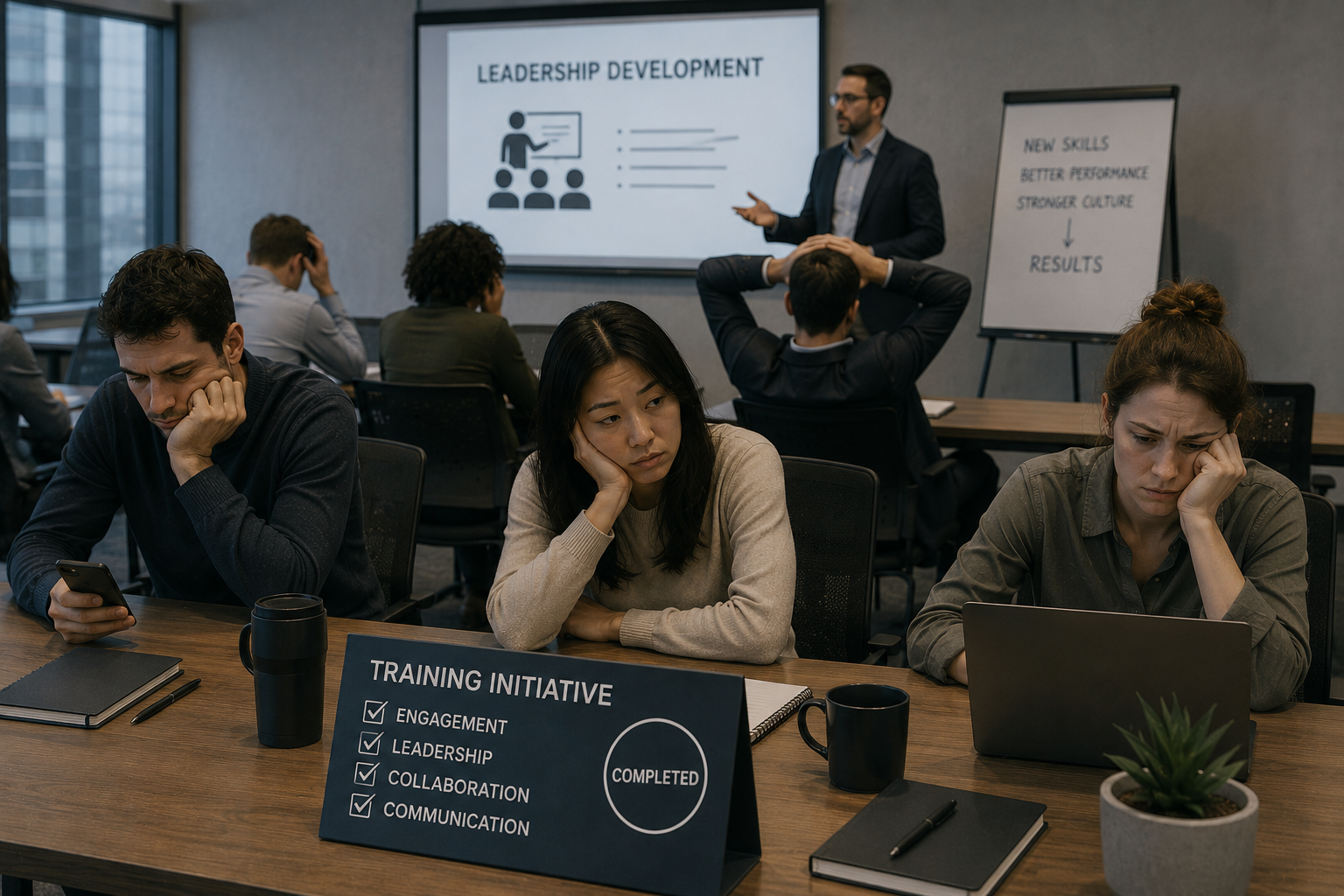
Organizations love the idea of a learning culture. They list it in job postings, mention it in town halls, and point to the annual training budget as evidence it exists. Then they send everyone to a workshop, file the attendance report, and call the culture built.
A learning culture is not measured by how many trainings were scheduled. It is measured by how much behavior actually changed as a result. And by that measure, most organizations are further behind than their training calendars suggest.
Truly knowing how to create a culture of continuous learning in your organization means designing learning into how work happens—not as a separate event that interrupts it.
The Problem
Most organizational learning is episodic. Something goes wrong, or a gap is identified, or an annual review cycle arrives—and then training is scheduled. People attend, information is delivered, and the event ends. The assumption is that learning happened. The evidence, consistently, is that it mostly didn’t.
Learning that happens in a room, separated from the context where it needs to be applied, has an extremely short shelf life. The brain retains what it uses. Training content that is never applied in real work is not learning—it is temporary awareness that fades within days. The workplace then continues exactly as before, and the organization wonders why the training didn’t take.
A learning culture is not built in a training room. It is built in the daily moments between training events—when managers coach, when mistakes are discussed openly, and when applying new behavior is expected, not optional.
The Solution
Continuous learning cultures are not accidents. They are designed—through the habits of leaders, the norms of teams, and systems that make applying what you learn a natural part of how work gets done.
- Make reflection a habit, not an event. End team meetings with one question: what did we learn this week that we’ll do differently next week? Two minutes of structured reflection is worth more than a two-hour debrief session once a quarter.
- Treat mistakes as curriculum. The organizations that learn fastest are the ones where mistakes are analyzed openly, not hidden or punished. What went wrong, why, and what will we do differently is the most valuable learning conversation a team can have.
- Use micro-learning in the flow of work. Short, focused lessons delivered daily inside working hours—not pulled out of them—build learning habits that last. The lesson that arrives on someone’s phone during the workday and asks them to apply it that afternoon is infinitely more effective than the workshop scheduled for next quarter.
- Connect learning to real goals. People learn faster when the learning is directly relevant to something they care about achieving. Link development to current projects, current challenges, and current growth targets—not generic competency frameworks.
- Leaders must model it visibly. A learning culture is impossible if leaders don’t visibly learn themselves. Share what you’re reading. Admit what you got wrong. Ask for feedback. When leaders model curiosity, teams follow. When leaders model certainty, teams perform—and stop growing.
The organization that learns fastest will outperform the organization that trains most. These are not the same thing. One is a calendar. The other is a culture. And cultures are built one daily habit, one honest conversation, and one applied lesson at a time.
Think About This
In your organization, what actually happens the day after a training ends—and does that day look any different from the day before it?

 Most leadership training is forgotten after the seminar.