“Voicemail” question “Is launching a new brand from the same company more preferable than franchising?”

We have a voice in question from an anonymous listener “Is launching a new brand from the same company more preferable than franchising?”

These are two distinct topics, and I am not quite sure how they relate. Unfortunately, it was an anonymous sender. The listener who sent the ‘voice’ question did not leave a name or email address.

Let’s see. Let me tackle this as two questions. The first one is “Launching a new brand from the same company.” If the new brand is not targetting a different customer, then that should be no problem. I assume the new brand is still on-brand with the company’s overall branding.

However, if the new brand being launched is targetting a different set of customers, it’s best to launch the new brand as another company.

For example, when the Toyota Motors directors decided to go after the luxury class of automobiles, they knew they could not launch the new brand of cars under the ‘Toyota’ banner.

The Toyota brand stood for quality and affordability. The target market is the middle class and lower middle class. Coming out with a luxury brand of cars would confuse buyers. The target market of the new vehicles is the upper class of buyers. These target customers will not likely buy ‘Toyota’ cars for personal use. They are after prestige and luxury.

So as not to confuse their existing ‘Toyota’ market and their target luxury market, the car manufacturer decided to create a separate branding and company for it. So they came out with the Lexus brand of cars. Lexus was made to go after the market of Mercedez Benz and BMW. They offered the same luxury level of automobiles with reliability and high quality at more affordable pricing that Japanese manufacturers are known for. So one conglomerate is coming up with two brands of cars.

Now, let us discuss the second topic – franchising. I don’t have enough context to reply correctly. Hopefully, the listener that sent the question will be able to read this and send a follow-up question. Please provide a little bit more context so I can properly reply.

In the meantime, have a good day, everyone, and be safe.

If you have a question in mind, please send your question via the link below.

https://bit.ly/Askjordan

Thinking out load, The Origin story

Photo by PhotoMIX Company on Pexels.com

I sometimes encounter people that are not open to learning new things. For them, learning stops when they leave college. As a result, they feel embarrassed to ask questions or attend learning sessions even if they are free. 

I feel bad for them because they are missing a lot. They can avoid mistakes others made and take the proper steps to help more successful people. 

Of course, there is the other type of people. Some have the humility to learn. They intend to put their new knowledge into practice. This podcast is dedicated to us lifelong learners. It’s for us that know and appreciate that we don’t know everything. 

Life is fascinating and offers something new to learn every day. 

I am amazed by his insight when listening to Gary Vee’s podcast. 

Interestingly, he is an avid observer of life.

He pays close attention to the people around him. Gary actively looks for lessons to be learned. I find his approach fascinating. His unapologetic honesty is refreshing. Of course, his messages would be more welcome without the F-bombs. Haha 

One of the things I love doing is designing and facilitating workshops, both free and paid. I enjoy sharing knowledge with others. Of course, if I were super-rich, all my workshops and consulting would be free.

My life purpose is: 

“transforming lives through continuous learning.” 

Tell you what? Let’s learn together. This way, we don’t make the same mistakes. It also helps us plan and improves every aspect of our life. 

Please feel free to leave me a question or a message. 

I invite you to take the time every day and see what you learned from the day. 

Have a great day. Peace.

It takes a community to grow a business

I started the first weekly workshop for Biz Sprout Community last night. Mostly BNI friends attended it. There were a dozen attendees in all.

I started the weekly workshop as a venue for sharing what I learned through the years of working with startups. The goal was for new startup owners to learn from common pitfalls and avoid them. The other intention is also for them to understand the better practices in starting, operating, marketing, and leading a business.

I plan to run this workshop weekly and see the benefits. I should, however, remind myself that it’s not a numbers game. I should not let myself get caught up with the number of attendees. Helping transform the point of view and practice of one entrep is a reward in itself.

Like a former manager used to say, ‘you can lead a horse to water, but you cannot force it to drink.’

It’s also interesting to observe that not all Entreps are interested in learning better ways of starting a business. For most, it’s just a question of seeking referrals. It’s so unfortunate to see Entreps like that.

If they understood the better practices of starting a business and the importance of proper marketing, then their business would be in a much better shape months and years from now.

It’s better to learn to fish than ask for ‘referral’ fish every day.

A few interesting things I observed about the mini-workshop: although the event was boosted, only two non-BNI or friends attended. There were 45 interested, and seven will attend. Only two attended from the boost.

I read an article before that Facebook is becoming so saturated with ads that it’s difficult to cut through the noise.

Second, even if you cut through the noise, an excellent copy is still necessary. My ad resulted in 45 interested registrars. The copy did not compel them to swing to ‘attending.’

Three, I should not take it personally that the turnout of the ad-paid event was low. A marketing professional needs to try to figure out the algorithm. We also have to keep in mind that algorithms change. The patience to figure out what works separates the good marketing professional from those who pretend to be one.

It’s always good practice to stand back and assess something that happened. I need to remember to extract the lessons learned.

Learning is a lifelong journey.

Don’t let anyone tell you you can’t have a bigger paper

Daniel Humm

When asked at a young age to draw a house on a piece of paper, Daniel Humm asked for a more extensive paper. His teacher told him to draw on the paper he had, just like everyone else in the classroom. He was not getting a bigger paper. He draw a house four times the size of the paper. He drew off the table and everything.

His teacher asked him to leave the classroom. Daniel was then asked to go to therapy. He met an amazing woman in therapy. She got upset with the teacher. They ran to an art store to buy the biggest paper and writing instruments. They drew a huge house. She told Daniel “do not let anyone tell you that there isn’t a big enough paper.”

Daniel dropped out from school at 14, ran away from home at 15, became a dad at 18. He was working in kitchens at 20.

He quotes, “Life is a daring adventure or nothing at all.” Helen Keller

His original passion was cycling. Unfortunately, an accident forced Daniel to reassess his career path. Daniel never gave up, got a job at a restaurant. He worked hard learning to be a chef with no formal education.

Today, Daniel owns the famous Eleven Madison Park restaurant (Three Michelin stars). He also owns The NoMad and Daniel Davies and Brook. Recently he opened a Vegan restaurant that earned a three Michelin star.

Feel free to listen to his podcast interview. He is living an amazing journey.

Optimism fueled by Practicality is unstoppable – a great GaryVee podcast episode

Lessons from a recent podcast episode of GaryVee.

• Great content is either Useful Information or Entertaining. Better yet, it’s both.

• If you want people to engage with your content, engage first with them. Leave an interesting comment. Do this every day.

• Content must be selfless, not selfish.

• Are you posting content for yourself or your others?

• Content is about creating awareness.

• Attention is real estate. If you are not acquiring real estate, your brand will not get very far.

• What you say is essential. Talk about something you know and are passionate about.

—-

We have read various copies of the lessons above many times. We all hear content is supposed to be for customer consumption and not an expression of vanity. Yet, most postings are about ourselves. Most are not putting our educational or entertaining content.

Check it out. All content with very high engagements is either educational or entertaining. The ones that are both are super viral.

Why aren’t we doing what needs to be done? Do we expect our social media presence to grow and not put in the effort to create the right content?

Transform lives with your content.

Don’t tolerate unproductive meetings

Are your meetings productive? Ironically, a vital work collaboration tool can also be a time-waster. Hundreds of hours are spent on meetings every week.

Sessions can also be calculated in Peso value. Depending on the people in the room, the total monetary value can run from thousands to hundreds of thousands.

Why is it that most employees and a few managers are allergic to meetings? They try to shun them. Meetings are avoided like the plague.

With over 30 corporate years of experience, many meetings I attended are time wasters. Some meetings I attended had no clear objectives. Some had no agenda. Some meetings seem to be a repeat of the previous one. There are days that meetings seem like we are listening to a monologue.

Don’t get me wrong. I still believe that meetings are excellent sources of ideas. Great collaboration can be exhibited during meetings. Yes, meetings can be productive provided the following:

– It has a clear written agenda sent before the meeting.

– The meeting is attended only by people who need to be present.

– Any reading materials and presentation decks are sent within 48 hours to participants. Sending reading materials saves time from having to read the deck at the actual meeting.

– If the meeting will be a monologue or announcement, then an email would be better.

– Minutes of meetings are captured and sent to the attendees 24 hours after the meeting.

– The meeting objective is stated before starting the meeting.

– The meeting facilitator keeps discussions back to the agenda.

– You should spend only 1/3 of your working time a week.

So go ahead. Follow the guidelines above and have highly productive and short meetings.

Do you really set your people to succeed?

A leader’s behavior shouts so loud people cannot hear what he is saying. Likewise, our actions shout so loud that people cannot hear our words. This is even more so for leaders.

As a leader, people always watch their every word and move. The leader’s behavior will always trickle down the company and become the culture. The values exhibited at the top are mimicked as you go down the ladder.

A great leader I met some time ago was very charismatic. He could utter the most inspirational words at the right moment. He commands attention without even trying when he stands in front of people. He is battle bruised and a successful entrepreneur. This leader has accomplished a great deal, given that he is just entering mid-life.

I would hear him say that the job of leaders is to set up their people to succeed. Leaders should set up people to succeed. That’s a great aspiration and a worthy purpose.

However, with his drive and determination for the company to succeed, he would sometimes forget that his leaders are not of the same caliber and experience.

We, as leaders, often forget that what may seem easy for us is not necessarily easy for our direct reports. What may seem like an easy goal for us can be a scary undertaking for our direct reports. After all, they do not yet possess the years of experience and knowledge gathered through the years as we do.

We all have our management and leadership maturity levels. No two levels are the same. We took different routes and learned different things up the ladder. We had different mentors, different sources of learning, and different values.

Having said this, it’s not fair to hold our direct reports to the same competency standards that we hold ourselves. Unfortunately, I am also a victim of this. I sometimes wonder why a direct report is struggling with a task that I think is easy enough. Well, the answer is because we have different levels of competencies.

When people that was supposed to be set up for success by the charismatic leader start to fail, they get verbally showered with painful words. Once this starts, a pattern emerges, and the occurrence becomes more frequent.

After a few months, the leader in question would begin to strain and leave. It’s not only the mediocre ones that go but also the good ones. Some leave even before being given a promotion. There is no psychological safety in the workplace.

On the other hand, I met another leader that also started from humble beginnings. She created a company of eight employees into 1,600 after several years. Her secret? She sets people to succeed. She never says this, but she does it anyway—one of her core beliefs in developing leaders to succeed. We had set up a leadership development program for the succession pool.

Without proper orientation, training, and support, she does not abruptly place a leader from one role to a higher position. They take months to prepare a leader properly. The up-and-coming leader is then posted in an OIC role for six months. This will give them the time to learn the ropes, and be trained, mentored, and guided accordingly.

One of the worse things we can do to our people is promoting them without providing them the tools to succeed. Providing them with the tools before we allow them to swim makes a big difference. Setting people to succeed means preparing them. Setting people to succeed also means that if someone we promote fails, we take accountability for the error in our judgment. We cannot just blame it on the failed leader. It’s primarily our fault.

Setting people to fail means promoting them, pressuring them, and blaming them. That’s a recipe for a toxic environment with a high attrition rate.

Let’s not do that. As leaders, we must develop our leaders. We have the responsibility to provide them with the tools needed to succeed. We need to teach them how to be successful swimmers before we get them to compete internationally. Finally, we need the humility to take accountability for a failed promotion.

That’s the true mark of a servant leader.

4 Steps to writing a more compelling message

Writing narratives for marketing collateral is challenging at times. Startup owners usually create narratives that are confusing, too wordy, or have too much industry jargon.

There are countless books about writing narratives for Marketing collaterals or copywriting. With a few guidelines, you can immediately make a better impact with your narrative.

All you have to do is remember to use the acronym PSHS. This stands for Problem, Solution, Hero, Story.

1. Craft your message to articulate a problem your target market has. Even better, identify the pain point of the problem.

2. Follow this with an explanation of how your solution solves the problem.

3. End by painting a picture of what success looks like for the Hero of your story, which is your target customer. Remember, your product or service is never the hero. They are the guide to the hero (customer).

4. Stitch the above in a story format. Don’t write this literally. Messages delivered in a story format are easier to recall.

One optional piece of information you may need to include is the CTA or Call to Action. You cannot assume that the reader knows what to do after reading your copy.

To illustrate this, let’s say you are writing a narrative for Father’s Day. You operate an e-commerce website that sells specially curated, limited edition gift boxes.

You can write an email blast with an image of a dad smiling as he opens a gift. Your copy goes, “Don’t forget to get your dad a gift for Father’s Day. We have a variety of limited selection, high-quality curated gift sets. Order now!”

You can then improve it a little using the PSHS approach.

“Are you struggling to find the perfect gift for dad for this Father’s Day on June 19?

You can give him our limited edition carbon fiber money clip, pen, notebook, and leather watch case.

Make your dad happy with our exclusive limited edition Father’s Day gift box.

Watch your dad’s face light up this Father’s Day.

We have limited stocks. Click here to order now.”

The approach can also be used as a guide when creating pitch decks or proposals. The approach highlights how you can solve a customer’s problem and show them how it feels to be a hero.

Customers are more attracted to the benefit of your product or service. Features only come second. Don’t pitch your features. Put the benefits they get front and center or your message.

You are not the hero. The customer is always the hero of the story. Your job is to help the customer solve their problem and paint a clear picture of what success looks like. You are ‘Yoda’ to Luke Skywalker. Luke becomes the hero with the help of Yoda.

There are a variety of creative ways to craft your copy or message. Have fun and make your message more compelling with the PSHS approach.

The enemy of progress is hesitation

Sometimes we look back at our life and think that we could have accomplished more things. We feel that there were things that we should have done but did not do.

I have done this retrospecting now and then. But, if you think about it, one of the significant causes of regret is that we stopped dead in our tracks in doing something.

We think of something fascinating that you want to do or accomplish. We plan for it. We put in the time and effort for it, and when we were about to embark on it, we hesitated. Then we stop. We postpone it for whatever reason. Finally, we get busy and forget it altogether.

One day, you meet one of your friends who seems to be getting in shape from boxing. First, you do a quick search of all boxing gyms around you. Then, you call each one and see which one you can afford or can accommodate your free time. Then, you research the gloves and the gear you want to buy.

On the day you plan to enroll, you hesitate and push back to the following week. You did not want to disrupt your next few days because you needed to focus on a project you needed to complete

The following week comes, and you have other excuses to push back. After a while, your boxing workout project is forgotten. Years later, you think. I could have been in better shape today if I had pursued my boxing interest. Regret seeps in.

The only cure to hesitation is just one thing, do it. That’s it. Just do it before you start hesitating and making all kinds of excuses.

In the book the 5-second rule, the author gives a straightforward yet powerful solution. She said that when you want to do something significant, count backward from 5 to 1. When you reach 1, do it. She noted that scientifically our brains are wired to protect us from change. As we count backward, our brains are occupied with counting that it does not have time to come up with excuses. When you reach ‘one’ and do it, then the brain no longer has the power to hold us back.

Pay attention to your thoughts. See if you are holding yourself back from doing something important or valuable. Then, even before you get the urge to come up with excuses, count backward and do it. Your life will be more fulfilling and happy for it.

Crafting your business in paper before turning it into reality

As a business consultant, I often come across business owners or entrepreneurs who had a business idea and jumped into turning that idea into a startup. I admire people who take the plunge with their ideas. But unfortunately, nine out of ten people would hesitate and walk away from their dream business. Their minds would throw in dozens of excuses why they should not do it. 

Later in life, some of these abandoned ideas tend to nudge us with regret. The regret is even more painful when someone else takes on a similar vision and succeeds with it.

Then there is the race for business survival and success. Statistically, only 14% of startups live beyond their 10th anniversary. The rest drop out of the race. 

Their first mistake is turning a business idea into a business without adequately defining their business model. They never took the time to scope out their business correctly. 

When I was younger, business ideas were documented in what was called a ‘business plan.’ The problem with business plans is two things. One, they are lengthy documents. It takes time to complete a proper business plan. The second problem is related to the first one. Since they are huge documents, they are never reviewed again when the business begins. Another possible reason is that most of the assumptions in the business plan are no longer valid. There is a difference between a plan and reality.

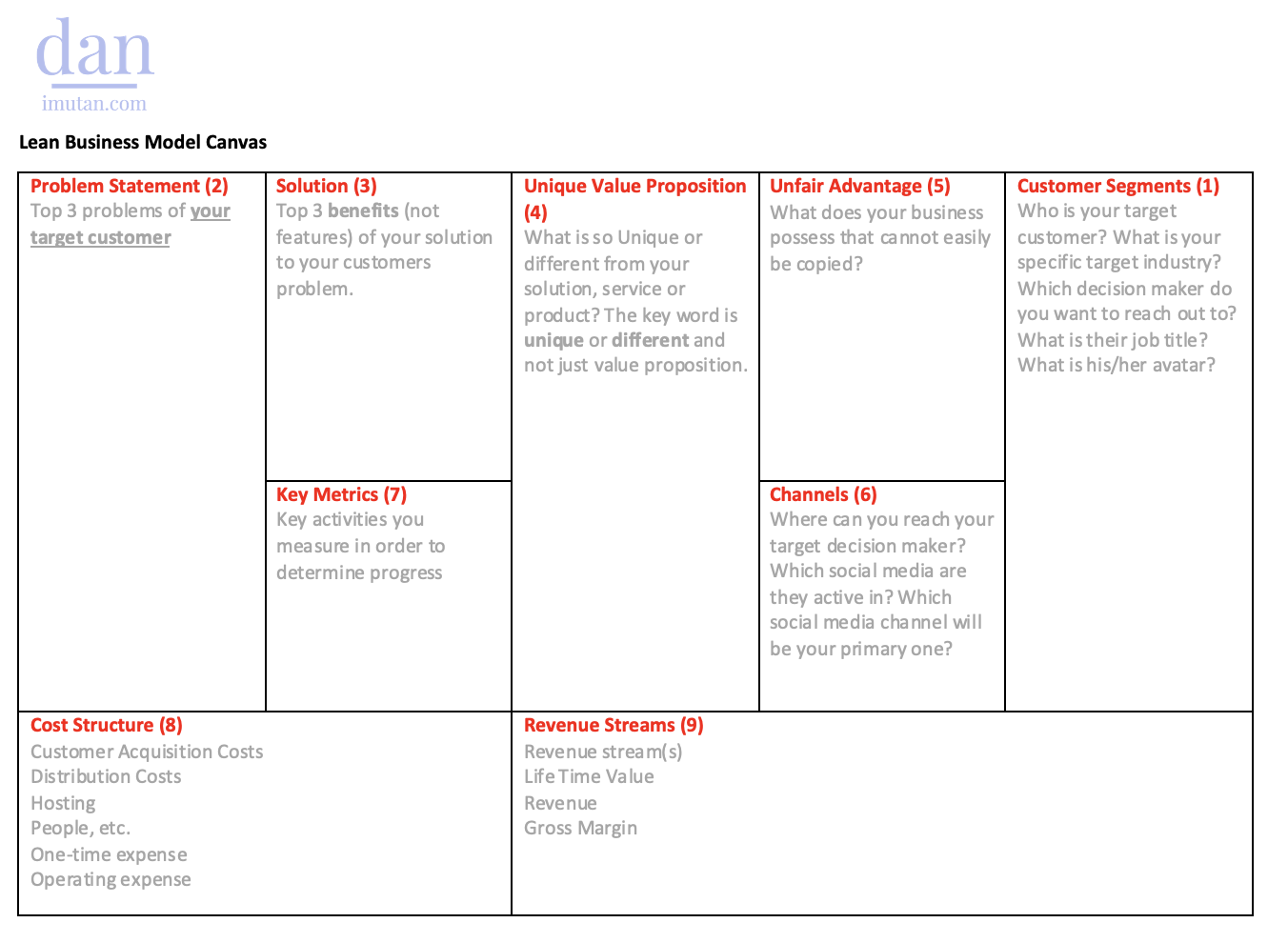
Simplicity is why the lean business model became popular. A lean business model template is only a page long. Completing it will result in one or two pages. 

The lean business model has nine sections to think about. Even if they are few, it’s still a challenge to come up with answers. Simply breezing through the questions without adequately thinking about them will only jeopardize your view of your business later. It also affects the way you will operate and market your business.

I finally wrote an educational article because I often share the benefits of the lean business model with others. I even send them a copy of the template. With this article, my friends have the template and instructions on how to complete it.

The image above is the lean business model template. You can get the word version by clicking here.:

Steps in completing the lean business model:

Customer segment. Define who your target market is. The target market cannot be everyone. It does not make sense to target everyone. You need to identify a target market that will benefit most from your product or service. A simple way to approach this is by identifying the industry and job title of the decision-maker you want to sell to. You then create a more detailed description of the decision-maker by creating a customer avatar. A customer avatar represents the decision-maker that you want to reach. For instance, you plan on going after Marketing Managers. Your customer avatar could be; The Chief Marketing Officer or CMO of a large multi-national FMCG. He is 47 years old and plays golf on the weekends. Joel is married to a beautiful housewife that graduated as an accountant. She chose to be a housewife to raise their children. They have a 25-year-old son and a 22-year-old daughter. They all live together in a luxury condominium in BGC.

Problem Statement. The best companies in the world are solving a problem. A car company solves the problem of transportation. A food company solves the problem of nutrition. A drill manufacturing company solves the problem of hanging memorable photos. You are not selling a project or service. What is the problem you are specifically solving?
Solution. What is your answer to your customer’s problem? What are the benefits of your solution? The features of your solutions will only be secondary to the benefits you bring to your customers. Your customer’s primary focus is the benefits.

Unique Value Proposition. Why should your customer come to you and not to your competitors? Here is where your entrepreneurs’ bias comes in. Entrepreneurs often state their value proposition in this section. We are not talking about just the value proposition. The keyword for this section is ‘unique’ or ‘different.’ What is unique about your product or service? If there is nothing special about it, then it’s a commodity. You will be faced with a pricing war. Can you be the lowest-priced product or service in your category and still make money? UVP is often one of the most challenging sections to answer honestly. Not having a unique answer to this question will make it very difficult to succeed in the business world.

Unfair advantage. What is it that you have that other companies do not have? When you succeed, other companies will start coming out with competing products or services. If you cannot keep your customers or attract new ones because of something others cannot copy, you will start losing customers. 

Key metrics. You need to set a few vital measures of success to know how you are progressing. You cannot improve what you don’t measure. Identify 3-5 things you need to measure to serve as your dashboard.

Channels. It is useless to be marketing on Facebook if your customers are on LinkedIn. It is futile to post content on LinkedIn when your market (see customer segment in item #1) is in TikTok. What channel will you use to promote your brand, product, and services? What blogs do they read? What groups do they belong to? What magazines do they subscribe to?

Cost structure. How much funding will you need to start your business and sustain it? What is your capital and operations expense for the next 24-36 months? You cannot make money if nobody knows you exist. Getting your product or service known by your target market takes time. In the meantime, do you have enough funds to cover this period where you are not making money or profitable?

Revenue streams. How will you make money? Will you make money from your net profit? Will you make additional revenue from an added insurance that you can offer? Do you have a second service you can up-sell or cross-sell?

If you have a new business or are about to start a business, I strongly encourage you to have a clear definition of your business. Then, taking the time to put it together provides you with a clear picture of your business. 

A clearly defined business model is also the input to a second equally important task – creating a marketing strategy. Your customer segment, UVP, etc., feeds into creating a marketing strategy and a marketing plan.

However, that’s for another article.

Please use the template provided, and feel free to reach out for any questions you may have. I am again wishing you the best with your business or startup.