1. Have clear and Stretch goals
Highly productive people have clear goals. They place a clear beacon on where they want to be. We are talking about goals that are slightly beyond their reach. They place stretch goals to stretch their capabilities.
2. Knows when to say ‘no’
Highly productive people know that there is a finite number of hours a day, a finite number of days in a week, a finite number of weeks in a month. They understand that their time is precious and is best spent on meaningful work. Work that adds value to their company, customers, employees, their department or other departments.
3. Consistently delivers on their commitment
One very clear differentiator between highly productive people and the rest is their drive to deliver on their promise. It’s sadly commonplace today to see people that do not deliver on their commitment. Commitments are taken lightly by most people. These people are usually the ones that are stuck in their careers. After all, who would want to promote someone who cannot deliver on commitment?
4. Results-driven
Highly productive people focus on results and do not use effort as an excuse. They do not hide behind their ‘seemingly’ massive efforts to deliver. At the end of the day, highly productive people understand that it’s results that matter more.
5. Holds oneself accountable
Highly productive people do not point fingers to anyone when things fall apart. They are the first to hold themselves accountable for their performance and the performance of the people that report to them.
6. Manages risks
Highly productive people regularly think about what can go wrong and put preventive measures in place. They are not negative people who simply give up because of what may go wrong. They understand that risks usually causes delays in plans. Highly productive people plan ahead and figure out what to do with the roadblocks and speed bumps they will be encountering.
7. Collaborates well with others
Highly productive people appreciate the fact that you cannot succeed on your own. You need to work closely with colleagues. Productivity is raised through collaboration with others. Success is delivered through a team effort.
Coming up with creative solutions, new products and services are often done in haste.
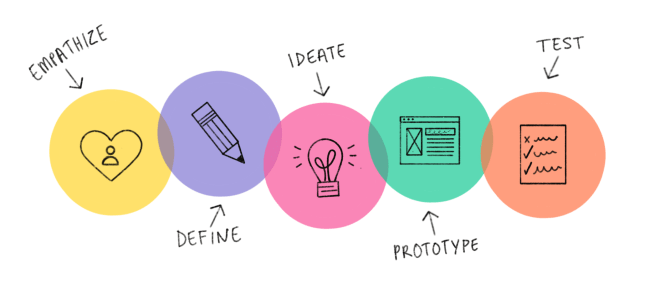
However, Design Thinking designers approach users with the goal of understanding their wants and needs, which might make their life easier and more enjoyable and how technology can be useful for them. Empathic design transcends physical ergonomics to include understanding the psychological and emotional needs of people—the way they do things, why and how they think and feel about the world, and what is meaningful to them. Design thinking does not need to be complicated.
It can be easily applied to work. We simplified the approach to design thinking and called it “creativity@work.ph” or Creativity at Work in the Philippines.
The approach can be applied to an important new service of product development. It can also be applied to simple things like turning six recruitment processes into a one page easy to understand process. It’s so easy to understand that our new recruitment officers are able to do their talent acquisition job very well from day 1.
However; designing and piloting a new product, service or solution is only half the battle. The other half is having a simple process for rolling out the idea. Your innovation is good only on paper unless properly executed.
We connected our effective execution (template-driven) approach to design thinking. Design thinking and effective execution complement each other. Hundreds of employees from dozens of companies are already using our template driven project management made simple tools.
Do you want to know more? We want to hear from you. We want to understand your goals for putting more creativity at work. We want to add value to you and your company.
Great innovation does not come from focus groups. It does not come from surveys. It does not come from interviews. It does not come from looking at months and years of statistical data. It does not come from guesstimates. It does not come from past successes.
Great innovation comes from paying attention to people. Yes, you read it correctly. Great ideas and innovation come from paying attention to people and empathizing with them.
In Design Thinking, empathy is, as explained in IDEO’s Human-Centred Design Toolkit, a “deep understanding of the problems and realities of the people you are designing for”.
Great ideas come about when you gain a deep understanding of people’s emotional and physical needs.
The power of simply using ‘numbers’ has caused about 17 plane crashes a day in the 1940’s. The leadership of the US Air Force attributed these to the ‘fact’ that planes were getting faster and more sophisticated. The Air Force leadership were baffled by the real reason for the crashes until one day the real reason was observed. The cause of the crashes was the cockpit equipment dimension. The cockpits were supposed to have been designed for the ‘average’ sized pilots. It was then observed that none of the 4,000 Air Force pilots fit the bill of the ‘average’ size pilot.
It became clear that the discomfort had been causing all the crashes. The problem was resolved when the Air Force designed adjustable equipment to fit the pilot’s body.
Just recently, I had been observing our HR recruitment people. They were clearly at a loss and inconsistent with the way they were managing their workload. I brought in a consultant to interview our HR Recruitment officers and document their processes. The resulting work was six different processes done by the Recruitment officers.
Weeks later, I still noticed that they were at a loss. They could not come back to me with simple things like how many applicants did we get for a certain position? How many candidates came from different sourcing channels. Why are some positions more difficult to fill than others? Actually, since they were clearly at a loss, they would simply not reply. One time, I walked over from my office and asked them why they had not replied to a particularly important inquiry from a hiring manager. I saw the ladies gazing at their laptop seemingly lost in thought. I asked them about the inquiry and they said that we have over a hundred job openings and they were trying to pull together the answer to my question. Long story short, they spent an hour on the inquiry only to come up with nothing.
Having observed this, I then gave a challenge to the same consultant that documented the Recruitment process. I asked him to pull all six processes spanning multiple pages into a one-page Recruitment process. I said that the process must be partially an image and links to the necessary tracking sheets and templates. The consultant was given a day. After the one-page process was drafted, I then walked two new HR recruitment officers through the process and invited their inputs. The process was tuned on the spot based on their feedback. We piloted the final version.
The ultimate test of compliance and a clear understanding of what’s happening in recruitment were the digital folders that are supposed to contain the CV’s of applicants. As applicants are being processed, their personal folders (containing their CVs, recruiters’ notes, employment requirements, etc.) move from one status to another. A master tracking list should also be capturing who is applying for what position along with their status.
I checked these digital tools a few days early and they are being properly and accurately populated. I asked the new recruiters questions about the process and they were able to answer properly.
We did not hold surveys or statistical analysis. We simply observed the recipients of a core HR process.
If you want your company, department or team to come up with meaningful innovation or ideas, start with paying attention to people. Pay attention with empathy and you will get to the heart of their problem and issues. Only then will you come up with sensible solutions.
Are you an optimist? A Stanford research shows that students perform better in math exams when they have a positive attitude towards math. The researchers showed data linking positive attitude to performance. The researchers said that “Having a positive attitude acts directly on your memory and learning system.”
In my life, I have never encountered a truly successful pessimist. Some pessimists may seem to be successful but if you dig deep down, their success was not a result of their effort. It could have been a result of DNA (inheritance) or luck (married to wealth). If you have the chance to watch Bill Gates, Steve Jobs or any other great leader speak you will notice that they are literally oozing with positive energy. They look at problems as challenges to conquer. They do not allow failure to take over their minds. They do not bicker or complain.
How do you foster a positive mindset? Well, you can start with the following:
1. Foster a strong relationship with God. A strong relationship with our maker always produces hope. There is always hope that there is nothing impossible with God.
2. Stay away from negative people. They tend to ‘drain’ your positive energy. They dump their woes of the world on you. They would complain about everything from their boss to the traffic situation, spouse and neighbor. Well ‘misery loves company.’ They want others to be as miserable as them.
3. Read biographies of successful people. There are few things as inspirational and positive than a successful life that started in adversity.
4. Always keep your eye on the benefits or value of what you are doing. Does your work glorify the provider of your blessings? Does your work glorify God?
5. Keep your mind occupied with learning new things. Do not dwell on negative news from nay-sayers. News sells by sensationalizing and scaring its readers.
Do you want to make the best out of your life? Do you want to share the resulting blessings with your love ones, family, friends, and colleagues? Start with having a positive mind.
For the last few months, we had been encouraging our team members to seek our APEX (be authentic, be purpose driven and be excellent) values being exhibited by our colleagues. Values are useless unless they are lived by people. Values are useless unless it is rooted into a culture.
Every weekly meeting, we encourage sharing stories of colleagues having lived one of the three values in the past week. We entice this behavior, in the beginning, with prizes hoping that one day the values become a norm in the company.
This week, after three of our colleagues sharing their story, it struck on me that I had witnessed a colleague from HR exhibiting all three values. Let me share her story.
Last weekend, our team members went to EK for a day of de-stressing in our local theme park. On the drive home, my colleague from HR shared something interesting. Apparently, she is an avid learner. She enjoys jotting down tips every Monday, during our team meetings. She was so enthused with her learning opportunity at work that she could not contain it to herself. On every opportunity that arises, she would energetically share her learnings with her friends.
She believes deep in her heart that learning is an opportunity that should be visibly celebrated through sharing knowledge with others. It is not enough that we learn something new. The true values come from sharing knowledge with others. She does not need to share. However, she is always compelled by her conviction to share her learnings for the week.
Veng is authentic, she cannot contain her passion to share her learnings with others.
Veng has a clear purpose to help others.
Veng is excellent as she purposefully learns new things in order to get better in life and at work.
Veng has shown us one way of living all three values. Thank you, Veng.
Another interesting read from my daily Bible reading.
The first churches were started by a bunch of common men and women who loved Jesus and loved seeing people meet Jesus. Their success wasn’t based on their position or their training, but on their passion.
Attitudes are contagious. One thing I love about the team I serve with is that being around them and discussing church, ministry and life in general, stirs my passion for what I do.
If you read through the book of Acts, Paul had a team of people who worked with him to try and accomplish a vision that was larger than he could have ever imagined. Any great leader knows you cannot persevere without great people.
An excellent leader will always persevere because they are not trying to do what they are doing alone. They’ve built a team with people who understand they are valued, their opinions are not only welcomed but necessary, and the goal is the advancement of an organization—not the attention of an individual.
You know you have the right team when you don’t just love the work you do, you love the people you do it with. You know you have the right team when problems do not belong to “me” but rather they belong to “we!” You know you have the right team when the people you lead love you and the organization too much to allow team members to make a ridiculous decision.
The right team will refuse to allow personal preferences to dictate decisions and will embrace uncomfortable conversations. The right team will bring people in when making a decision that directly impacts their area, understanding that this does not slow down the process, but speeds it up, because people are way more likely to buy into a decision when they’ve had input.
What’s Next:
Do you have the right people around you? People who would stick with you no matter what the circumstances?
Is there anything about your attitude that you don’t want to pass to your team? What steps can you take this week to set the tone for the people you lead?
If someone special comes over for dinner, you don’t start pulling the leftovers out of the fridge. You go all out to give them your absolute best.
God gave us His very best when He sent Jesus to the cross, and God calls us to give our best to Him as well.
I once heard a football player say, “the separation is in the preparation.” The reason his team was winning was because they prepared the best they could for each game. What set them apart from other teams wasn’t their facilities or their skill, but their preparation.
The same is true for us. The separation between good and great organizations is the preparation people are willing to put into doing the absolute best they can do. Organizations that anticipate great things prepare for greater things.
Sitting around wanting something great for yourself, your company, or your church is not a bad thing; in fact, it can be the fuel that sets the vision in your heart on fire. However, many times it’s not a lack of vision that holds us back from achieving maximum potential, but rather our lack of execution.
There will never be a day when we don’t have a next step to take in our walk with Jesus or in our roles as leaders. We don’t have to be perfect, but we should work hard, learn as much as we can, and THEN trust God to make up the difference.
We cannot effectively lead people long term if we are not dedicated to increasing our leadership capacity. As long as we are learning, we are growing. When you stop growing as a leader, you begin dying as one.
We have no other talent pool to take from. We have no other pool to select successors for key positions in your company. In the next few years, we will only have the Millennial pool to pick and develop talent from.
When it comes to Generation Y or Millennials, we have three choices:
1. We Villainize them. We choose to brand them as the corporate enemy refusing or incapable of doing things our way.
2. We Tolerate them. We choose to treat them as a necessary evil.
3. We Engage them. We adjust and develop them to be future leaders and managers.
Frankly, if we were to make sure that our company survives and even thrives after the Baby Boomers and Gen-X have left, then we only have option #3.
It is not easy and that is exactly why we developed a management development program called ‘Understanding and Managing Millennials”. The program, designed for supervisors and managers, is a combination of a one day classroom lecture with a 30 day on the job assignment and mentoring.
If your company has such Millennial challenges, then please have your assistant reach out to us. We will be more than happy to drop by and discuss the matter with you.
We also encourage you to read the article below.
11 Tips for Managing Millennials BY SUSAN M. HEATHFIELD
The millennials joining your workforce now are employees born between 1980 and 2000, or 1981 and 1999, depending on the source. Unlike the Gen-Xers and the Baby Boomers, the Millennials have developed work characteristics and tendencies from doting parents, structured lives, and contact with diverse people.
Millennials are used to working in teams and want to make friends with people at work. Millennial employees work well with diverse coworkers.
They grew up in an environment in which diverse children were the norm.
Millennials have a can-do attitude about tasks at work and look for feedback about how they are doing frequently—even daily and certainly weekly. Millennials want a variety of tasks and expect that they will accomplish every one of them. Positive and confident, millennials are ready to take on the world.
They seek leadership, and even structure, from their older and managerial coworkers, but expect that you will draw out and respect their ideas. Millennials seek a challenge and do not want to experience boredom. Used to balancing many activities such as teams, friends, and philanthropic activities, millennials want flexibility in scheduling and a life away from work.
Millennials need to see where their career is going and they want to know exactly what they need to do to get there. Millennials await their next challenge—and there better be a next challenge.
Millennials are the most connected generation in history and they will network right out of their current workplace if these diverse needs are not met. Computer experts, millennials are connected all over the world by email, instant messages, text messages, and the internet. Job searching, business contacts, and friends are just a couple of key taps away.
Know this because it really matters to millennials.
11 Tips for Millennial Management
1. Provide structure. Reports have monthly due dates. Jobs have fairly regular hours. Certain activities are scheduled every day. Meetings have agendas and minutes. Goals are clearly stated and progress is assessed. Define assignments and success factors. Millennials don’t need to be boxed in but they do need banks on their pond.
2. Provide leadership and guidance. Millennials want to look up to you, learn from you, and receive daily feedback from you. They want in on the whole picture and to know the scoop. Plan to spend a lot of time teaching and coaching and be aware of this commitment to millennials when you hire them. They deserve and want your very best investment of time in their success.
3. Encourage the millennial’s self-assuredness, “can-do” attitude, and positive personal self-image. Millennials are ready to take on the world. Their parents told them they can do it—and they can. Encourage—don’t squash them or contain them. They’re always looking to provide input and ideas. Encourage them to voice their thoughts and opinions.
4. Take advantage of the millennial’s comfort level with teams. Encourage them to join teams and provide a work environment that stresses teamwork. They are used to working in groups and teams. In contrast to the lone ranger attitude of earlier generations, millennials actually believe a team can accomplish more and better—they’ve experienced team success. Not just related to age, watch who joins the volleyball match at the company picnic. Millennials gather in groups and play on teams; you can also mentor, coach, and train your millennials as a team.
5. Listen to the millennial employee. Your millennial employees are used to loving parents who have scheduled their lives around the activities and events of their children. These young adults have ideas and opinions and don’t take kindly to having their thoughts ignored. After all, they had the best listening, the most child-centric audience in history.
6. Millennial employees are up for a challenge and change. Boring is bad. They seek ever-changing tasks within their work. What’s happening next is their mantra. Don’t bore them, ignore them, or trivialize their contribution.
7. Millennial employees are multi-taskers on a scale you’ve never seen before. Multiple tasks don’t phase them. Talk on the phone while doing email and answering multiple instant messages—yes! This is a way of life. In fact, without many different tasks and goals to pursue within the week, the millennials will likely experience boredom.
8. Take advantage of your millennial employee’s computer, cell phone, and electronic literacy. Are you a Boomer or even an early Gen-Xer? The electronic capabilities of these employees are amazing. You have a salesman in China? How’s the trip going? Old timers call and leave a message in his hotel room. Or, you can have your millennial text message him in his meeting for an immediate response. The world is wide, if not yet deep, for your millennial employees.
9. Capitalize on the millennial’s affinity for networking. Not just comfortable with teams and group activities, your millennial employee likes to network around the world electronically. Keep this in mind because they are able to post their resume electronically as well on web job boards viewed by millions of employers. They intermingle on sites such as Facebook and LinkedIn and rate your company at Glassdoor.com. Sought after employees, they are loyal, but they keep their options open—always.
10. Provide a life-work balanced workplace. Your millennials are used to cramming their lives with multiple activities. They may play on sports teams, walk for multiple causes, spend time as fans at company sports leagues, and spend lots of time with family and friends. They work hard, but they are not into the sixty hour work weeks defined by the Baby Boomers. Home, family, spending time with the children and families, are priorities. Don’t lose sight of this. Balance and multiple activities are important to these millennial employees. Ignore this at your peril.
11. Provide a fun, employee-centered workplace. Millennials want to enjoy their work. They want to enjoy their workplace. They want to make friends in their workplace. Worry if your millennial employees aren’t laughing, going out with workplace friends for lunch, and helping plan the next company event or committee. Help your long-term employees make room for the millennials.
By internet research counts, 75,000,000 millennials are joining the workforce—in 2015 they became the majority of your workers. These are desirable employees. Make your millennial employees happy in a fun, yet structured setting, and you are building the foundation for the superior workforce you desire. You are developing the workforce of your future.
As always, when characterizing a particular group of employees based on age, or any other special characteristic, some employees will fit this description; some employees will fit a part of this description; some employees will not fit this description at all.
Yet, if you heed these tips, you will steer your organization forward, more times than not, with a positive approach to managing your millennial employees.
Another way of looking at the old saying ‘Practice what you preach’ is ‘Practice what you learn.’ Far too often, we sit down in a classroom type training learning something new. However, we seldom put new-found knowledge into practice. This is such a waste of time, money, resource and opportunity to improve.
After returning to the Philippines five years ago, one glaring practice I noticed about training companies is that they have this ‘training hit & run’ approach. These training companies provide classroom training but fail to consider the sustainability of the lesson in real life. Such training companies do this either in a public workshop or in a more contained corporate training setting. Knowledge retention with such an approach is very low. People usually go back to business as usual and gradually forget what they learned.
AGMC, the company we set-up, has a different approach. After we conduct our ‘classroom training’ the learning process does not end there. Participants have an assignment to use what they learn in their day-to-day work. Three or four weeks after the classroom training, we reconvene and the participants share their experience using their new competencies.
Participants report on the work situation where the skill was used. They are also required to analyze the situation and report on their insights. It is only now, after the discussions, that they receive their certifications.
This is not a new approach to sustainable learning. It has been used abroad for some time now. Locally, when you take up a Lean Six Sigma program, the participant is required to have an actual work project proving the use of the lessons learned. They identify a challenging problem at work and use the tools and lessons they learned to fix the problem. The participant then proceeds and analyzes the financial benefits of the project and present/defend it to a panel. Only when they prove that they effectively used their newly acquired competency will they get their Lean Six Sigma Certification.
To all training companies back here. Let us design our programs as sustainable competency development programs and not as a one-shot deal. When a customer calls us again for a development program, it should be for a new competency. Getting a call to come back and re-train people for a competency that did not stick simply means we failed.
Entering the workplace can be intimidating for a first timer. Often, a new millennial employee would not know where to begin his or her journey. This is particularly worse if the company does not have a structured on-boarding program.
The first thing you ask for on your first day at work is for the on-boarding program. For the first time employees, the on-boarding program is a set of activities designed to get a newly hired person to quickly be productive in the workplace. This can include a brief background of the company, the key leaders, critical HR policies and procedures, walk-through on where to get information when needed, tour of the office and so on.
After the on-boarding has been accomplished, the very first question you ask your manager for is your latest job profile or job description. You need to read this very carefully as it narrates your job and the activities it entails. You need to clearly know what is expected from you. A former Citibank executive used to tell us “In order to do a good job, you first need to understand what is expected from you. Do not guess.” Ask your manager what he or she expects from you.
Start observing which of your colleagues actually deliver on their commitment and which ones are simply full of lip service. You need to stay away from the nay sayers or negative ones. These people will drain your energy with their negative vibes. Make sure you keep close to the high potential ones and get their help when needed.
Do not forget to dive into and understand your KPI’s and goals. You need to know how your performance will be measured at the end of the year. You need to understand what your goals are and plan how to reach them. Your ability to work as a team and deliver your goals has a big influence on your career in the company. It will also influence your pay scale and bonus.
Make sure you try and get along with everyone. At this point you will be feeling your way around the workplace and the last thing you need is someone who dislikes you. Let me make it very clear right now – no matter how bright you may think you are, you cannot win in the workplace if you are alone.
There you have it. Please feel free to pass this on to your friends and colleagues.









 Too many companies have untrained leaders that fail.