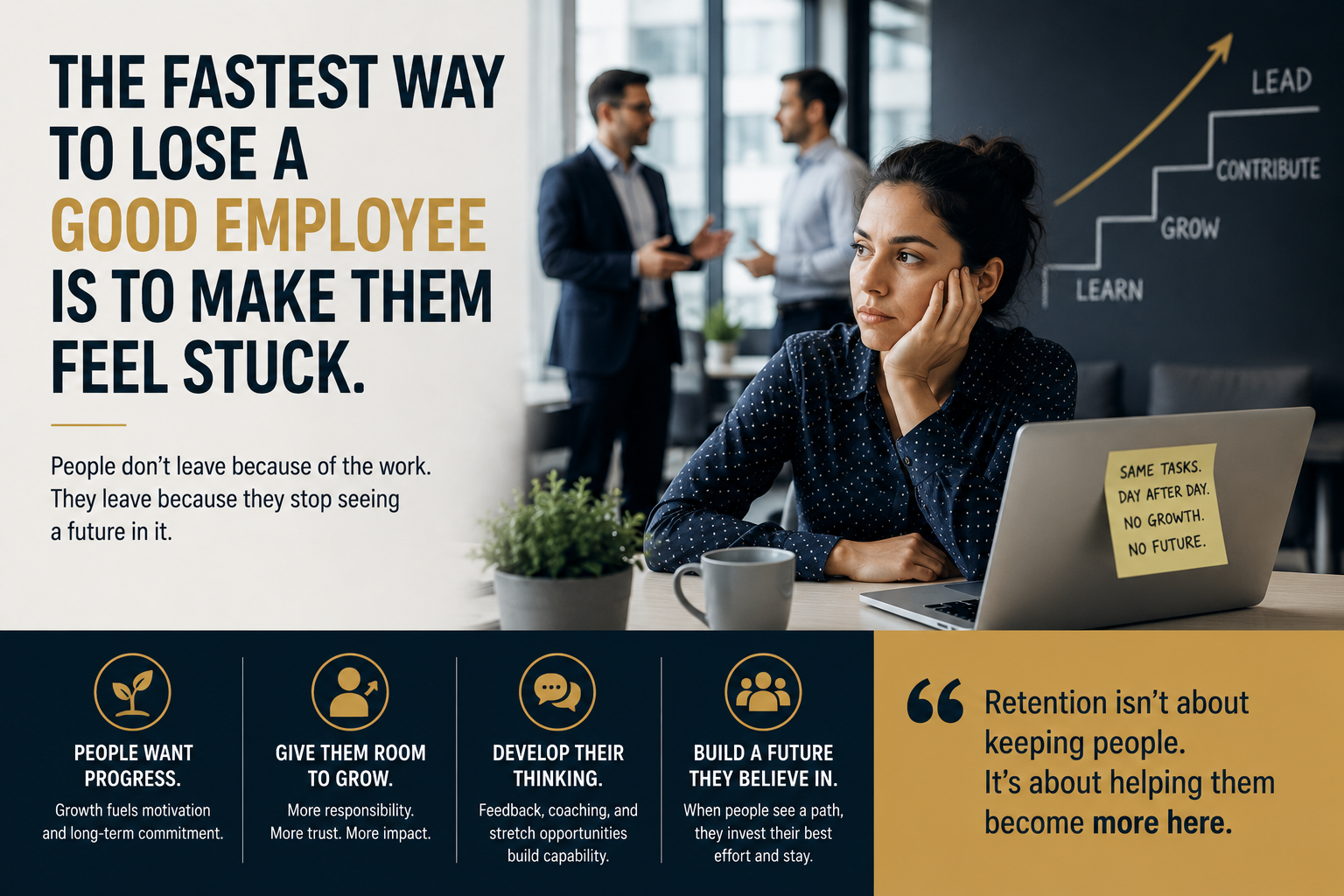
At first, the employee is excited.
They learn quickly.
Take initiative.
Ask thoughtful questions.
They care about improving.
Managers notice them immediately.
“This person has potential.”
“They’re one of our strongest people.”
“They think differently.”
Then something slowly changes.
The energy becomes quieter.
The ideas become fewer.
The excitement disappears.
Not because the employee suddenly became lazy.
But because they started feeling trapped.
This is one of the most overlooked reasons organizations lose strong employees:
People rarely stay emotionally committed in environments where growth feels impossible.
Let’s break this down.
Most employees do not expect promotions every few months.
They understand reality.
Business takes time.
Opportunities are limited.
But people still need movement.
Movement in learning.
Movement in responsibility.
Movement in trust.
Movement in capability.
Without movement, work begins feeling emotionally repetitive.
And repetitive environments slowly drain ambition.
At first, employees try harder.
They volunteer.
Contribute more.
Show initiative.
But when growth never follows effort—
People emotionally adjust.
They stop stretching.
Stop proposing ideas.
Stop imagining a future inside the company.
And eventually, they begin mentally leaving long before they resign physically.
Now here’s the dangerous part.
Managers often misread this behavior.
They say:
“They lost motivation.”
“They changed.”
“They’re not as hungry anymore.”
But many times, the employee did not lose ambition.
They lost belief that ambition mattered there.
That’s a very different problem.
Now let’s talk about growth itself.
Many leaders think growth only means promotion.
It doesn’t.
Growth can also mean:
More ownership.
More trust.
More decision-making exposure.
More meaningful involvement.
People want evidence that they are progressing.
Because progress creates emotional energy.
And emotional energy matters more than many leaders realize.
Why?
Because human beings are naturally future-oriented.
People want to feel they are becoming better, stronger, more capable over time.
Without that feeling—
Even stable jobs eventually feel emotionally heavy.
Now here’s the uncomfortable truth:
Many organizations accidentally create emotional ceilings around good employees.
How?
By over-controlling them.
Keeping responsibilities too narrow.
Failing to develop their thinking.
Or worse—
Using strong employees only for execution while never preparing them for leadership growth.
Now the employee becomes productive…
But stagnant.
And stagnant people eventually disconnect.
Not always loudly.
Quietly.
They stop imagining themselves staying long-term.
Now let’s talk about managers.
Strong leaders do not only manage performance.
They expand capability.
That’s the difference.
Because leadership is not simply getting work done today.
It is preparing people for larger responsibilities tomorrow.
And employees can feel when a manager genuinely invests in their growth.
It changes the emotional experience of work completely.
Now let’s talk about learning.
Most companies still approach development incorrectly.
They rely heavily on occasional training events.
A workshop here.
A seminar there.
But growth is not built through occasional exposure alone.
It is built through continuous reinforcement and practical application.
This is where microlearning becomes powerful.
Because growth happens gradually.
Daily.
Inside real work.
Not only inside classrooms.
Here’s how it can look.
Day 1:
Ask an employee to lead a small decision.
Day 2:
Give feedback on their thinking—not just the outcome.
Day 3:
Introduce a small stretch responsibility.
Day 4:
Discuss future capability goals.
Day 5:
Reflect together:
“What new strength are you developing right now?”
That’s one cycle.
Now repeat it consistently.
Employees begin feeling movement again.
Not because their title changed overnight.
But because their growth became visible.
And visible growth creates emotional commitment.
Now imagine this across your organization.
People stop feeling trapped.
Managers become talent builders.
Employees begin imagining a future inside the company again.
Because leadership development becomes part of daily work—not just annual HR activities.
That’s when retention improves naturally.
Not through fear.
Not through perks alone.
But through meaningful growth.
Let’s be direct.
Most strong employees do not leave only because of salary.
They leave because emotionally, they stopped seeing a future version of themselves inside the organization.
And leadership is not only about managing today’s performance.
It is about helping people believe tomorrow inside the company can become bigger than today.
So before asking why talented employees keep leaving, pause for a moment.
Look at how much growth people actually experience.
Look at how often capability is developed intentionally.
Look at whether your strongest employees feel challenged—or quietly stuck.
And ask yourself:
Are your leaders creating environments where talented people can keep growing… or environments where good employees slowly outgrow the organization emotionally?
Here are five related articles from jordanimutan.com that offer frameworks for creating “vertical” and “horizontal” growth paths to keep your best talent engaged:
1. The 7 Levels of Delegation: Creating a Roadmap for Autonomy
Employees feel “stuck” when they’ve mastered their tasks but aren’t given more authority. This article provides a clear framework for expanding an employee’s “territory.” By moving a top performer from Level 3 (Recommend) to Level 6 (Execute and Notify), you provide a sense of progression and trust that acts as an antidote to stagnation.
2. The LEAD Coaching™ Framework: Identifying Growth Desires Early
“Feeling stuck” is a subjective emotion that often goes unvoiced until it’s too late. This piece introduces the LEAD (Listen, Explore, Align, Drive) framework for 1-on-1s. It teaches managers how to use the “Explore” phase to uncover an employee’s long-term aspirations, ensuring that their current role is a stepping stone rather than a dead end.
3. The STRIDES™ Framework: Systematizing Career Development
Growth shouldn’t be an annual conversation; it should be part of the organizational rhythm. This article focuses on the “E—Empower” and “S—Sustain” pillars. It explains how to build systems for “Stretch Assignments” and internal cross-training, ensuring that employees are constantly learning new skills even if a vertical promotion isn’t immediately available.
4. Psychological Safety: Why Your Best People Are Afraid to Ask for More
Ironically, good employees often feel “stuck” because they are too “valuable” in their current role for the manager to let them move. This article explores how to create a culture of safety where employees feel comfortable discussing their boredom or desire for change without fear of being labeled as “ungrateful” or “disloyal.”
5. The Accountability Ladder: Shifting from “Waiting” to “Owning” Career Growth
This piece helps managers coach employees to take charge of their own development. It identifies “Feeling Stuck” as a middle-rung problem. By using the Accountability Ladder, managers can help employees move from “Waiting for a Promotion” to “Creating Value” that makes their growth undeniable and inevitable.

 Most leadership training is forgotten after the seminar.