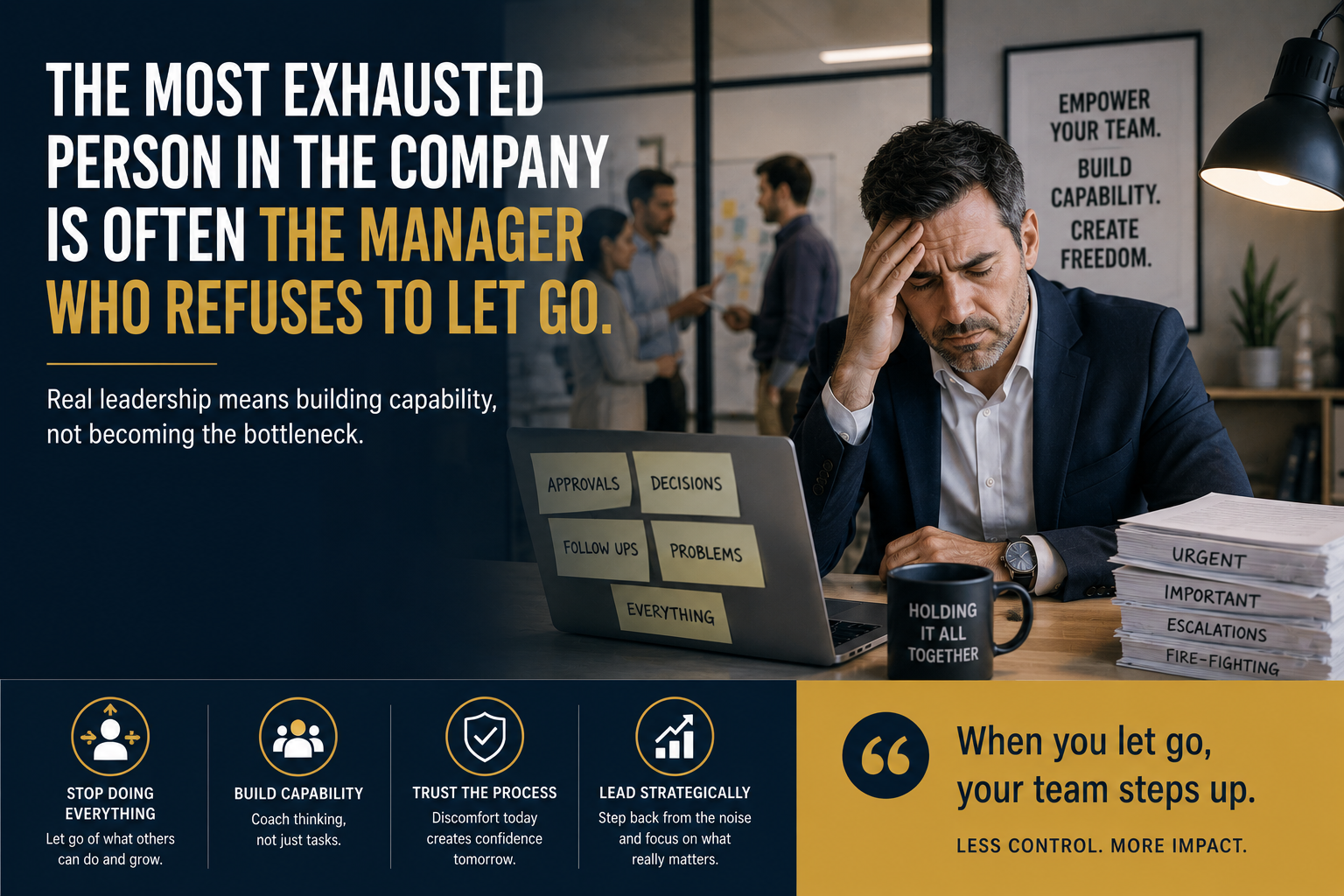
They arrive early.
Leave late.
Reply to messages constantly.
Check everything personally.
At first, it looks admirable.
Dedicated.
Responsible.
Reliable.
People even praise them for it.
“Nothing moves without them.”
“They’re always hands-on.”
“They care deeply about the work.”
But beneath the praise, another reality quietly grows.
They are exhausted.
Not because leadership is impossible.
But because they have slowly become the center of everything.
Every decision flows through them.
Every issue reaches them.
Every problem waits for their involvement.
And eventually, the manager becomes trapped inside the very system they built.
This is one of the most common leadership problems in growing organizations:
Managers who refuse to let go eventually become operational bottlenecks disguised as hardworking leaders.
Let’s break this down.
Most managers do not start controlling everything intentionally.
It usually begins with good intentions.
They want quality.
They want speed.
They want things done correctly.
So they step in often.
Correct quickly.
Solve problems personally.
At first, this works.
The team becomes dependent on their experience.
Mistakes reduce temporarily.
Execution feels safer.
But over time, something dangerous happens.
The team stops growing.
Not completely.
But gradually.
Because when one person constantly rescues the system—
Everyone else unconsciously learns to rely on them.
Now the manager becomes essential for everything.
And strangely, many leaders mistake this dependency for leadership value.
“If I step away, things fall apart.”
That statement usually sounds impressive.
But operationally?
It’s often a warning sign.
Because scalable leadership creates capability beyond the leader.
Not permanent dependency on them.
Now here’s the hidden cost.
The manager slowly loses strategic thinking capacity.
Why?
Because mental energy gets consumed by operational noise.
Approvals.
Corrections.
Constant follow-ups.
Daily firefighting.
Now the leader spends most of the day reacting instead of thinking.
And organizations suffer quietly when leaders become trapped inside tactical work forever.
Now here’s the uncomfortable truth:
Many exhausted managers are not overloaded because the organization is too weak.
They are overloaded because they struggle to release control.
That changes everything.
Because the solution is not always hiring more people.
Sometimes it is redesigning leadership behavior.
Now let’s talk about trust.
Control problems are often trust problems.
Managers fear mistakes.
Fear inconsistency.
Fear losing standards.
So they stay heavily involved.
But here’s the irony:
The more managers over-control, the less confident the team becomes.
Because confidence grows through ownership.
Not observation.
People develop judgment by making decisions.
Solving problems.
Learning through experience.
Not by waiting for approval endlessly.
Now let’s talk about delegation.
Most managers misunderstand it.
They think delegation means assigning tasks.
It doesn’t.
Real delegation means transferring responsibility for thinking.
That’s much harder.
Because once people begin thinking independently, outcomes may not look exactly how the manager would personally do them.
And that discomfort causes many leaders to step back in too quickly.
Now the cycle repeats.
The manager rescues.
The team waits.
The dependency deepens.
Now let’s talk about exhaustion itself.
Constant control creates invisible emotional pressure.
The manager feels responsible for everything.
Even things they should no longer personally own.
This creates chronic mental tension.
Because emotionally, they never fully disconnect from work.
Everything feels urgent.
Everything feels personal.
Everything feels like “my responsibility.”
And eventually, burnout appears.
Not because leadership requires suffering.
But because leadership was never meant to function through permanent over-involvement.
Now here’s where most leadership training misses the point.
It teaches productivity.
Communication.
Time management.
All useful.
But many exhausted leaders do not need another productivity framework.
They need permission—and systems—to stop being the operational center of gravity.
This is where microlearning becomes powerful.
Because it helps managers slowly release unhealthy control habits in real work situations.
Not through theory.
Through daily behavior change.
Here’s how it can look.
Day 1:
Identify one decision you unnecessarily hold onto.
Day 2:
Allow someone else to handle it fully.
Day 3:
Coach the thinking instead of taking over the task.
Day 4:
Avoid stepping in immediately when discomfort appears.
Day 5:
Reflect:
Did the team fail completely—or simply do it differently?
That’s one cycle.
Now repeat it consistently.
Managers begin stepping back strategically.
Teams begin stepping up naturally.
And something important changes.
The leader becomes less emotionally trapped inside daily operations.
Now there is space to think again.
Space to improve systems.
Space to lead long-term instead of surviving short-term.
Now imagine this across your organization.
Managers stop becoming bottlenecks.
Teams become more capable.
Decisions move faster without constant escalation.
Because leadership is finally being distributed.
Not centralized emotionally around one exhausted person.
That’s when organizations become scalable.
Not when one heroic manager carries everything.
But when many people become capable enough to carry responsibility together.
Let’s be direct.
Being needed for everything is not always a sign of strong leadership.
Sometimes it is evidence that leadership development beneath the manager has quietly stopped.
And leadership is not about proving how indispensable you are.
It is about building systems and people strong enough that progress continues even when you step back.
So before praising the manager who “does everything,” pause for a moment.
Look at how dependent the team has become.
Look at how much still requires approval.
Look at how emotionally exhausted the leader truly is.
And ask yourself:
Is your organization developing scalable leaders… or simply creating exhausted managers who have become the unofficial operating system of the company?
Here are five related articles from jordanimutan.com designed to help “Hero Managers” transition into “Empowering Leaders”:
1. The 7 Levels of Delegation: From ‘Control’ to ‘Confidence’
This is the primary diagnostic tool for the exhausted manager. It illustrates that delegation isn’t a binary “on/off” switch but a spectrum. By identifying which tasks are currently at Level 1 (Tell) and systematically moving them to Level 5 (Investigate) or Level 7 (Fully Delegate), a manager can reclaim hours of their week while developing their team’s skills.
2. The STRIDES™ Framework: Systematizing Your Exit from the Day-to-Day
Exhaustion happens when the manager is the system. This article focuses on the “S—Systematize” and “E—Empower” pillars. It teaches leaders how to build “Standard Operating Procedures” (SOPs) and guardrails that allow the business to function without the manager’s constant intervention, moving them from “Chief Problem Solver” to “Chief Strategist.”
3. The LEAD Coaching™ Framework: Stop Giving Answers, Start Asking Questions
Managers refuse to let go because they believe they are the only ones with the answers. This piece introduces the LEAD (Listen, Explore, Align, Drive) framework. It provides a practical method for coaching employees through a problem rather than doing it for them, which is the only way to build a team that doesn’t require “saving” every afternoon.
4. Outcome-Based Leadership: Trusting the Result, Not the Process
A major source of exhaustion is “process-watching”—monitoring how people do things rather than what they achieve. This article helps managers shift their focus to outcomes. When you manage by results, you can let go of the “how,” which drastically reduces the mental energy required to lead.
5. The Accountability Ladder: Moving the Burden of Ownership
When a manager refuses to let go, they keep their team at the bottom of the ladder (Wait and Hope). This article explains how to pull the team up to “Ownership.” By shifting the burden of responsibility to the team, the manager’s exhaustion is replaced by the team’s engagement, creating a healthier balance for everyone.

 Most leadership training is forgotten after the seminar.