Lost in the Philippines – a “Sense of Urgency”

One thing common to our local companies and employees alike; there is a lack of urgency. Complacency has become our norm. When I was younger, I used to think that this would be true only for government agencies. Being back for four after working abroad for twenty years, I see that this is equally true to most of our local companies.

You would think that complacency is the result of past success. Yes, that is true to most previous successful companies. After reaching a certain level of success, not matter how big or small, they hardly do anything anymore with a sense of urgency. A small start-up growing to a successful company can have its negative side effects. Such companies tend to rest on its laurels. They start focusing inward and on reliving their glory days. They neglect to scan the external horizon. They start dropping the ball on customer service, creeping competition & productivity.

How do you detect a complacent company? How can you say that a company lacks a sense of urgency? It’s quite easy really. These are companies that take forever to launch an important initiative. These are companies that constantly talk about improving products and services but never really start anything. These are companies that start an initiative and drags it to forever. These are companies with a huge number of busy bodies. These are managers and employees who act busy working late at night. How can you tell if these are “busy bodies” and not productive employees? It’s simple and check what they are working on. Are they working hard on tasks that are critical to a company’s growth or important customer service? If the answer is ‘no’ then these ‘spinning wheels’ are working on trivial matters just to look busy.

Complacent people are employees that love to shoot down ideas. A majority are passive resistant. Saying ‘yes’ to great ideas and not completing tasks assigned to them. These are employees that are habitually moving target deadlines. These are employees that are adamant to point fingers to colleagues when called out as complacent or busy bodies. These are employees that are quick to complain about everything yet they have no solid recommendation how to fix things. These are employees that come in late and start their real work near noon time and pretend to be so overworked they stay late.

The brother of complacency is lack of accountability. Every single complacent person lacks a sense of accountability. They do not hold themselves accountable for their lack of focused action on critical matters. They are not held accountable by management for consistently missing their deadlines. They focus on effort and not on result. Management does not reward employees on result.

How do you know if your company is headed for a massive storm? Check if your workforce if made up of a complacent majority. If this is the case then you better act quickly and turn things around.

How do you turn things around? Establish a burning platform or a reason for people to rapidly improve customer service or company products. Second, hold everyone accountable to deliver on commitment. Reflect this on their performance goals. Measure employees and reward accordingly. Constantly review the progress of your strategy. Constantly review the progress of your initiatives. Put in place important metrics. We don’t mean complicated KPIs. Identifying your Vital Few KPI’s is more than enough.

Take your busy bodies off their spinning wheels, give them a burning platform and make them accountable to delivering critical tasks and projects on time. Bring in the right people and develop your leadership. After all, a company’s sense of urgency starts and is maintained from the top.

If you have this challenge, we will be more than happy to share with you how some of our clients are managing complacency.

Genuine Leaders Develop Leaders

Often, when employees aspire for a leadership position, it’s usually related to rising in the ranks. Rising the corporate ladder is related to the word ‘leadership’. Such a view is common and sadly flawed. It’s a selfish and self-serving view of leadership.

Leadership is about helping the people around us to rise. It is about developing leaders. True leaders develop leaders. True leaders mean having followers who respect you enough to fight and achieve your vision.

True leadership is about serving, not being served. The adage that ‘there is no success without successors’ holds very true. An organization that does not develop their bench of leaders will eventually falter and fail. The organizations success cannot be sustained when the current leadership starts retiring.

Management guru Jack Welch mentioned in his book that a true leader’s main function is to find and develop potential leaders. Billionaire investor Warren Buffets carefully considers the management or leadership team of the company that he is considering to buy. Warren will only invest in companies that have a strong leadership team. A true leadership team that develops next in-line leaders. Warren’s investments are very long term. It will usually cut across various company leadership regimes. If the current leaders do not care to develop future leaders then it’s companies long term prospect will look weak. The company will not be a viable long term investment.

Great sustaining companies have a culture of leaders developing future leaders. This does not come by accident. Developing future leaders takes persistence, structure and it is intentional. It will not come by chance.

How are you at developing your leaders?

If you are interested in the competencies of leaders, feel free to reach out and schedule our ‘Anyone Can Lead’ 90-minute talk.

Have a great day.

Jordan

http://www.imutan.com http://www.jordansviews.ph http://www.axelgabe.com

Integrity and the IT guy

We were contracted to recreate the website of one of our clients. Although we were able to bring up the new website, we asked the IT personnel of our client to provide us a copy of their old content. We wanted to repost them on the new site.

I started the first 10 years of my career in IT and I know that this request takes a few minutes. Just search for the pages and linked photos and that’s it. The IT personnel of our client said that he will send them over. A week passed by and when reminded he said the same thing.

A few more weeks passed by and I decided to copy the owner of the company is my request. The IT guy finally replied and said that he emailed it over but it the email bounced. I replied back saying that from the hundreds of emails I get, he was the only one that could not get through. I then replied that I have another email address with him that I am reading his reply from. Why didnt he send the files to both email address.

The email address that he was referring to is automatically forwarded to a central email address. Technically, it was impossible that a forwarding email could bounce. The email is not received at the original inbox server. It is bring forwarded to another email address that he said could be reached. He said that the email I use as a central email address did not bounce. He was trying to get away with the fact that he did not do his job. What he forgot was that I used to be a computer programmer and could see through his technical excuses.

The irony of this story is that IT guy is still under probationary period. He clearly lacks integrity. If he works for me and tried to get away with not doing his job then I will think twice before hiring him. On top of that, he tried to cover up his action with a clear attempt to decieve me with a lame technical excuse. That shows lack of integrity. Such a person best work somewhere else.

I guess what I am trying to say is this:
1. No matter what kind of job we are in, it is our duty to do great work to the best of our ability.
2. If we genuinely fail to deliver then acknowledge it and prevent it from happening again.
3. If we genuinely fail to deliver then be honest about the reason. Don’t bullshit.
4. Focus on finding, keeping and developing employees with great behaviors and potentials. This is were your successors will come from.

High potential employees are far and few in between. Hold on to them. Develop future leaders.

If you are interested in a free power talk about leadership and developing your Millennial successors, please feel free to reach out.

Jordan
http://www.imutan.com http://www.axelgabe.com http://www.jordansviews.ph

Wisdom of a 9-year old

After waiting for a few years and a failed attempt, the wife of a good friend of mine finally got pregnant. However, the last weeks of the pregnancy proved to be challenging. Their baby was delivered five weeks ahead of schedule. This resulted in a more delicate care for the baby. Their baby needed to stay in the hospital for a few more weeks under watchful and dedicated care. We all know that staying for long periods of time in a hospital can be quite costly. My friend does not have full medical coverage with his church’s HMO. As a young pastor, or pastors in general do not really make a lot. Their lives are dedicated to their faith “Honoring God and Making Disciples.”

What makes this season of his life more challenging is that this is the third trial in the last few months. First it was his mom. Then his dad suffered a mild stroke.

I find it amazing that his faith and drive never wavered. My friend was being bombarded with a series of difficult events. Yet, he maintains a positive outlook. When he asks for prayers, it will always be in the context of positive news. He would post something positive and ask for prayers for an even more positive turnout of events.

People with the strongest faith face the heavier challenges. I would often revert to my logical nature and ask myself ‘why is this happening to him?’ I am not asking myself this question in defiance. I am asking out of curiosity.

When I asked our 9-year-old this question. He looked at me and said, ‘Do you remember papa when God was testing Job?’ I said ‘yes’. God was testing his faith. When Job proved himself in the end, God rewarded him. Job received much more than what he lost. Axel reminded me also that even Jesus himself was tested by the Devil. When the Devil asked Jesus to jump from the cliff, Jesus held steadfast.

Whoever said that our youth have no clue as to what is going around them in the world? They are clearly wrong. There is wisdom in our children.

Jordan

http://www.imutan.com http://www.jordansviews.ph http://www.axelgabe.com

True Leaders are Truly Humble

Essam B. is one of the best Saudi nationals I have ever had the privilege to mentor. High Potential employees, like Essam, who actually put to action what they learn. Leaders, like Essam, who transfer their experience for the development of their employees.

I first met Essam years ago. He applied to have his OJT (On the Job training) with my department. He was a young, energetic and ambitious Saudi that was overflowing with questions and willingness to listen. Like most Departments in the Bank, we treat OJT’s as employees. We don’t give them trivial tasks like making coffee or running errands. Our OJTs get to learn our business. They get to contribute to our Departments vision.

After he graduated from KFUPM (the most progressive University in Saudi Arabia at the time) he applied for and got a job in our Bank. He reported directly to me. Years later, he got the opportunity to work for a start-up telecom. It was sad to see him resign from the bank but clearly it was for his career growth.

He started rising up in the companies he works for. He moved from one company to another. Essam is currently the Chief Operating Officer of the largest Mega Recruitment agency in Middle East. They hire more than 8,000 employees for various companies all over the Kingdom.

Despite his success, he still remembers his beginnings. He sent me text yesterday asking for a few minutes of my time. As soon as I agreed, I got an international call from him.

He was at odds with a management decision. He wanted to seek my advice. He had a highly technical employee promoted to management level sometime back. Remembering that subject matter experts do not automatically become great managers, he wanted to correct the situation.

However, his superior was not convinced. His boss did not want to lose the manager in the role because of this technical capabilities.

I asked Essam for his views. Essam said that he needed someone for the job who is 80% a great manager and 20% a technical person. The existing manger was the opposite, 90% technical and 10% manager. He wanted to move the existing manager to a more technical role and at the same time keep him as a technical adviser.

Essam will then appoint another manger to take care of the department and the people. He wanted to put someone with strong management skills.

Essam was on the right track. I told him this. He just needed another opinion from someone thousands of miles away.

This is a great example of a leaders humility. This shows a strong leader acknowledging that he still needs outside advise to validate his thoughts.

This is also just one example of the power of a strong mentoring culture. A mentoring culture that was planned and executed to develop high potential employees to take on management positions.

More power to you Essam. May you continue adding great leadership value to your company.

See you soon.

Jordan

http://www.imutan.com

http://www.axelgabe.com

Strategies need not be complicated

We have several clients that requested assistance in reviewing their strategies. They built their strategies with the guidance of a local consultant. A few things emerge when we reviewed the work they have done. A few tips to other local organizations seeking to create or update their strategies.

  1. Vital few – The resulting number of strategic plans was simply a lot. How can we execute strategies supported by too many projects? Focus on the vital few that jump starts the strategy on year one. The key words being ‘vital few’.

  2. Separate the projects from day to day work – A project is an initiative that has a start, an end and an output. Day to day work (or business as usual – bau) is something you do on a regular or operational basis. Sometimes these two gets mixed up and confuses people. Don’t’ confuse your employees.

  3. Provide the skills – Most of the time, companies assign important initiatives to employees and yet do not provide them the necessary project management skills. The employees are later blamed when they fail. Don’t assign projects to fail.

  4. Understand the roles – A project has more than one person responsible for its success. The project manager is accountable for the overall success. However, there are other important players that need to be acknowledged. Understand that sponsors, accountable executives, subject matter experts, project teams, steering committees also have an important role to play. It takes a team to succeed.

  5. Keep Project Management Simple – Project Management methodology and techniques can get complicated. This is fine with professional project managers. However, 95% of projects are assigned to normal employees. They have their paying day job to worry about. Give them a simple project management process to use. Keep things simple and template driven.

  6. Review for success – Another common pitfall is the lack of a review process. Out of sight, out of mind. Projects that are not reviewed tend to fade away until an executive asks about it. The matriarch of a huge logistics conglomerate commented that certain projects in her company lasted 10 years and remained uncompleted. Once they put in place a governance process, they completed two projects in the first two months. Keep the project progress in sight.

  7. Measure the benefits – Most initiatives are implemented to generate business benefits. Unless the project is mandated by a regulating body, a project is implemented to generate revenue increase or loss/cost reduction.

Companies that address the seven keys mentioned above have a higher chance of having successful initiatives. Successful initiatives result in a successful strategy.

No matter how great your strategies are, if they are complicated or unimplemented then it is useless. It is not worth the paper it is printed on. The best companies have simple strategies that are implemented very well.

How does your strategy look like?

If you are interested in finding out more about having a simple approach to an effective strategy execution, drop us an email. Let us come over and present the concept to your team for free. All it takes is 90 minutes or less.

Have a great day!

Jordan

http://www.imutan.com

http://www.axelgabe.com

Why Great Managers Are So Rare

Companies fail to choose the candidate with the right talent for the job 82% of the time, Gallup finds

Management talent exists in every company. It’s often hiding in plain sight.

Gallup has found that one of the most important decisions companies make is simply whom they name manager. Yet our analytics suggest they usually get it wrong. In fact, Gallup finds that companies fail to choose the candidate with the right talent for the job 82% of the time.

Bad managers cost businesses billions of dollars each year, and having too many of them can bring down a company. The only defense against this problem is a good offense, because when companies get these decisions wrong, nothing fixes it. Businesses that get it right, however, and hire managers based on talent will thrive and gain a significant competitive advantage.

Managers account for at least 70% of variance in employee engagement scores across business units, Gallup estimates. This variation is in turn responsible for severely low worldwide employee engagement. Gallup reported in two large-scale studies in 2012 that only 30% of U.S. employees are engaged at work, and a staggeringly low 13% worldwide are engaged. Worse, over the past 12 years, these low numbers have barely budged, meaning that the vast majority of employees worldwide are failing to develop and contribute at work.

Gallup has studied performance at hundreds of organizations and measured the engagement of 27 million employees and more than 2.5 million work units over the past two decades. No matter the industry, size, or location, we find executives struggling to unlock the mystery of why performance varies from one workgroup to the next. Performance metrics fluctuate widely and unnecessarily in most companies, in no small part from the lack of consistency in how people are managed. This “noise” frustrates leaders because unpredictability causes great inefficiencies in execution.

Executives can cut through this noise by measuring what matters most. Gallup has discovered links between employee engagement at the business unit level and vital performance indicators, including customer metrics; higher profitability, productivity, and quality (fewer defects); lower turnover; less absenteeism and shrinkage (i.e., theft); and fewer safety incidents. When a company raises employee engagement levels consistently across every business unit, everything gets better.

To make this happen, companies should systematically demand that every team in their workforce have a great manager. After all, the root of performance variability lies within human nature itself. Teams are composed of individuals with diverging needs related to morale, motivation, and clarity — all of which lead to varying degrees of performance. Nothing less than great managers can maximize them.

But first, companies have to find those great managers.

Few managers have the talent to achieve excellence

If great managers seem scarce, it’s because the talent required to be one is rare. Gallup’s research reveals that about one in 10 people possess the talent to manage. Though many people are endowed with some of the necessary traits, few have the unique combination of talent needed to help a team achieve excellence in a way that significantly improves a company’s performance. These 10%, when put in manager roles, naturally engage team members and customers, retain top performers, and sustain a culture of high productivity.

It’s important to note that another two in 10 people exhibit some characteristics of basic managerial talent and can function at a high level if their company invests in coaching and developmental plans for them. In studying managerial talent in supervisory roles compared with the general population, we find that organizations have learned how to slightly improve the odds of finding talented managers. Nearly one in five (18%) of those currently in management roles demonstrate a high level of talent for managing others, while another two in 10 show a basic talent for it. Combined, they contribute about 48% higher profit to their companies than average managers do.

Still, companies miss the mark on high managerial talent in 82% of their hiring decisions, which is an alarming problem for employee engagement and the development of high-performing cultures in the U.S. and worldwide. Sure, every manager can learn to engage a team somewhat. But without the raw natural talent to individualize, focus on each person’s needs and strengths, boldly review his or her team members, rally people around a cause, and execute efficient processes, the day-to-day experience will burn out both the manager and his or her team. As noted earlier, this basic inefficiency in identifying talent costs companies billions of dollars annually.

Conventional selection processes are a big contributor to inefficiency in management practices; they apply little science or research to find the right person for the managerial role. When Gallup asked U.S. managers why they believed they were hired for their current role, they commonly cited their success in a previous non-managerial role or their tenure in their company or field.

These reasons don’t take into account whether the candidate has the right talent to thrive in the role. Being a successful programmer, salesperson, or engineer, for example, is no guarantee that someone will be adept at managing others.

Most companies promote workers into managerial positions because they seemingly deserve it, rather than have the talent for it. This practice doesn’t work. Experience and skills are important, but people’s talents — the naturally recurring patterns in the ways they think, feel, and behave — predict where they’ll perform at their best. Talents are innate and are the building blocks of great performance. Knowledge, experience, and skills develop our talents, but unless we possess the right innate talents for our job, no amount of training or experience will matter.

Gallup finds that great managers have the following talents:

  • They motivate every single employee to take action and engage employees with a compelling mission and vision.

  • They have the assertiveness to drive outcomes and the ability to overcome adversity and resistance.

  • They create a culture of clear accountability.

  • They build relationships that create trust, open dialogue, and full transparency.

  • They make decisions based on productivity, not politics.

Very few people can pull off all five of these requirements of good management. Most managers end up with team members who, at best, are indifferent toward their work — or, at worst, are hell-bent on spreading their negativity to colleagues and customers. However, when companies can increase their number of talented managers and double the rate of engaged employees, they achieve, on average, 147% higher earnings per share than their competition.

Management talent could be hiding in plain sight

It’s important to note — especially in the current economic climate — that finding great managers doesn’t depend on market conditions or the current labor force. Large companies have approximately one manager for every 10 employees, and Gallup finds that one in 10 people possess the inherent talent to manage. When you do the math, it’s likely that someone on each team has the talent to lead — but chances are, it’s not the manager. More than likely, it’s an employee with high managerial potential waiting to be discovered.

The good news is that sufficient management talent exists in every company. It’s often hiding in plain sight. Leaders should maximize this potential by choosing the right person for the next management role using predictive analytics to guide their identification of talent.

For too long, companies have wasted time, energy, and resources hiring the wrong managers and then attempting to train them to be who they’re not. Nothing fixes the wrong pick.

A version of this article originally appeared on the HBR Blog Network.

Methodology

Gallup has a five-decade-long history of studying individuals’ talents across a broad spectrum of jobs, including numerous studies of managerial talents across a wide range of managerial positions. Talent-based assessments, consisting primarily of in-depth structured interviews and Web-based assessments, have been designed to predict performance, and large-scale meta-analyses have been conducted examining the predictive validity of the instruments. Thresholds in instrument scores are set in an effort to optimize the probability of selecting high performers. Such thresholds, examined across 341,186 applicants and 70 applicant samples from organizations using managerial assessments, were used to inform the percentage of individuals with high and basic managerial talent. These findings were then cross-validated in a random sample of Gallup panelists (n=5,157).

In estimating the percentage of variance in employee engagement that managers account for, multiple regression analysis was conducted across 11,781 work teams examining the relationship between various manager-related independent variables (team members’ perceptions of their manager, the managers’ engagement, and manager talent) and the team’s overall engagement as defined by Gallup’s Q12 instrument.

The financial value of manager talent was estimated using standard utility analysis methods that include the relationship between manager talent and financial performance, variability in financial performance across business units Gallup has studied, and the increase in manager talent from the average when an organization selects the top 10% of managers on a Gallup manager talent assessment.

Randall Beck is a former Managing Partner at Gallup.
Jim Harter, Ph.D., is Chief Scientist, Workplace Management and Wellbeing for Gallup’s workplace management practice. He is coauthor of the New York Times bestsellers 12: The Elements of Great Managing and Wellbeing: The Five Essential Elements. His research is featured in First, Break All the Rules, and he contributed the foreword to Gallup’s new edition of this groundbreaking bestseller.

March 25, 2014
Gallup http://www.gallup.com/businessjournal/167975/why-great-managers-rare.aspx
Gallup World Headquarters, 901 F Street, Washington, D.C., 20001, U.S.A
+1 202.715.3030


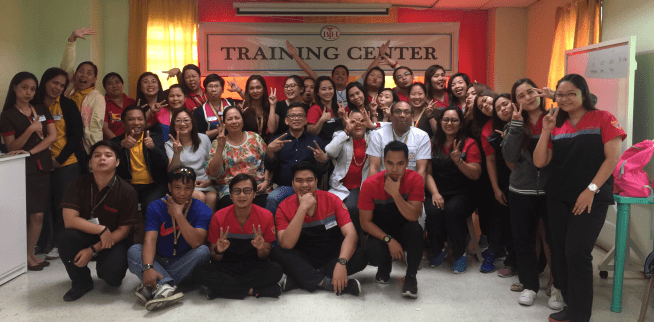
BLH A small provincial hospital with a Big Heart

Traveling from Ortigas to Binangonan Rizal usually takes a little over an hour and a half. Yesterday, the trip took 45 minutes even in heavy traffic. You would need diplomatic plates to quickly navigate through Manila traffic. Our ride was better. We were picked up and brought back by an ambulance. We whizzed through crawling traffic.

That morning, I thought that this would be the highlight of a usually normal workshop. I was pleasantly mistaken.

The hospital is managed by a tandem of two very strong ladies; Dr. Conception sits as the Chairperson, Dr. Lei as the President. The two Doctors overflow with humor and were also very humble. Their leadership style is reflected on their team of nurses and doctors.

Their staff was great. So far, I have never met a group of participants that were all so friendly and nice. In our line of work, you come across groups of workshop participants composed of nice, not so nice and a few that are arrogant.

The BLH group was the exception. Every single one of them was so nice. They do not need to be told to help set-up the workshop, distribute food, print or remove the garbage. It was all voluntarily performed with a genuine smile.

We were so happy with the participants that we ‘almost’ forced them to book our FREE Power talks on Effective Execution and Dare to Believe. It was a pleasure to come back again and share our experience for free.

I pray that after our two day Leadership Development Workshop, the participants quickly gain the self-confidence and techniques on being even better managers and leaders.

If we have more service people in the country with their heart and dedication to serve, the Philippines will be a more progressive country.

Thank you once again to Dra. Conception, Dra. Lei and the team of Binangonan Lake View Hospital. Thank you Sir Joey for coordinating a successful workshop.

Looking forward to conducting our FREE sessions with them next month.

Who do you let inside the door?

Who do you let inside the door?

Working as a consultant and executive mentor to various types of employees gives me an interesting view of human nature. Having worked with different nationalities for twenty years has been an eye opener.

We often encounter managers and executives complaining about certain individuals in their organization. In my former corporate life, this include me. We would highlight the poor work output of this person. Often, it is the behavior that we talk about. In my consulting career, I keep getting asked for suggestions on how to get rid of such employees. How can we find a better job fit for them elsewhere in the company. How about finding a better fit for them outside the company?

After the dust settles in these heated discussions, I would often say “why don’t we step back and look at the bigger picture?” The problem stems back further than the current challenges we face with them.

The problem stems all the way back to the recruitment process. Why did we let the person inside the company? Why is our selection and recruitment process so weak? We often hear reasons like; he seem like a fit at the start, we don’t have time to sift through hundreds of CVs, let’s give him more time to adopt to our culture.

Unless we inherited our problem employee, we have nobody to blame except ourselves. We assessed his CV. We were part of a meticulously designed interview schedule. We signed off to hire the person after a six-month probation.

For short, we have nobody to blame except ourselves. We let the person inside the door.

Southwest Airlines is the most profitable airlines in the U.S. When the airline started, they focused on recruiting former cheerleaders. The logic then was that “why hire demotivated people and spend a fortune trying to motivate them.” In the airline industry, the behavior of the flight attendant is a big factor. The passengers loved the energy and enthusiasm that the former cheerleading crew brought to the plane.

How does your recruitment process weed out the chaff from the grain? Do you hire people based on their behavior or their technical skills? What questions do you ask to understand how a candidate thinks of behaves? How much time do we spend trying to find the right candidate for the company?

David Jones, my forger manager and COO of NCB, keeps reminding us back then “We are only as good as our people.”

Who do you let inside your door?

Failure to execute

I was fortunate enough to meet and consult with the owner of one of the largest shipping companies in the Philippines. The original scope of the consulting engagement was to review and improve their Account Receivables. They had so much outstanding collections that it was affecting their cash flow. This causes the company to take on loans to cover their payables. Millions of pesos loaned generates interest payments to banks.

To get an appreciation of their business, the conglomerate has over 40 companies under a holding company. These 40 company CEOs report to a group CEO. The group CEO is the child of the founder. Upon taking over the business, the group CEO had the business savvy to grow the business from one company to over 40.

Our second meeting revolved around how we will charge for our consulting service. We came in with a pricing based on estimated effort required to do the job. We charge, like most consulting firms in the world, on a per hour basis. The client proposed to pay us based on a percentage of the amount we will recover. My partners and I came back with a combination of both approaches.

In one of the meetings, the group CEO expressed frustration over their strategy and plans. Projects that were started ten years ago has not yet seen the light of day. Projects would inch forward when it had executive attention. Projects comes to a halt when the Group CEO needed to focus on more pressing matters.

The group CEO had requested that we change the focus of our consulting proposal. Their bigger challenge was the effective execution of their strategies and plans. The group CEO fully understood that success in resolving day to day challenges was largely dependent on how they execute projects designed to resolve them.

This became our scope of work for the next few months. Here is a summary of the lessons learned from the engagement:

  1. When we assign projects to employees, we need to train them on project management fundaments. We trained over 40 managers on a one day program we called ‘Project Management for none Project Managers’.

  2. For projects to succeed, the progress (or lack of) needs to be reviewed on a regular schedule. We requested the group CEO, COO and CFO to be part of the Steering Committee. These group of executives reviews project progress, gives guidance to the project and help resolve very difficult challenges.

  3. Projects are created because there is a business benefit to it. A project will either increase revenue or reduce loss/expense.

  4. Most projects fail because project managers do not spend effort identifying and preventing what can go wrong. They simply react.

There are a lot more learnings that our client picked up from the engagement. The four we listed above are just a few of them.

We always preach to our clients (or potential clients) that strategies are useless unless effectively executed. We would rather have a mediocre strategy properly implemented than a great strategy frozen in time.

If you believe that effective execution of your plans will help your company rise to the next level, feel free to reach out to us. We have a FREE 90 minute Power talk that will give you an insight on how we help companies execute their plans.