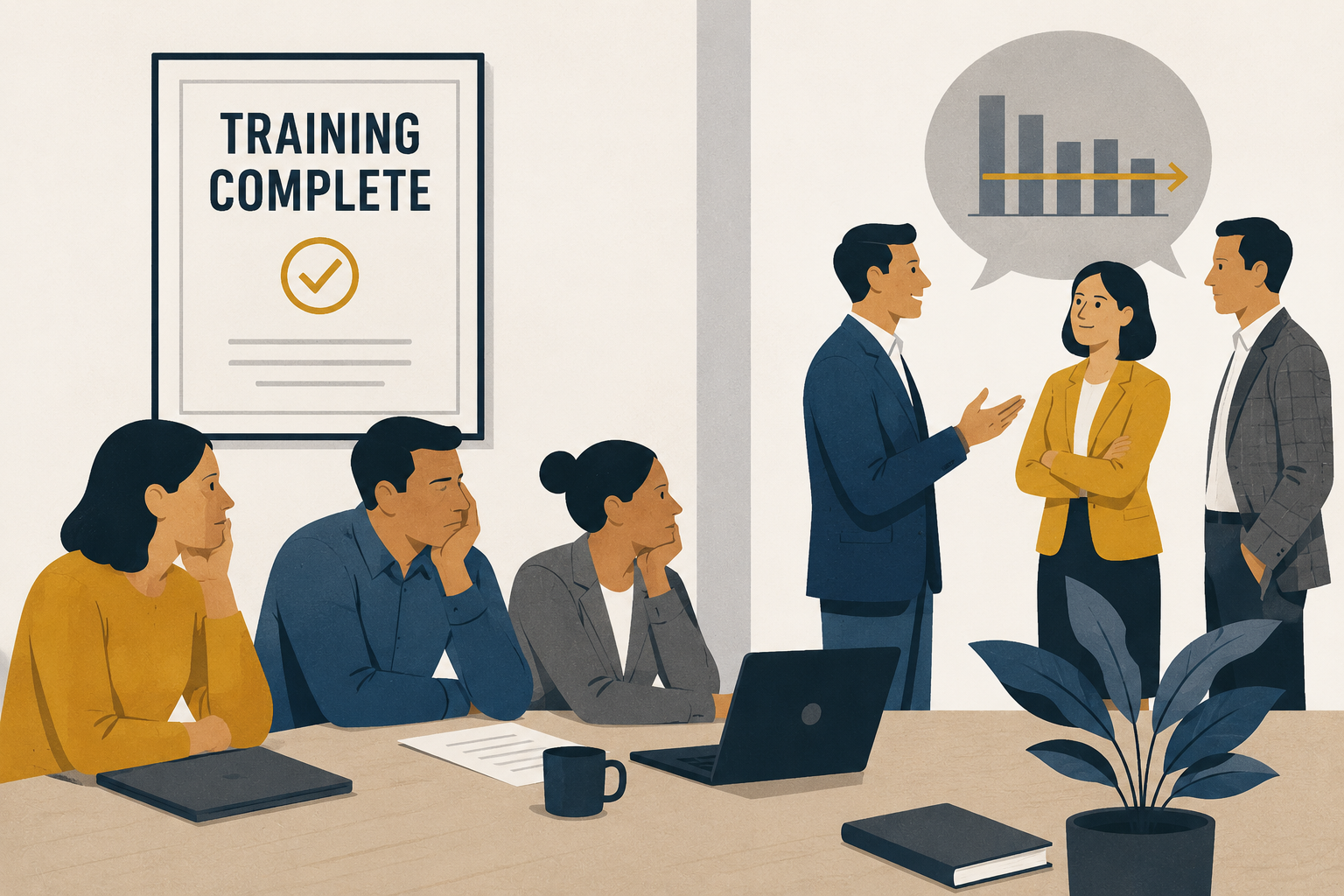
Most leadership programs teach the right things in the wrong order. The real work — the part that makes skills stick — begins the day after the workshop ends.
Every year, companies spend billions sending their managers to leadership workshops — and every year, most of those managers walk back to their desks on Monday and quietly forget everything they learned by Wednesday.
This isn’t a cynical take. It’s measurable. Research consistently shows that up to 90% of new skills are lost within a year if they aren’t applied and reinforced after training. In 2026, with organizations under more pressure than ever to build capable leaders fast, this gap between “trained” and “changed” has become the most expensive problem in professional development.
The good news? It’s a solvable problem — just not with another one-day workshop.
90%of training content forgotten without post-training reinforcement
70%of organizations struggling with leadership accountability gaps in 2026
2.3×more likely to innovate when leadership development sticks
26%of companies offer actual on-the-job application — vs. 71% who just offer courses
The One-Day Training Trap
Picture this: a group of managers spends a full day in a leadership workshop. The facilitator is energetic. The content is solid. The slides are sharp. By 4pm, the room is buzzing with ideas and good intentions.
Then real life happens. Emails pile up. Deadlines return. Teams need answers right now. And all those fresh leadership insights get quietly filed in the same mental drawer as last year’s New Year’s resolutions.
This isn’t a motivation problem. It’s a design problem. Training programs built around a single event are designed to inform, not to change behavior. And changing behavior — especially under the daily pressure leaders face — requires something completely different.
One-time training programs may build awareness, but they rarely change behavior without ongoing practice, reinforcement, and application.
Why Leadership Skills Don’t Transfer Back to Work
The science on this is clear. Skills learned in a classroom setting don’t automatically travel back to the workplace. Three things get in the way:
- No practice context. Leaders learn a concept in a training room, but never get a structured chance to try it in their actual job with their actual team. Without real application, the skill never moves from short-term memory to actual habit.
- No reinforcement system. When nobody checks in — no follow-up session, no peer accountability, no manager nudge — the new behavior has no reason to compete with old habits. Old habits always win by default.
- No psychological safety to try. Trying a new leadership approach at work carries risk. What if it feels awkward? What if the team notices? Leaders need a supported, low-stakes environment to practice before they go live with new behaviors.
In 2026, the challenge isn’t skill acquisition — it’s skill activation. Organizations have plenty of training. They’re short on application architecture: the structures that turn a course into a lasting change in how someone actually leads.
What “After-Training” Programs Do Differently
Effective leadership development programs don’t treat the workshop as the product. They treat it as the starting point. The real program lives in the weeks that follow — in the conversations, habits, experiments, and feedback loops built specifically to make skills take root.
Here’s what that looks like in practice:
The Training Transfer Framework
The best programs build three things after the event:structured application challenges(real tasks that require leaders to use new skills immediately),accountability loops(peer cohorts or check-ins at 2 weeks, 6 weeks, and 90 days), andembedded reflection(short, regular prompts that help leaders notice what’s working and what isn’t in their real leadership moments).
This isn’t complicated. It’s consistent. Short refreshers, manager-led discussions, peer accountability, and practical application assignments — stacked intentionally over 60 to 90 days — transform what a leader learned on a Tuesday into how they lead every day.
Skillshub and other L&D researchers put it plainly: the more leadership development is woven into everyday processes, the more likely it is to stick. Not because it’s magical. Because repetition with real stakes builds real confidence.
The Business Case Is Impossible to Ignore
This isn’t just an HR talking point. Organizations with strong, applied leadership development are more than twice as likely to outperform their peers in innovation. They also see lower change fatigue, stronger team engagement, and healthier leadership pipelines.
Meanwhile, companies that run one-time training events and call it “leadership development” are paying for an experience, not a result. In a year where 63% of employers cite skills gaps as their biggest barrier to growth, that’s a very expensive habit to keep.
The leaders who are pulling ahead in 2026 aren’t the ones who attended the most training. They’re the ones whose organizations built the systems to make training matter after the room cleared out.
What a Real Leadership Development Program Looks Like
If you’re evaluating a leadership training program — or designing one — here are the questions that separate a genuine behavior-change program from an expensive seminar:
- What happens on Day 2? If the answer is “nothing structured,” that’s a red flag. Application starts the next working day, not next quarter.
- Is there peer accountability built in? Cohort learning — where leaders share what they tried and what happened — is one of the most powerful reinforcement tools available. It also costs almost nothing extra.
- How does it measure behavior change, not just satisfaction? Smile sheets (the “How was your experience?” survey) measure comfort, not competence. A real program tracks whether leaders are actually doing things differently 60 days later.
- Does the manager of the participant play a role? The direct manager is the single biggest factor in whether training transfers. If they’re not looped in before and after, the program is working with one hand tied behind its back.
- Is learning embedded in daily work? Short, targeted skill sprints tied to real projects beat full-day workshops for retention every time. Learning that feels disruptive doesn’t stick.
The Shift That Changes Everything
The organizations winning at leadership development in 2026 have made one fundamental shift: they’ve stopped treating training as an event and started treating it as a process.
The workshop might be eight hours. The real program is 90 days. The workshop gives leaders language and concepts. The 90 days give them confidence, competence, and the muscle memory to lead differently under pressure — which is, of course, the only situation where it actually matters.
Leadership isn’t what someone does in a training room. It’s what they do when they’re exhausted, behind on a deadline, and their team is waiting for an answer. That’s the moment a well-designed after-training program is built for.
You wouldn’t send someone to a one-day swimming lesson and then throw them in the deep end and walk away. Yet that’s essentially what most organizations do with leadership training — and then wonder why their managers are flailing.
The fix isn’t a better workshop. It’s building the system around the workshop that actually teaches people to swim.
If your leaders went through training last year and nothing visibly changed — what’s stopping you from fixing the part that happens after the training ends?
Topics: Why leadership training doesn’t work How to make leadership training stick Leadership skills application after training Leadership development ROI 2026 Behavior change after leadership training Leadership training transfer to workplace


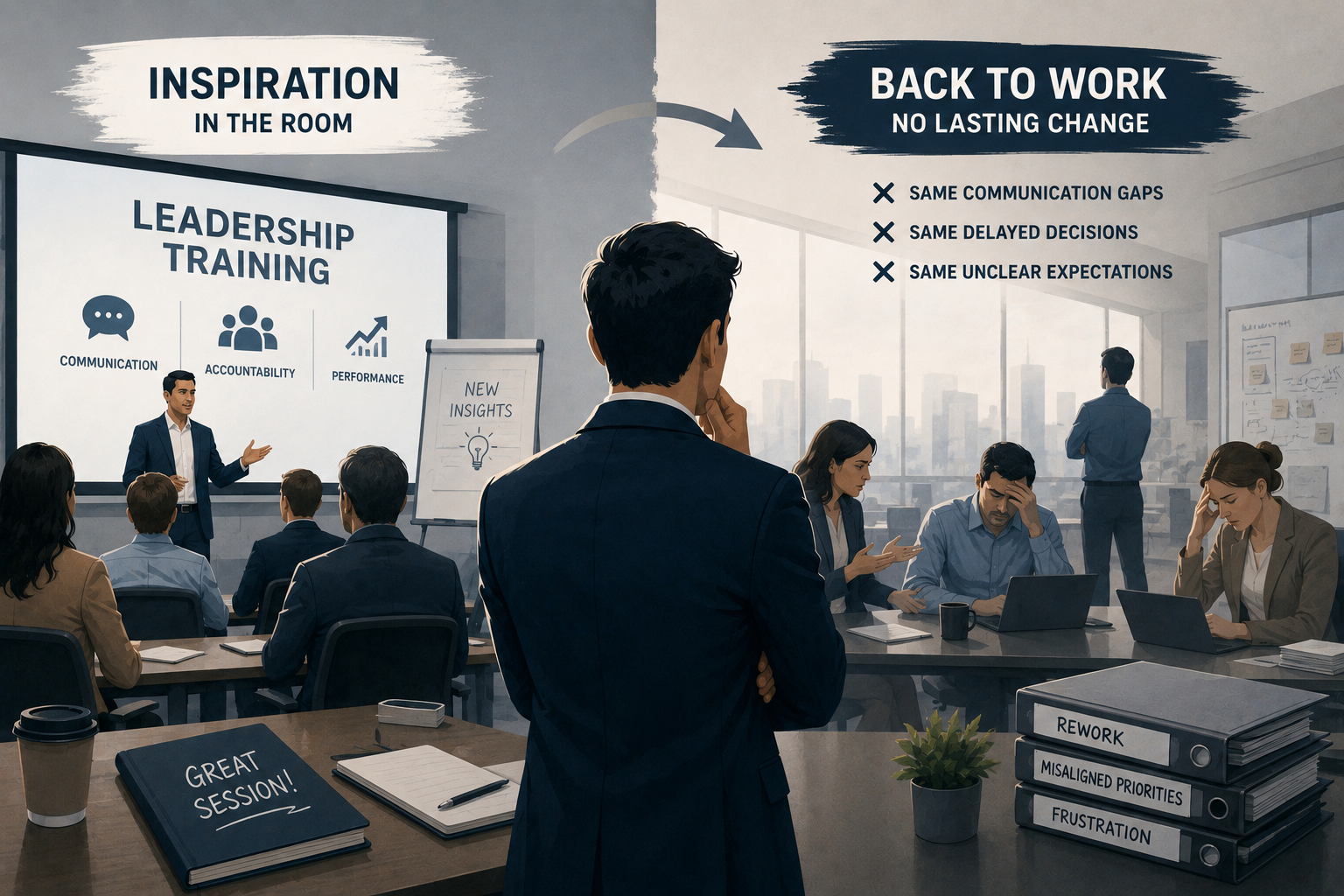



 Most leadership training is forgotten after the seminar.