The Power of Visual Cues

When you drop by McDonalds you will notice how quickly they serve customers. They have an automated ordering process. As soon as an order is placed, the kitchen has the order appear on a TV set that displays them in sequence. First in first out.

Quality service or product quality is pegged on consistency. If we only provide a great service every now and then, it is not really quality service. Consistent service quality is the result of many things. The people we hire, the training we provide, the quality of our management team and the process they follow.

When I was younger, I found processes to be limiting. They were boring and constraining. As I went up the corporate ladder, I started appreciating their value. This is specially more for companies that design processes to shorten the time it takes to service customers and reduce mistakes.

Processes, on it’s own, cannot survive the rigors of new employees and day to day work without the corresponding templates or visual cues.

Visual cues are powerful ways of triggering an action. For instance, an inbox and outbox on top of an employees table are visual cues. They visually tell the employees how much work they have done and how much are still pending.

Back to visual cues, I noticed this in McDonalds yesterday. I ordered a few things and the cashier thought that I was dining in. Before the food came, she placed the ketchup packs on a tray with a paper lining.

She was not sure if she asked me if I was dining in. The cashier asked me, with a little embarrassment, if I was dining in. With a smile, I told her that I ordered for take away.

Almost automatically, she removed the paper lining on top of the serving tray. I thought that it was odd. As I observed the other cashiers. I noticed the pattern. Dine in orders had paper linings on the tray. Take out orders do not have paper linings on the tray.

This way, nobody can ever make a mistake of mixing the preparation of the two types of orders. They have consistency in the way they prepare both types of orders because of visual cues.

Visual cues. How often do you use it at work or in your personal life?

Keep your mind sharp

Keep your mind sharp and open to new ideas, make it a point to read a book every month. It doesn’t matter if it is a novel, a biography, or a self-help book. What is important is that you develop the habit of reading. If you are one of the lucky ones who developed the habit at a young age then kudos to you. Keep it up! If not, it is never to late to start getting into reading.

If you are really not into reading books, then choose other kinds of reading material. There are many quality magazines out there with interesting articles. If you prefer to read on your tablet, there are thousands of e-books waiting to be discovered online. Why not go for audiobooks? With audiobooks you can listen on your commute to work or even while you are driving.

I personally go for self-help and motivational books. These books actually inspired me to create my own self-help book (which I hope is helping!). To make sure I remember what I read, I jot down the books’ titles on my electronic journal called Evernote. it also helps to jot down lessons learned from books I read.

As you progress in your career, never neglect to make time for reading. It is one of the best ways to “exercise” your brain and continually learn new ideas.

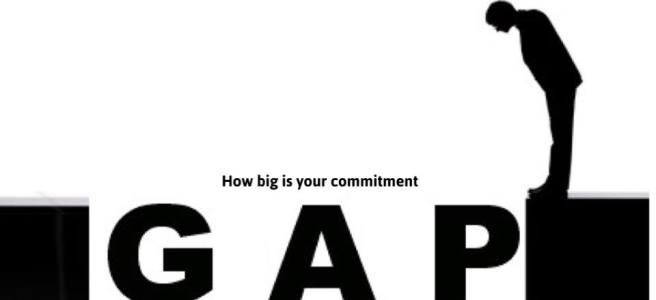
How big is your commitment gap?

The gap between what an aspiring leader commits to and what he/she actually does makes a great difference in determining their success. The bigger the gap, the less likely the success. The smaller the gap, the more likely the success.

In my years mentoring both high potential employees and executives alike, successful mentees have a number of common traits for instance; great communication skills, are able to influence others, ability to execute plans, takes accountability, simplifies a complex discussion, humble and so on.

One very interesting trait of successful mentees, I noticed, is their focus on having a very small or non-existing gap between what they say they will do and what they actully do. When they commit an action to a specific date, chances are, they deliver. No need to chase them on their target dates. They take pride on delivering to their commitment.

Their superiors are able to rely on them because they deliver. They get things done. They are true to their word.

Their peers and subordinates can rely on their commitment. They will not leave you hanging. They deliver.

In this world of excuses, finger pointing and moving targets they stand out. They rise up the corporate ladder. They succeed.

How about you? How small is your gap?

What can go wrong

Mentoring Project Managers of varying experience has shown me certain traits from highly successful ones. Project Managers are powerful agents of change. Leaders understand that success in transforming organizations is directly related to their ability to execute change programs. The rest of us call these ‘Projects’.

Projects have been given a bad rap through the years with all the failed projects that populate a company. If we look at a few successful transformation projects, we will notice a certain trend.

Great agents of change (or Project Managers) have the following competencies going for them:
1. Clear and concise communicators
2. Well organized
3. Makes sure that tasks have single accountabilities and specific deadlines
4. Great motivators
5. Holds others accountable to their deliverables
6. Focused at making timelines work
7. Holds a clear vision of the end game

On a side note, these are the same competencies we find in successful leaders. At the end of the day great project managers are great leaders. Imagine having a group of people, who do not work for you, work together and deliver a common goal.

Stepping back, most projects fail or gets delayed because Project Managers do not bother to think about what can go wrong with their project and prevent/mitigate them. Mediocre project managers, like mediocre leaders, simply react to events. They allow risks (problems that have not happened yet) to transition into issues (problems that have materialized).

With all the moving parts of a project, managing risks is probably one of the most important activity of a change agent. Regular assessment of what can go wrong and managing it before it materializes, is the mark of a truly great project manager.

It is not rocket science. It is simply listing down what can go wrong, how to prevent/mitigate it, assign a person accountable for the prevention/mitigation. If a project is important enough, a weekly assessment of project risk instantly gives the project a better chance at succeeding.

When a risk materializes into an issue, it creates a speed bump or even a road block to the project.

How about you? Do you manage the risks of projects or initiatives you own?