4 Steps to writing a more compelling message

Writing narratives for marketing collateral is challenging at times. Startup owners usually create narratives that are confusing, too wordy, or have too much industry jargon.

There are countless books about writing narratives for Marketing collaterals or copywriting. With a few guidelines, you can immediately make a better impact with your narrative.

All you have to do is remember to use the acronym PSHS. This stands for Problem, Solution, Hero, Story.

1. Craft your message to articulate a problem your target market has. Even better, identify the pain point of the problem.

2. Follow this with an explanation of how your solution solves the problem.

3. End by painting a picture of what success looks like for the Hero of your story, which is your target customer. Remember, your product or service is never the hero. They are the guide to the hero (customer).

4. Stitch the above in a story format. Don’t write this literally. Messages delivered in a story format are easier to recall.

One optional piece of information you may need to include is the CTA or Call to Action. You cannot assume that the reader knows what to do after reading your copy.

To illustrate this, let’s say you are writing a narrative for Father’s Day. You operate an e-commerce website that sells specially curated, limited edition gift boxes.

You can write an email blast with an image of a dad smiling as he opens a gift. Your copy goes, “Don’t forget to get your dad a gift for Father’s Day. We have a variety of limited selection, high-quality curated gift sets. Order now!”

You can then improve it a little using the PSHS approach.

“Are you struggling to find the perfect gift for dad for this Father’s Day on June 19?

You can give him our limited edition carbon fiber money clip, pen, notebook, and leather watch case.

Make your dad happy with our exclusive limited edition Father’s Day gift box.

Watch your dad’s face light up this Father’s Day.

We have limited stocks. Click here to order now.”

The approach can also be used as a guide when creating pitch decks or proposals. The approach highlights how you can solve a customer’s problem and show them how it feels to be a hero.

Customers are more attracted to the benefit of your product or service. Features only come second. Don’t pitch your features. Put the benefits they get front and center or your message.

You are not the hero. The customer is always the hero of the story. Your job is to help the customer solve their problem and paint a clear picture of what success looks like. You are ‘Yoda’ to Luke Skywalker. Luke becomes the hero with the help of Yoda.

There are a variety of creative ways to craft your copy or message. Have fun and make your message more compelling with the PSHS approach.

The enemy of progress is hesitation

Sometimes we look back at our life and think that we could have accomplished more things. We feel that there were things that we should have done but did not do.

I have done this retrospecting now and then. But, if you think about it, one of the significant causes of regret is that we stopped dead in our tracks in doing something.

We think of something fascinating that you want to do or accomplish. We plan for it. We put in the time and effort for it, and when we were about to embark on it, we hesitated. Then we stop. We postpone it for whatever reason. Finally, we get busy and forget it altogether.

One day, you meet one of your friends who seems to be getting in shape from boxing. First, you do a quick search of all boxing gyms around you. Then, you call each one and see which one you can afford or can accommodate your free time. Then, you research the gloves and the gear you want to buy.

On the day you plan to enroll, you hesitate and push back to the following week. You did not want to disrupt your next few days because you needed to focus on a project you needed to complete

The following week comes, and you have other excuses to push back. After a while, your boxing workout project is forgotten. Years later, you think. I could have been in better shape today if I had pursued my boxing interest. Regret seeps in.

The only cure to hesitation is just one thing, do it. That’s it. Just do it before you start hesitating and making all kinds of excuses.

In the book the 5-second rule, the author gives a straightforward yet powerful solution. She said that when you want to do something significant, count backward from 5 to 1. When you reach 1, do it. She noted that scientifically our brains are wired to protect us from change. As we count backward, our brains are occupied with counting that it does not have time to come up with excuses. When you reach ‘one’ and do it, then the brain no longer has the power to hold us back.

Pay attention to your thoughts. See if you are holding yourself back from doing something important or valuable. Then, even before you get the urge to come up with excuses, count backward and do it. Your life will be more fulfilling and happy for it.

Crafting your business in paper before turning it into reality

As a business consultant, I often come across business owners or entrepreneurs who had a business idea and jumped into turning that idea into a startup. I admire people who take the plunge with their ideas. But unfortunately, nine out of ten people would hesitate and walk away from their dream business. Their minds would throw in dozens of excuses why they should not do it. 

Later in life, some of these abandoned ideas tend to nudge us with regret. The regret is even more painful when someone else takes on a similar vision and succeeds with it.

Then there is the race for business survival and success. Statistically, only 14% of startups live beyond their 10th anniversary. The rest drop out of the race. 

Their first mistake is turning a business idea into a business without adequately defining their business model. They never took the time to scope out their business correctly. 

When I was younger, business ideas were documented in what was called a ‘business plan.’ The problem with business plans is two things. One, they are lengthy documents. It takes time to complete a proper business plan. The second problem is related to the first one. Since they are huge documents, they are never reviewed again when the business begins. Another possible reason is that most of the assumptions in the business plan are no longer valid. There is a difference between a plan and reality.

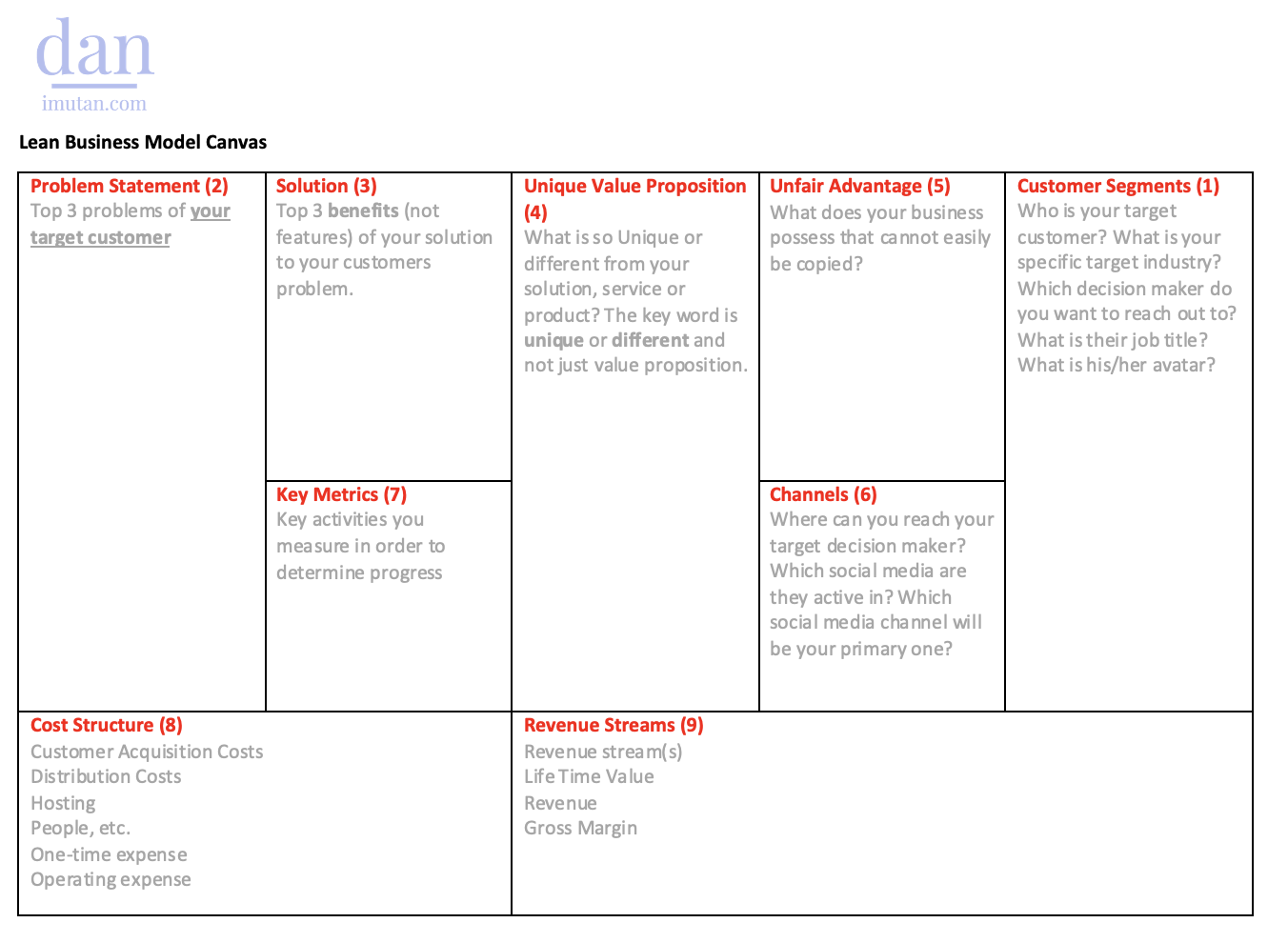
Simplicity is why the lean business model became popular. A lean business model template is only a page long. Completing it will result in one or two pages. 

The lean business model has nine sections to think about. Even if they are few, it’s still a challenge to come up with answers. Simply breezing through the questions without adequately thinking about them will only jeopardize your view of your business later. It also affects the way you will operate and market your business.

I finally wrote an educational article because I often share the benefits of the lean business model with others. I even send them a copy of the template. With this article, my friends have the template and instructions on how to complete it.

The image above is the lean business model template. You can get the word version by clicking here.:

Steps in completing the lean business model:

Customer segment. Define who your target market is. The target market cannot be everyone. It does not make sense to target everyone. You need to identify a target market that will benefit most from your product or service. A simple way to approach this is by identifying the industry and job title of the decision-maker you want to sell to. You then create a more detailed description of the decision-maker by creating a customer avatar. A customer avatar represents the decision-maker that you want to reach. For instance, you plan on going after Marketing Managers. Your customer avatar could be; The Chief Marketing Officer or CMO of a large multi-national FMCG. He is 47 years old and plays golf on the weekends. Joel is married to a beautiful housewife that graduated as an accountant. She chose to be a housewife to raise their children. They have a 25-year-old son and a 22-year-old daughter. They all live together in a luxury condominium in BGC.

Problem Statement. The best companies in the world are solving a problem. A car company solves the problem of transportation. A food company solves the problem of nutrition. A drill manufacturing company solves the problem of hanging memorable photos. You are not selling a project or service. What is the problem you are specifically solving?
Solution. What is your answer to your customer’s problem? What are the benefits of your solution? The features of your solutions will only be secondary to the benefits you bring to your customers. Your customer’s primary focus is the benefits.

Unique Value Proposition. Why should your customer come to you and not to your competitors? Here is where your entrepreneurs’ bias comes in. Entrepreneurs often state their value proposition in this section. We are not talking about just the value proposition. The keyword for this section is ‘unique’ or ‘different.’ What is unique about your product or service? If there is nothing special about it, then it’s a commodity. You will be faced with a pricing war. Can you be the lowest-priced product or service in your category and still make money? UVP is often one of the most challenging sections to answer honestly. Not having a unique answer to this question will make it very difficult to succeed in the business world.

Unfair advantage. What is it that you have that other companies do not have? When you succeed, other companies will start coming out with competing products or services. If you cannot keep your customers or attract new ones because of something others cannot copy, you will start losing customers. 

Key metrics. You need to set a few vital measures of success to know how you are progressing. You cannot improve what you don’t measure. Identify 3-5 things you need to measure to serve as your dashboard.

Channels. It is useless to be marketing on Facebook if your customers are on LinkedIn. It is futile to post content on LinkedIn when your market (see customer segment in item #1) is in TikTok. What channel will you use to promote your brand, product, and services? What blogs do they read? What groups do they belong to? What magazines do they subscribe to?

Cost structure. How much funding will you need to start your business and sustain it? What is your capital and operations expense for the next 24-36 months? You cannot make money if nobody knows you exist. Getting your product or service known by your target market takes time. In the meantime, do you have enough funds to cover this period where you are not making money or profitable?

Revenue streams. How will you make money? Will you make money from your net profit? Will you make additional revenue from an added insurance that you can offer? Do you have a second service you can up-sell or cross-sell?

If you have a new business or are about to start a business, I strongly encourage you to have a clear definition of your business. Then, taking the time to put it together provides you with a clear picture of your business. 

A clearly defined business model is also the input to a second equally important task – creating a marketing strategy. Your customer segment, UVP, etc., feeds into creating a marketing strategy and a marketing plan.

However, that’s for another article.

Please use the template provided, and feel free to reach out for any questions you may have. I am again wishing you the best with your business or startup.

Are you a bricklayer or are you building a Cathedral?

Sometimes, it’s a struggle to get people to a higher level of capability. At times, they don’t care so much about developing themselves. Sometimes, they want to learn new things, but their ability to learn and apply is not very fast. Sadly, some people are coming to work just for the salary. Some only look at work-life as a series of tasks to complete.

The challenge is how to distinguish one type from another?

It’s not an easy question. The best recourse is to manage your expectation of people. One, understand that everyone is different. Even more profound is that everyone is different from you.

Second, ask them and look them in the eye as they answer. Ask them if they are genuinely interested in developing themselves. Listen to their answer and watch their body language. Try to see if they are both giving you the same answer.

Third, empathize with them. Some don’t know what they don’t know. People are sometimes conditioned that work is all it is work. They were not allowed to dream of a better career. They have the notion that learning stops after you leave the University.

There is this excellent lesson from John Maxwell’s book about Mentoring. We need to filter the people we mentor using a set of criteria. We have a certain amount of time and resources to develop others. We need to use it wisely and be selective.

When selecting whom to mentor:

Mentoring the 20% who will make 80% difference

1. Select mentees who make things happen

2. Select mentees who seek opportunity

3. Select mentees who can influence others

4. Select mentees who add value

5. Select mentees who attract other leaders. They influence others. They focus on others’ strengths. To attract leaders, you need to be a better leader.

6. Select mentees who equip others.

7. Select mentees who have positive attitude.

8. Select mentees who are loyal. Mentees who put you in a positive light in front of others. Seeks to help you, their mentor.

As I step back, thinking about it. It is profoundly true. For many years I have had the opportunity to mentor different people of different nationalities. However, the more meaningful ones possess a particular set of behaviors and competencies.

Let me share the story of the bricklayer and cathedral builder. This Italian gentleman was walking in Rome in the 15th Century. After a few blocks, he comes across a bricklayer laying bricks under the heat of the noon sun.

The gentleman stops and asks the bricklayer, ‘Good day, May I know what you are doing?’ The bricklayer looks up. With sweat on his forehead, he frowns and says, ‘I’m laying bricks.’

The gentleman thanks him and walks further down the wall being built. After ten meters, he comes across another bricklayer. He asks the bricklayer the same question. ‘Good day. May I know what you are doing?’ The bricklayer puts down the brick he is holding. He wipes the sweat off his brows and looks up. ‘Can’t you see? I’m laying bricks!’

The gentleman thanks him and walks further down the wall. After another ten meters, he comes across a third bricklayer. He asks the bricklayer the same question. ‘Good day. May I know what you are doing?’ The bricklayer wipes his face and looks up. With a big smile, he replies, ‘Ah, young man. Thank you for asking. I am building a Cathedral!’

Seek people that understand they are building a cathedral.

Find cathedral builders and help set them up for success.

Not developing our people is costly

In my three decades in the workplace, it’s interesting that most companies don’t pay enough attention to developing their people.

They would even look at it as a cost or expense. In times of financial difficulties, the first budget cut is training. That’s assuming there even is a training budget, to begin with.

The world is evolving so fast that we need to transform our organizations constantly. It means that new skills or upgrading of skills are required. We want to be competitive, yet we don’t invest in our people. How is that even possible?

We claim that our people are our most valuable asset, yet we don’t grow our most valuable asset. We expect them to become better at their work. We expect over and above performance. How is that possible without adequately planned and executed development strategies?

Would you expect your child to be good at a skill without someone teaching him? Would you expect your son to be good at playing the piano but not invest in honing his skills? I should hope not. Would you say, ‘here is a piano, son, learn it? Oh, by the way, I expect you to be the next Piano genius in the country.’

As our economies recover, the more aggressive companies are positioning themselves to be able to capture a more significant cut of the pie. They invest in their people’s ability to sell, provide fantastic customer service, effectively manage projects, and turn out great marketing content.

It’s a great time to grab market share from the slower players. We cannot do that without people. We cannot do that if we don’t develop our people to a higher competency.

Google, Apple, Rustans, Citibank, and other significant players know the importance of people and the criticality of developing them. That’s one of the reasons these companies can outperform their competition. They invest in their most valuable assets. The operative word is ‘invest.’ They don’t spend; they invest.

Companies cannot provide excellent customer service, products, and customer experience with a mediocre workforce. After all, behind these are people.

Our most important asset is our people. Invest in them, and the investment will return with great dividends.

The value of learning comes from application

“The doer alone learneth.” — Friedrich Nietzsche

Time and again, we have a piece of knowledge or information we wish we knew. We are at a loss on how to motivate our team. We can’t figure out how to prepare and execute an effective presentation. Our level of expertise helps propel our careers and life.

When we do get that nugget of knowledge that can make a difference in our lives, we would usually do one of two things.

We continue our fascination with it for a few weeks or even months. After that, we allow it to fizzle out without a fighting chance.

Or we put the knowledge to use. We understand that learning is useless unless it is put into action.

Putting learning into action improves our lives, our careers, and the lives of the people that look up to us.

Let us remember that learning is not the key to a better life. It’s the application of the learning.

Have a great day!

My two cents, post Philippine Presidential Elections

I have been silently watching the bashing that happened during the campaign and now even after our votes where casted.

Here are my two cents.

We should unify and not divide the country. May we all have peace and unify for a better Philippines! It is written that ‘Blessed are the peacemakers’.

It is God who position leaders for a reason. Who are we to question Gods wisdom? Let us support whoever God placed for the sake of the country and not for our candidate.