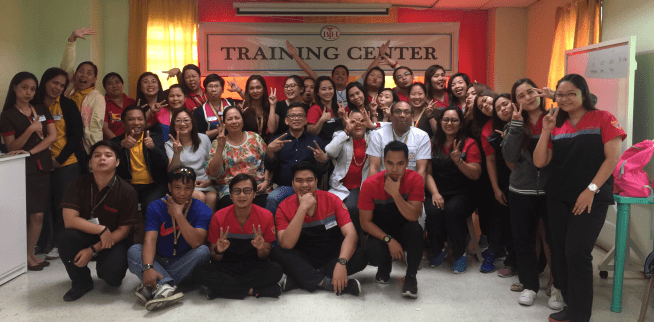
BLH A small provincial hospital with a Big Heart

Traveling from Ortigas to Binangonan Rizal usually takes a little over an hour and a half. Yesterday, the trip took 45 minutes even in heavy traffic. You would need diplomatic plates to quickly navigate through Manila traffic. Our ride was better. We were picked up and brought back by an ambulance. We whizzed through crawling traffic.

That morning, I thought that this would be the highlight of a usually normal workshop. I was pleasantly mistaken.

The hospital is managed by a tandem of two very strong ladies; Dr. Conception sits as the Chairperson, Dr. Lei as the President. The two Doctors overflow with humor and were also very humble. Their leadership style is reflected on their team of nurses and doctors.

Their staff was great. So far, I have never met a group of participants that were all so friendly and nice. In our line of work, you come across groups of workshop participants composed of nice, not so nice and a few that are arrogant.

The BLH group was the exception. Every single one of them was so nice. They do not need to be told to help set-up the workshop, distribute food, print or remove the garbage. It was all voluntarily performed with a genuine smile.

We were so happy with the participants that we ‘almost’ forced them to book our FREE Power talks on Effective Execution and Dare to Believe. It was a pleasure to come back again and share our experience for free.

I pray that after our two day Leadership Development Workshop, the participants quickly gain the self-confidence and techniques on being even better managers and leaders.

If we have more service people in the country with their heart and dedication to serve, the Philippines will be a more progressive country.

Thank you once again to Dra. Conception, Dra. Lei and the team of Binangonan Lake View Hospital. Thank you Sir Joey for coordinating a successful workshop.

Looking forward to conducting our FREE sessions with them next month.

Who do you let inside the door?

Who do you let inside the door?

Working as a consultant and executive mentor to various types of employees gives me an interesting view of human nature. Having worked with different nationalities for twenty years has been an eye opener.

We often encounter managers and executives complaining about certain individuals in their organization. In my former corporate life, this include me. We would highlight the poor work output of this person. Often, it is the behavior that we talk about. In my consulting career, I keep getting asked for suggestions on how to get rid of such employees. How can we find a better job fit for them elsewhere in the company. How about finding a better fit for them outside the company?

After the dust settles in these heated discussions, I would often say “why don’t we step back and look at the bigger picture?” The problem stems back further than the current challenges we face with them.

The problem stems all the way back to the recruitment process. Why did we let the person inside the company? Why is our selection and recruitment process so weak? We often hear reasons like; he seem like a fit at the start, we don’t have time to sift through hundreds of CVs, let’s give him more time to adopt to our culture.

Unless we inherited our problem employee, we have nobody to blame except ourselves. We assessed his CV. We were part of a meticulously designed interview schedule. We signed off to hire the person after a six-month probation.

For short, we have nobody to blame except ourselves. We let the person inside the door.

Southwest Airlines is the most profitable airlines in the U.S. When the airline started, they focused on recruiting former cheerleaders. The logic then was that “why hire demotivated people and spend a fortune trying to motivate them.” In the airline industry, the behavior of the flight attendant is a big factor. The passengers loved the energy and enthusiasm that the former cheerleading crew brought to the plane.

How does your recruitment process weed out the chaff from the grain? Do you hire people based on their behavior or their technical skills? What questions do you ask to understand how a candidate thinks of behaves? How much time do we spend trying to find the right candidate for the company?

David Jones, my forger manager and COO of NCB, keeps reminding us back then “We are only as good as our people.”

Who do you let inside your door?

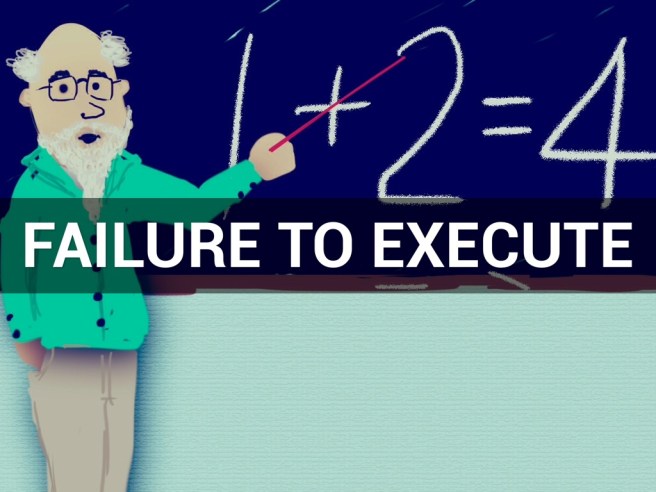
Failure to execute

I was fortunate enough to meet and consult with the owner of one of the largest shipping companies in the Philippines. The original scope of the consulting engagement was to review and improve their Account Receivables. They had so much outstanding collections that it was affecting their cash flow. This causes the company to take on loans to cover their payables. Millions of pesos loaned generates interest payments to banks.

To get an appreciation of their business, the conglomerate has over 40 companies under a holding company. These 40 company CEOs report to a group CEO. The group CEO is the child of the founder. Upon taking over the business, the group CEO had the business savvy to grow the business from one company to over 40.

Our second meeting revolved around how we will charge for our consulting service. We came in with a pricing based on estimated effort required to do the job. We charge, like most consulting firms in the world, on a per hour basis. The client proposed to pay us based on a percentage of the amount we will recover. My partners and I came back with a combination of both approaches.

In one of the meetings, the group CEO expressed frustration over their strategy and plans. Projects that were started ten years ago has not yet seen the light of day. Projects would inch forward when it had executive attention. Projects comes to a halt when the Group CEO needed to focus on more pressing matters.

The group CEO had requested that we change the focus of our consulting proposal. Their bigger challenge was the effective execution of their strategies and plans. The group CEO fully understood that success in resolving day to day challenges was largely dependent on how they execute projects designed to resolve them.

This became our scope of work for the next few months. Here is a summary of the lessons learned from the engagement:

  1. When we assign projects to employees, we need to train them on project management fundaments. We trained over 40 managers on a one day program we called ‘Project Management for none Project Managers’.

  2. For projects to succeed, the progress (or lack of) needs to be reviewed on a regular schedule. We requested the group CEO, COO and CFO to be part of the Steering Committee. These group of executives reviews project progress, gives guidance to the project and help resolve very difficult challenges.

  3. Projects are created because there is a business benefit to it. A project will either increase revenue or reduce loss/expense.

  4. Most projects fail because project managers do not spend effort identifying and preventing what can go wrong. They simply react.

There are a lot more learnings that our client picked up from the engagement. The four we listed above are just a few of them.

We always preach to our clients (or potential clients) that strategies are useless unless effectively executed. We would rather have a mediocre strategy properly implemented than a great strategy frozen in time.

If you believe that effective execution of your plans will help your company rise to the next level, feel free to reach out to us. We have a FREE 90 minute Power talk that will give you an insight on how we help companies execute their plans.

The Power of Visual Cues

When you drop by McDonalds you will notice how quickly they serve customers. They have an automated ordering process. As soon as an order is placed, the kitchen has the order appear on a TV set that displays them in sequence. First in first out.

Quality service or product quality is pegged on consistency. If we only provide a great service every now and then, it is not really quality service. Consistent service quality is the result of many things. The people we hire, the training we provide, the quality of our management team and the process they follow.

When I was younger, I found processes to be limiting. They were boring and constraining. As I went up the corporate ladder, I started appreciating their value. This is specially more for companies that design processes to shorten the time it takes to service customers and reduce mistakes.

Processes, on it’s own, cannot survive the rigors of new employees and day to day work without the corresponding templates or visual cues.

Visual cues are powerful ways of triggering an action. For instance, an inbox and outbox on top of an employees table are visual cues. They visually tell the employees how much work they have done and how much are still pending.

Back to visual cues, I noticed this in McDonalds yesterday. I ordered a few things and the cashier thought that I was dining in. Before the food came, she placed the ketchup packs on a tray with a paper lining.

She was not sure if she asked me if I was dining in. The cashier asked me, with a little embarrassment, if I was dining in. With a smile, I told her that I ordered for take away.

Almost automatically, she removed the paper lining on top of the serving tray. I thought that it was odd. As I observed the other cashiers. I noticed the pattern. Dine in orders had paper linings on the tray. Take out orders do not have paper linings on the tray.

This way, nobody can ever make a mistake of mixing the preparation of the two types of orders. They have consistency in the way they prepare both types of orders because of visual cues.

Visual cues. How often do you use it at work or in your personal life?

Keep your mind sharp

Keep your mind sharp and open to new ideas, make it a point to read a book every month. It doesn’t matter if it is a novel, a biography, or a self-help book. What is important is that you develop the habit of reading. If you are one of the lucky ones who developed the habit at a young age then kudos to you. Keep it up! If not, it is never to late to start getting into reading.

If you are really not into reading books, then choose other kinds of reading material. There are many quality magazines out there with interesting articles. If you prefer to read on your tablet, there are thousands of e-books waiting to be discovered online. Why not go for audiobooks? With audiobooks you can listen on your commute to work or even while you are driving.

I personally go for self-help and motivational books. These books actually inspired me to create my own self-help book (which I hope is helping!). To make sure I remember what I read, I jot down the books’ titles on my electronic journal called Evernote. it also helps to jot down lessons learned from books I read.

As you progress in your career, never neglect to make time for reading. It is one of the best ways to “exercise” your brain and continually learn new ideas.

How big is your commitment gap?

The gap between what an aspiring leader commits to and what he/she actually does makes a great difference in determining their success. The bigger the gap, the less likely the success. The smaller the gap, the more likely the success.

In my years mentoring both high potential employees and executives alike, successful mentees have a number of common traits for instance; great communication skills, are able to influence others, ability to execute plans, takes accountability, simplifies a complex discussion, humble and so on.

One very interesting trait of successful mentees, I noticed, is their focus on having a very small or non-existing gap between what they say they will do and what they actully do. When they commit an action to a specific date, chances are, they deliver. No need to chase them on their target dates. They take pride on delivering to their commitment.

Their superiors are able to rely on them because they deliver. They get things done. They are true to their word.

Their peers and subordinates can rely on their commitment. They will not leave you hanging. They deliver.

In this world of excuses, finger pointing and moving targets they stand out. They rise up the corporate ladder. They succeed.

How about you? How small is your gap?

What can go wrong

Mentoring Project Managers of varying experience has shown me certain traits from highly successful ones. Project Managers are powerful agents of change. Leaders understand that success in transforming organizations is directly related to their ability to execute change programs. The rest of us call these ‘Projects’.

Projects have been given a bad rap through the years with all the failed projects that populate a company. If we look at a few successful transformation projects, we will notice a certain trend.

Great agents of change (or Project Managers) have the following competencies going for them:
1. Clear and concise communicators
2. Well organized
3. Makes sure that tasks have single accountabilities and specific deadlines
4. Great motivators
5. Holds others accountable to their deliverables
6. Focused at making timelines work
7. Holds a clear vision of the end game

On a side note, these are the same competencies we find in successful leaders. At the end of the day great project managers are great leaders. Imagine having a group of people, who do not work for you, work together and deliver a common goal.

Stepping back, most projects fail or gets delayed because Project Managers do not bother to think about what can go wrong with their project and prevent/mitigate them. Mediocre project managers, like mediocre leaders, simply react to events. They allow risks (problems that have not happened yet) to transition into issues (problems that have materialized).

With all the moving parts of a project, managing risks is probably one of the most important activity of a change agent. Regular assessment of what can go wrong and managing it before it materializes, is the mark of a truly great project manager.

It is not rocket science. It is simply listing down what can go wrong, how to prevent/mitigate it, assign a person accountable for the prevention/mitigation. If a project is important enough, a weekly assessment of project risk instantly gives the project a better chance at succeeding.

When a risk materializes into an issue, it creates a speed bump or even a road block to the project.

How about you? Do you manage the risks of projects or initiatives you own?