I have been silently watching the bashing that happened during the campaign and now even after our votes where casted.
Here are my two cents.
We should unify and not divide the country. May we all have peace and unify for a better Philippines! It is written that ‘Blessed are the peacemakers’.
It is God who position leaders for a reason. Who are we to question Gods wisdom? Let us support whoever God placed for the sake of the country and not for our candidate.
Today, we will be adding mini-lessons on the different aspects of running a business. We will be covering mini five-minute lessons on; starting a business, operating a business, leading a business, and marketing a business. From my experience as a consultant, these are the four areas of challenge in most companies.
Productivity is an important element in all companies. That is why we decided to start making mini-lessons on employee productivity. The reason why the lessons are short is because of retention. We don’t want to bombard you with too many things to remember that you end up remembering nothing. We also understand that you may not have the luxury of sitting down for a two-hour lesson.
Every time we share a lesson, we will make sure that it’s short and focuses on one sub-topic only.
Enjoy and please feel free to let us know if there are topics that you want us to simplify and share.
It seemed like a typical Thursday as I got down from our unit to the basement parking. Ten minutes before going down, we always advise our driver Iyas that we are on the way.
Iyas met me in the basement three waiting area. We walked and got in our Starex almost at the same time. I settled myself in the passenger seat, and Iyas tried to start the car. After pressing the start button, nothing happened. He tried again. Once again, nothing.
I asked Iyas to turn on the headlights. Nothing happened. The car battery is dead. It was a good thing I did not have any meetings that morning. I called the Motolight service to have a replacement car battery delivered and installed.
While we waited, I asked Iyas why the car battery was fully drained; his first reply was he did not know. ‘I don’t know ’ is his default reply for everything. I checked my records, and the battery was less than a year old. It’s not likely that it does not store electricity properly.
I asked him to think harder. After five minutes, he said that he might have left the lights open. The night before was his brother’s birthday. He was in a hurry to catch up on the birthday gathering. He may have left the car lights open.
If we step back, we could have wrongly taken it for granted that the car battery had died. We could have just replaced it without thinking deeper about the actual cause.
The cause was not the car light draining the battery. The real root cause was my driver’s negligence. When we got to the root cause, I informed Iyas that the next time we needed to spend replacing the car battery due to his negligence, he would need to pay for half the cost of the car battery. Since that agreement, we have never had to replace a drained car battery due to negligence.
If we take a helicopter view of what transpired, you will notice the essential elements of a structured problem-solving technique.
1. Information gathering. I dug deeper beyond what ‘seemed’ to be the cause.
2. Define the problem. The problem, in this case, is that my driver was negligent.
3. Options. We could jump-start the car, but that might not be a sustained solution. Getting the battery checked and replaced was more of the proper long-term resolution. The preventive action was the agreement for Iyas to shoulder half the cost of a replacement battery.
4. Solution. Get the battery replaced, and Iyas to agree.
5. Post-event assessment. The incident never happened again.
Solving a problem should not be done in haste. A proper information gathering, problem definition, options identification, solution selection, and implementation helps resolve and prevent the recurrence of a problem.
I heard an exciting blog concept from Pat Flynn’s podcast. When he started blogging many moons ago, he decided to blog about his startup journey. He would share his wins and difficulties in starting his solopreneur business.
I thought that was an exciting concept. This blog will be following Pat’s lead. The timing is suitable for a service we are pivoting from my current employer. PMII is a professional sales and marketing service company with clients mainly from the Pharmaceutical industry. Since the client’s medical representatives need to distinguish themselves from their competitors when visiting doctors and hospitals, they come to work wearing their official corporate uniforms. These serve as a branding tool as well.
For the last 20 years, PMII has been providing the corporate uniform requirements of their clients. So it would not be too much of a surprise to create a “startup” business from it. So we named the company – Kuhana Corporate Uniform.
“Kuhana” is loosely translated as “Get already” or “Get now”. We use an umbrella word for the companies’ startups; Kuhana Amore, Kuhana Mum&Me, Kuhana Outdoor, Kuhana Corporate Goods, Kuhana Corporate Uniform. These are all tiny startups.
Two weeks ago, Kuhana Corporate Uniform or KCU was just on the back burner. However, when we reviewed the revenues of the startups last week, we noted that Kuhana Corporate Goods and Kuhana Uniform somehow has a steady flow of income. It’s not that big since we look at it as an added service to our existing clients. It’s provided primarily as goodwill.
Ann, the person in charge of KCU, and I noted that we needed to start from the start. First, we needed to create a business model and a marketing strategy. In simple terms, we needed to clearly define how the company would compete in which target industry.
Creating a clear business model is not as easy as it sounds. With the standard template we use, there are a few components that are difficult to define:
A niche target market and client avatar.
A truly unique value proposition. From experience, most founders claim that their product or service is unique even though they have dozens of similar competitors.
“Unfair advantage” is also challenging to define. What does the company have that competitors cannot easily copy? Successful products, services, and even product features are rapidly duplicated in today’s business landscape.
We need to fill in other components to complete the business model.
It usually takes from a few days to weeks to truly complete the business model. When rushed, the content is sometimes weak and can easily be dismissed.
The next step is defining a clear marketing strategy. Some of the marketing strategy components will come from the business model.
For instance, when crafting a marketing slogan, it’s wise to mention the unique value proposition. What makes KCU different from the others? Why should clients reach out to KCU and not its competitors? The Corporate Uniform industry is matured and has been commoditized through the years. It would be challenging to develop a unique business model that should make it stand out in the market.
However, it’s not impossible. Part of the research would be to check on the leaders in the industry and identify their UVP. We need to figure out what’s unique about them and how they have survived for years in their industry.
This is entry 1 of the “KCU Startup journey.” Stay tuned. We plan to post the progress of the other startups.
You cannot give what you do not have. Employees cannot care for their customers if they are not cared for.
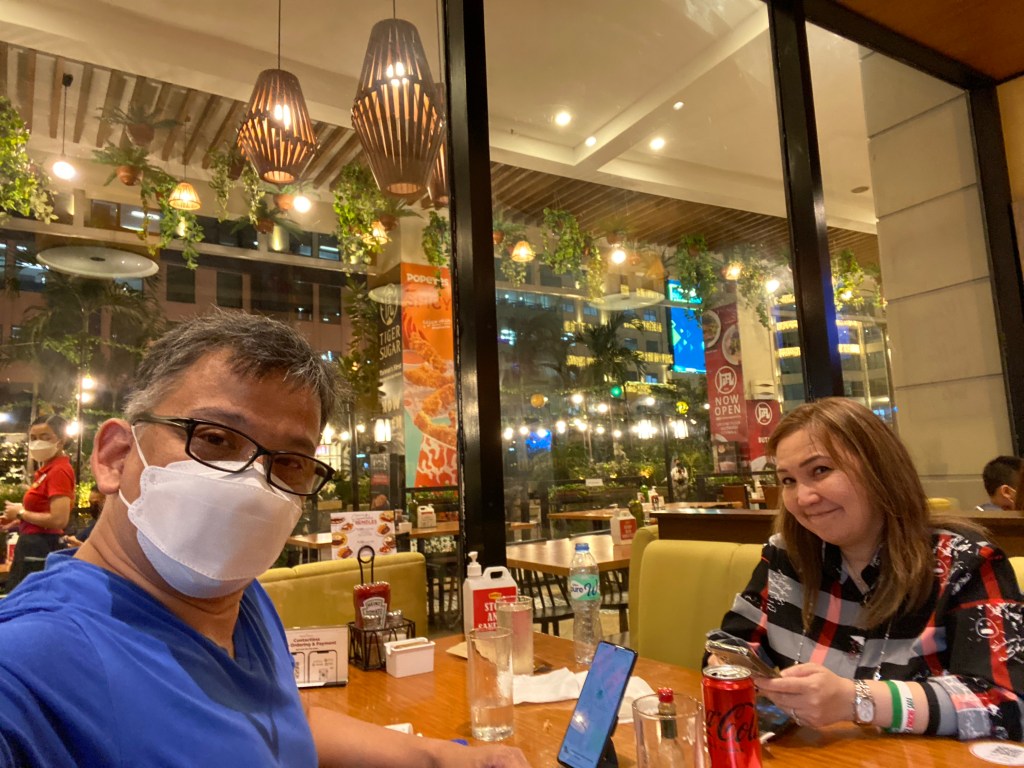
Yesterday, my wife decided to treat me to dinner even though she was fasting. The event is like an eclipse. It seldom happens, and it’s even more seldom that it’s a complete Solar eclipse.
We were in Eastwood mall, and I did not want anything fancy, so we chose to eat at “D.” As we entered, we were greeted and walked to our table. There were no customers at the time, but for some reason, the server gave us a table near the end of a narrow hallway. It was far from where the servers stood.
We sat down and checked the digital menu. We downloaded the menu from a QR code displayed on the table. After choosing what to order, I turned around, and there was no server. I stood up and saw a server with her back turned from me.
I gently called her and sat down again. It took her a few minutes to come over, even though there was nobody else in the restaurant at the time. After taking our order, she asked me if I had a ‘B’ card. I had a digital version of my discount card on my phone as an app. I opened the app and clicked on the QR code of my membership. It showed my membership number. I assume that she would need to write this down to enter it in their POS.
Without hesitation or permission, server A just took my phone and walked to the POS to type in the membership number. I thought that wasn’t nice. However, considering that she may be having a bad day, I just kept watching to see if she did anything else with my phone. Like everyone else, we have confidential or personal information and photos on our phones.
When the food arrived, they were placed on our table. I called the same server; let’s call her server A. I asked server A for Tabasco and some tissue. Server A has been stoic or showed no emotions at all since we came. Not a smile, nothing.
Another server, server B, brought the hot sauce and tissue to our table. Server B had the same stoic look on her face. I’m not sure if she’s unhappy with her job or just tired. They had the same lifeless look. Not a very pleasant environment to be having a meal.
At the end of the meal, I asked for the bill. Sever B brought it over. She showed me the discount amount from my “B” card membership.
While opening up my gcash to pay, I asked server B what’s the name of the street across their restaurant. To my surprise, server B just quickly said she did not know. That was puzzling. She works in a restaurant and does not know the street across it. Maybe she was dropped to work by a private helicopter, so she did not have to see the street names.
I asked her to ask the manager standing near us at the time. As soon as she asked, the Manager just turned his back as if not hearing anything and just walked away. I did not make a big deal out of it. I needed the Information for the grab service I was booking.
This morning as I was processing what had happened in my mind, the quickest reaction would be to get upset with the employees. We experienced terrible customer service from a popular chain of restaurants. However, it’s not one-sided.
Of course, the employees can decide how they will treat their customers. We always have that decision regardless of what we are going through.
However, the more important question is how are they being treated by their company? How do their superiors manage them? How are they motivated and developed? How are they selected for their roles? All these play an important factor in customer service.
It’s not only the profits that stop at the leaders’ office. Accountability for their employees and customers is entirely theirs; that is what great leaders have.
Outstanding leadership takes accountability for their people and customers.
Are you taking accountability for your people and customers?
The Chief HR officer (CHR) role in the company is a standalone function. The position does not have anyone directly reporting to her at the central or corporate level.
However, two HR managers are looking after the human resource operations of the three companies in the group. We also have a compensation and benefits function looking after the payroll of all employees.
Even though our CHR person does not have a direct line employee reporting to her, she still manages to get her assignments done. More so, if the work requires cooperation from other functions in the company. I was discerning her a few times as she took on new tasks.
She manages to get things done through others because she positively influences the people around her. It’s her influence on others. The following set of behaviors surfaces with her.
1. Humility. She is never rude or disrespectful when dealing with others.
2: Curious. She will ask questions about her assignment regardless of how it makes her look.
3. Inclusive. She makes sure that all relevant stakeholders are part of the discussion.
4. Helpful. When she notices someone struggling with an assignment, she is quick to lend a helping hand.
These are four simple behaviors I have noticed with our CHR that provide electricity for her magnet of influence in the company. She can get things done regardless of how big or small the challenge is.
How about you? How is your influence on your workmates? How strong is your influence in your organization?




 Most leadership training is forgotten after the seminar.