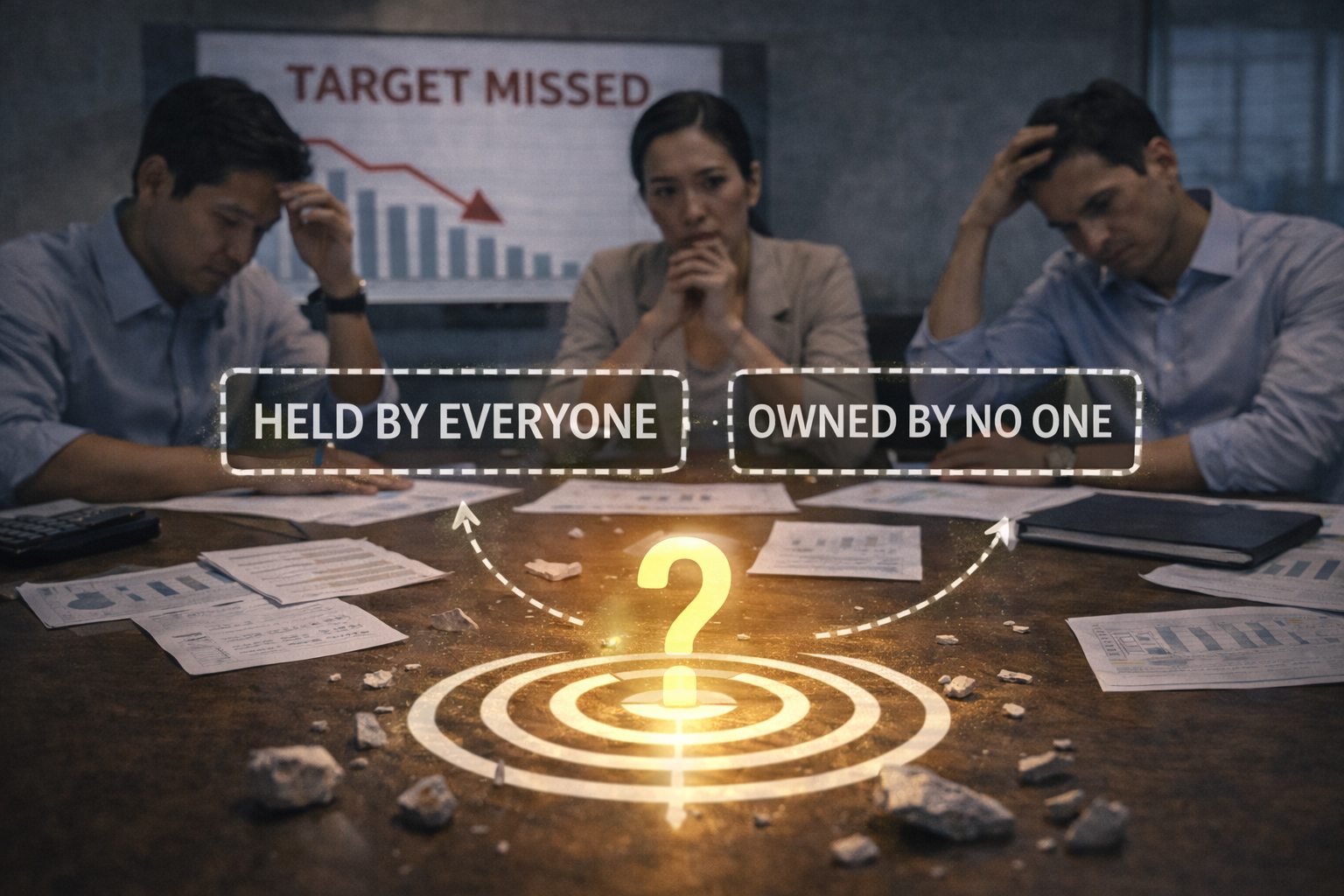
It sounds mature.
“Let’s all own this.”
“This is a team target.”
“We win together. We lose together.”
It feels collaborative. Inclusive. Aligned.
It’s also one of the fastest ways to blur ownership beyond recognition.
Shared responsibility is often a leadership shortcut. It avoids the discomfort of assigning a single owner. It spreads risk across a group. It protects relationships. No one feels singled out. No one feels exposed.
But here’s what it quietly destroys: clarity.
When everyone owns the outcome, no one fully owns the decision.
And when no one fully owns the decision, escalation becomes inevitable.
Let’s say revenue is behind target. Leadership announces it’s a “company-wide effort.” Sales pushes harder. Marketing launches more campaigns. Operations tries to support demand. Everyone works.
But ask a simple question:
Who owns the number end-to-end?
Not who contributes.
Not who influences.
Who decides what changes when it’s off pace?
If that answer isn’t sharp, performance becomes fragmented. Each function optimizes its part. The outcome floats in the middle. When numbers miss, explanations multiply.
Sales says lead quality.
Marketing says conversion rate.
Operations says capacity.
No one is wrong. But no one is fully responsible either.
This is where decision escalation quietly fills the gap.
Because when ownership is shared, authority is unclear. Managers hesitate to make trade-offs that affect other departments. So they escalate.
“Let’s get leadership input.”
“Let’s align first.”
“Let’s bring this to the founder.”
Escalation feels safe. It removes the burden of deciding alone.
And the founder becomes the tie-breaker.
Founder bottlenecks rarely start with ego. They start with shared responsibility. If no single leader is accountable for the outcome, the highest authority becomes the default owner.
Over time, this creates a predictable pattern.
Decisions move upward.
Ownership moves outward.
Execution slows inward.
Targets don’t miss dramatically. They drift.
Because when ownership is collective, accountability becomes theoretical.
The uncomfortable truth is this:
Shared responsibility is emotionally comfortable but operationally weak.
Clear ownership feels sharper. It creates tension. It forces one person to absorb risk. It makes it obvious who must decide when results are off track.
But that discomfort is exactly what creates speed.
If every meaningful outcome has multiple owners, it has none.
If every decision requires group consensus, it will land late.
If every trade-off needs escalation, authority is already diluted.
Leadership isn’t about distributing responsibility evenly.
It’s about concentrating ownership deliberately.
Because the moment you can’t point to one person and say, “This outcome belongs to them,” the target is already vulnerable.
And by the time it’s officially missed, the shortcut has already done its work.

 Too many companies have untrained leaders that fail.