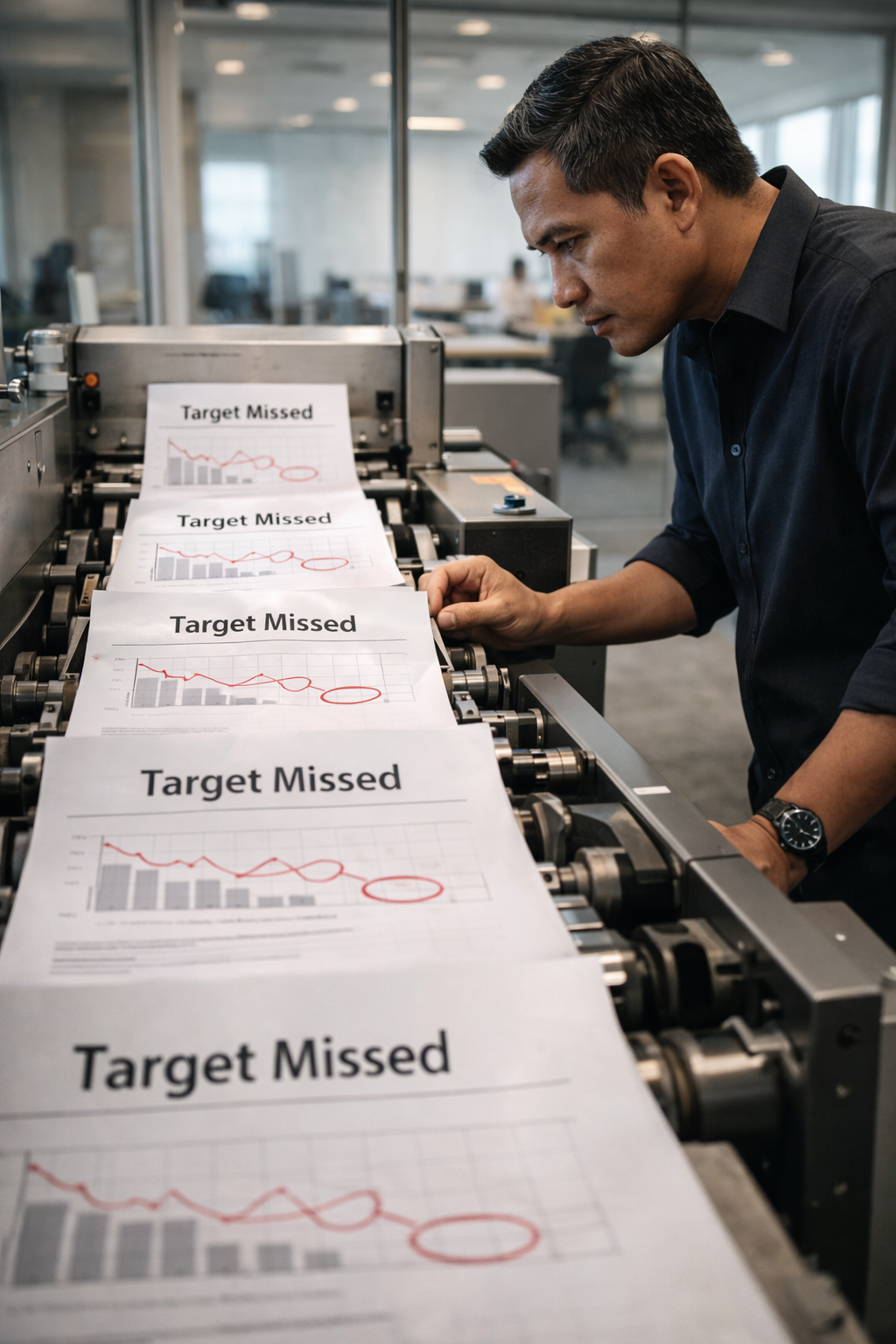
The numbers came in.
They weren’t great. Again.
And just like every other quarter, the room filled with familiar questions:
What went wrong?
Why didn’t the team execute?
Where did we lose momentum?
As if the result was some kind of accident.
Here’s the truth most leaders avoid because it’s deeply inconvenient:
Your company didn’t miss its targets by surprise. It did exactly what it was designed to do.
Missed targets are rarely the result of sudden incompetence. They’re the natural output of unclear ownership, chronic decision escalation, and founders acting as the final safety net for everything.
Let’s break that down.
In many organizations, goals are ambitious but responsibility is abstract. Everyone agrees on what needs to happen. Fewer people are clear on who owns the outcome. Management roles exist, but authority is vague. Decisions are discussed, debated, and reviewed—but rarely owned cleanly.
So the system adapts.
Managers learn that deciding is risky.
Escalating feels safer.
Waiting feels professional.
Before long, decision escalation isn’t an exception—it’s the operating model.
Every unresolved issue floats upward. What starts as a small decision becomes a leadership conversation. What should have been resolved in a day becomes a meeting. What should have stayed in one department ends up with the founder.
And the founder, being responsible, steps in.
This is where leaders often misread the situation. They think the founder is being helpful. In reality, the organization is signaling a design flaw. When founders consistently catch what falls through the cracks, the system learns not to fix the cracks.
Founder bottlenecks don’t happen because founders want control. They happen because the organization quietly outsourced clarity to the top.
Over time, the consequences show up in the numbers.
Targets slip—not dramatically, but predictably.
Projects slow—not visibly, but steadily.
Teams stay busy—but not effective.
And leadership keeps asking why without noticing how consistent the outcome has become.
That consistency is the clue.
If managers hesitate, it’s because ownership isn’t explicit.
If decisions escalate, it’s because authority is unclear.
If everything lands on the founder, it’s because the system rewards waiting.
This isn’t a people problem. It’s a design problem.
Most organizations don’t need more motivation, more meetings, or stronger reminders about accountability. They need fewer gray areas. Fewer shared responsibilities. Fewer decisions without names attached to them.
Because systems don’t drift randomly. They behave exactly as structured.
If responsibility is shared, accountability dissolves.
If decisions are optional, hesitation wins.
If founders always catch the fall, the fall never stops.
So when targets are missed, the real question isn’t “Who failed?”
It’s “What behavior did the system reward?”
Because once you see the pattern, the outcome stops being surprising.
And if the same results keep repeating quarter after quarter, it’s not bad luck.
It’s design.

 Too many companies have untrained leaders that fail.