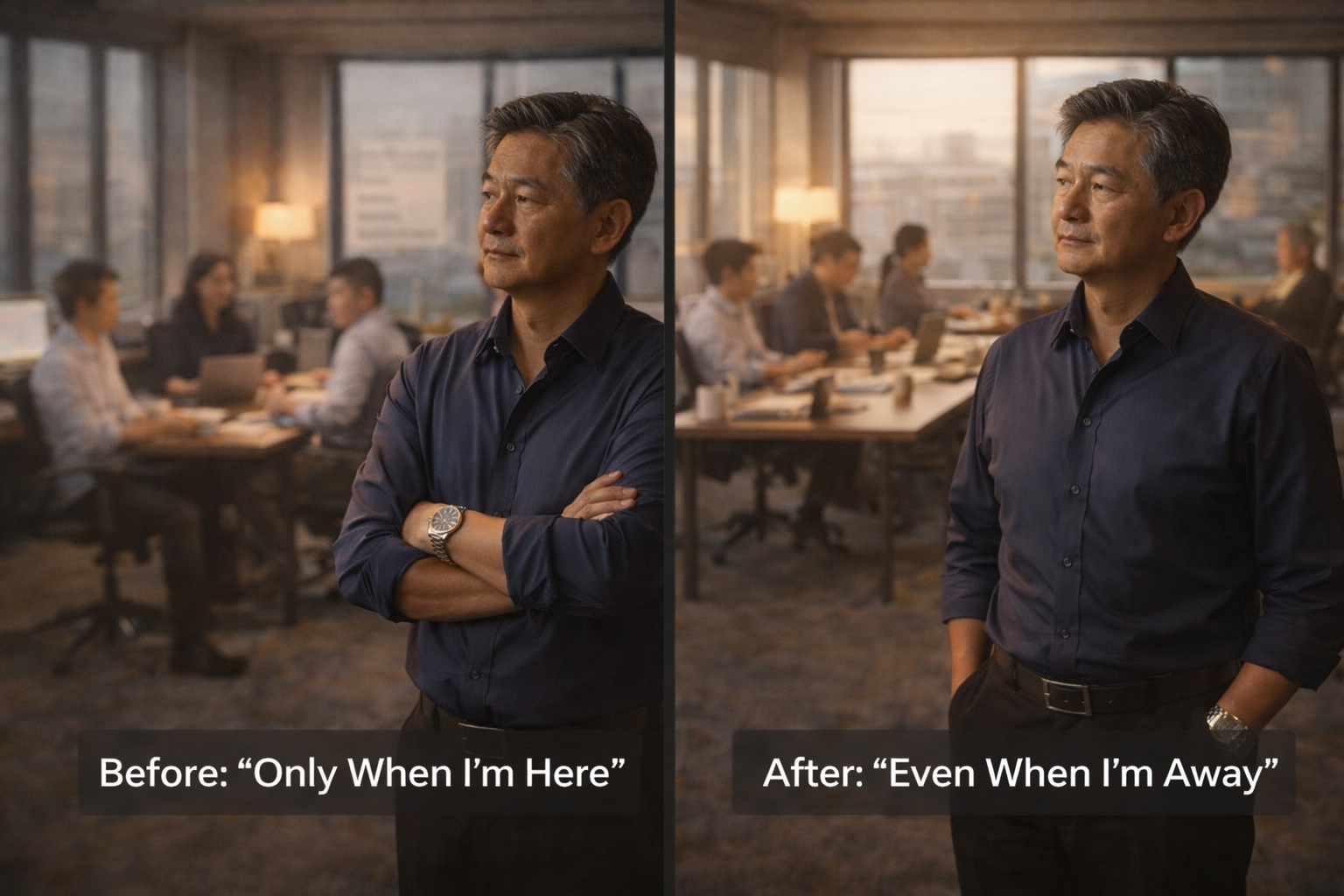
When you’re in the office, things move.
Decisions get made.
Questions get answered.
Problems get fixed.
People come to you, you respond, and the day keeps flowing.
But the moment you step away—even briefly—things change.
Questions pile up.
Decisions wait.
Work slows down “until you’re back.”
Nothing breaks dramatically. It just… pauses.
At first, this feels like leadership. You’re involved. You’re available. You’re hands-on.
But over time, a quiet realization sets in: the business works because you’re there—not because it’s designed to work.
This is the problem many leaders don’t talk about openly: everything runs smoothly—until you’re not around.
And it’s unsettling.
Because you didn’t plan to become the glue holding everything together. It just happened.
Let’s talk about how.
In the early days, your involvement made sense. You were close to everything. Decisions were quick. People needed direction, and you provided it. Your presence was an advantage.
Then the business grew.
More people joined.
Work spread across teams.
Decisions became less obvious.
And without anyone realizing it, your presence turned into a dependency.
People started checking in “just to be safe.”
Small decisions came to you because it felt faster.
Questions were held back until you were available.
You became the bridge between teams. The final checkpoint. The place where uncertainty went to rest.
Not because people weren’t capable—but because the rules weren’t clear.
From your seat, it felt like responsibility.
From the system’s point of view, it was fragility.
One leader described it honestly after taking a short leave:
“I thought I was keeping things moving. Turns out, I was the thing things waited for.”
That moment is uncomfortable. But it’s also powerful—because it points to the real issue.
A business that only works when the leader is present doesn’t have a people problem. It has a design problem.
Work depends on memory instead of rules.
Decisions depend on availability instead of clarity.
Progress depends on presence instead of process.
So when you’re gone, the system hesitates.
Leaders often respond by becoming even more involved.
They stay online.
They respond faster.
They avoid stepping away.
It feels responsible—but it makes the problem worse.
The goal isn’t to remove the leader.
The goal is to remove the need for the leader to be everywhere.
The shift happens when leaders stop asking, “Why do they need me?” and start asking, “Why does this require me at all?”
That question changes how work is designed.
Instead of being the decision-maker, the leader defines decision rules.
Instead of being the checker, the leader sets clear standards.
Instead of being the bridge, the leader removes the gaps.
This doesn’t happen overnight. It starts small.
Clear limits on what teams can decide on their own.
Clear signals for what needs escalation—and what doesn’t.
Clear outcomes so people don’t guess what “done” means.
At first, people feel unsure.
“Are you sure I can decide this?”
“What if I get it wrong?”
That hesitation is normal. It means people are adjusting from dependence to ownership.
The key is consistency.
When leaders stop stepping in “just this once,” people step up. When leaders don’t rescue work mid-way, confidence grows. When rules stay clear, waiting disappears.
Over time, something changes.
The leader steps away—and work continues.
Not perfectly.
Not silently.
But steadily.
Decisions are made.
Problems are handled.
Progress holds.
The business doesn’t need constant supervision anymore.
This is the “after” state most leaders don’t realize they want until they experience it.
Presence becomes optional—not required.
Leaders finally get space to think, plan, and lead instead of react. Teams grow into responsibility instead of avoiding it. Growth stops feeling risky because absence no longer breaks flow.
The irony is that letting go doesn’t weaken leadership. It strengthens it.
Because real leadership isn’t about being everywhere.
It’s about building something that works even when you’re not.
So if your business only runs smoothly when you’re around, don’t assume your team isn’t ready.
Chances are, the system just needs clarity.
Fix that, and something powerful happens.
The business keeps moving—even when you step away.
Now here’s the question worth ending on:
If you were unavailable for a week, would the business pause—or would it prove you’ve built it right?

 Too many companies have untrained leaders that fail.