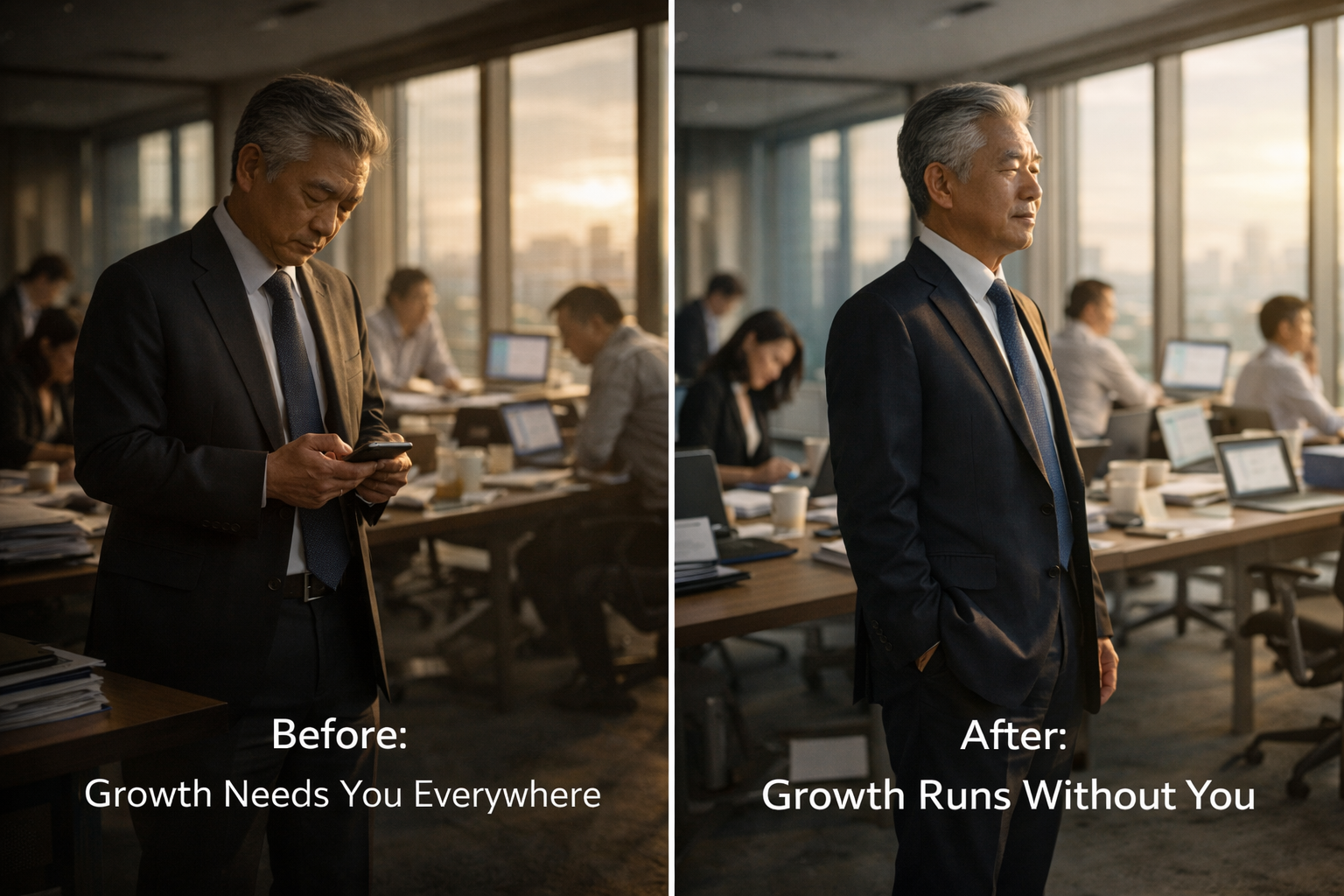
The first sign something changed wasn’t dramatic.
No big announcement.
No sudden jump in revenue.
No flashy new system.
It was quieter than that.
The leader noticed fewer questions landing on his desk. Fewer follow-ups. Fewer messages asking for clarification. Meetings started ending early—not because people rushed, but because there was nothing left to explain.
For the first time in a long while, the business moved without him pushing it.
That’s the “after” most leaders secretly want—but rarely experience.
Before that point, the business looked successful on the outside. Clients were coming in. The team was growing. Revenue was steady.
Yet inside, everything depended on the leader.
Decisions waited.
Work slowed when he was unavailable.
Small issues escalated quickly.
Everyone meant well—but nothing moved without direction.
This wasn’t control. It was dependence.
The leader didn’t plan it that way. It happened slowly, as businesses usually do. Small adjustments. Extra approvals. More check-ins. A few “just to be safe” steps added along the way.
The business kept growing.
The leader kept carrying more.
Until growth stopped feeling exciting and started feeling heavy.
That’s when the question changed.
Instead of asking, “How do we grow faster?”
He asked, “Why does everything still need me?”
That question changed everything.
The problem wasn’t effort. People were working hard.
The problem wasn’t trust. Everyone was capable.
The problem was that work had no clear flow.
Tasks depended on memory.
Updates depended on reminders.
Decisions depended on availability.
The business didn’t have a system. It had habits.
So instead of adding more people or more tools, the leader did something uncomfortable.
He started removing things.
Meetings that existed only for updates were cut.
Approvals that didn’t change outcomes were dropped.
Repeated tasks were simplified or allowed to move on their own.
Nothing fancy. Just fewer steps.
At first, the team was unsure.
“Are you sure we don’t need to check this?”
“Should we wait for approval?”
“What if something goes wrong?”
That hesitation was expected. The team had been trained to wait. But slowly, something changed.
Work stopped stalling.
People acted without asking.
Decisions were made once—and stuck.
The business became quieter—but more effective.
This is the “after” leaders rarely talk about because it doesn’t sound exciting.
No hustle.
No urgency.
No drama.
Just progress.
Clients noticed it first.
Responses were faster.
Mistakes dropped.
Deliveries were more consistent.
Then the team felt it.
Less chasing.
Less rework.
More confidence.
And finally, the leader felt it.
Time opened up.
Thinking replaced reacting.
Growth felt manageable again.
The business didn’t need him everywhere anymore—and that was the point.
This “after” state doesn’t come from working harder. It comes from letting go of work that shouldn’t exist.
When routine tasks stop depending on people pushing them forward, everything else speeds up naturally. Leaders stop being the engine. Teams stop waiting. Systems start doing their job.
This doesn’t mean leaders disappear. It means they finally lead where it matters.
The biggest shift is psychological.
Leaders realize that control doesn’t come from being involved in everything. It comes from designing work so things move correctly without constant attention.
That’s the real outcome most leaders are chasing—whether they say it out loud or not.
A business that grows without draining them.
A team that moves without waiting.
A system that doesn’t fall apart when they step away.
This is the “after” state that makes growth sustainable.
The irony is that getting here often requires doing less, not more.
Less checking.
Less approving.
Less fixing.
And more clarity.
If your business still depends on you to function, the problem isn’t leadership. It’s flow.
Fix the flow, and something powerful happens: the business finally starts working with you—not against you.
Now here’s the question worth ending on:
If the business could run well without you for a week, what kind of leader would you finally get to be?

 Too many companies have untrained leaders that fail.