When Managers Stop Deciding, Organizations Start Drifting

At first, nothing seems wrong.

The meetings still happen.
The reports still circulate.
The teams still work hard.

From the outside, the organization looks active and professional. Everyone is busy. Everyone is responsive. Everyone is participating.

But something subtle has changed.

Managers have stopped deciding.

Not completely. Not obviously. But gradually enough that no one notices the moment it happens.

Instead of deciding, they start coordinating.

Instead of committing, they start consulting.

Instead of landing decisions, they move them.

It usually begins with good intentions.

A manager faces a decision that touches another department. Maybe it affects marketing, or operations, or hiring. Instead of deciding independently, the manager wants to be careful.

“Let’s align with the team first.”

Alignment feels responsible. No one objects to it. Collaboration is a good thing.

But alignment slowly replaces authority.

Another decision comes up.

“Let’s check with leadership.”

Then another.

“Let’s escalate this.”

Each step feels safe. Each step spreads risk. Each step protects the manager from making a decision that might be questioned later.

And slowly, the system learns a new pattern.

Managers gather information.
Leadership makes decisions.

Once that pattern takes hold, the middle layer of the organization begins to change its role. Managers are no longer decision-makers. They become translators.

They translate problems upward.

They translate decisions downward.

Execution still happens, but ownership has shifted.

This is where founder bottlenecks begin.

Not because founders want control.

Because the system routes decisions toward the place where they consistently land.

The founder or senior leader becomes the final filter. Hiring decisions. Pricing adjustments. operational trade-offs. Strategic priorities.

Each one arrives at the top because the layer below it stopped absorbing risk.

Meanwhile, targets start slipping.

Not because people stopped working.

But because the system slowed down.

Decisions that once took hours now take days. Decisions that once belonged to managers now require leadership meetings. Adjustments that should have happened early happen late.

And the organization begins drifting.

This is the quiet danger of decision escalation.

It feels professional in the moment. It protects individuals from exposure. It avoids conflict. It maintains harmony.

But it gradually removes the very thing organizations rely on to move quickly.

Ownership.

If managers stop deciding, the organization loses its engine. The founder becomes the bottleneck. The middle layer becomes informational instead of operational.

And every target becomes harder to reach.

Because execution depends on one simple thing:

Decisions landing where the work happens.

When they stop landing there, momentum disappears.

And the organization slowly learns to move only as fast as the top of the structure can decide.

The Real Reason Decisions Keep Moving Up

Every company says the same thing.

“We want managers to take ownership.”

It sounds right. It sounds modern. It sounds like the kind of leadership culture everyone claims to build.

But if you watch how decisions actually move inside most organizations, a different pattern appears.

Decisions keep traveling upward.

A manager gathers the facts. They analyze the options. They prepare the recommendation. Then the conversation ends with a familiar phrase.

“Let’s bring this to leadership.”

And just like that, the decision leaves the level where the work actually happens.

At first, this doesn’t seem like a problem. Escalation can feel responsible. It reduces risk. It ensures alignment. It protects people from making a call that might have broader consequences.

But when escalation becomes routine, the system quietly changes.

Managers stop deciding.

Not because they lack intelligence or experience, but because the organization trained them to pass decisions upward.

It usually starts with a few harmless moments.

A manager makes a call. Leadership revisits it later. Maybe it gets adjusted. Maybe it gets reversed. No one intends to undermine anyone. The goal is simply to improve the outcome.

But the signal is received clearly.

The decision didn’t really belong to the manager.

Next time, that manager hesitates. Instead of deciding, they gather more input. They loop in more people. Eventually, they escalate.

And that’s when the structure begins to shift.

The organization still has managers on paper. But operational authority starts concentrating above them. Leadership meetings begin filling with decisions that should have been resolved two levels below.

The middle layer becomes a relay station.

Information goes up. Decisions come down.

Founder bottlenecks often appear here.

The founder or senior leader doesn’t necessarily want to be involved in every operational call. But if decisions keep arriving at the top, someone eventually has to resolve them.

So they do.

Quickly.

Decisively.

And the system learns something dangerous: the fastest way to get clarity is to escalate.

Once that lesson takes hold, escalation accelerates. Managers stop absorbing uncertainty. They forward it instead. Decisions move higher. Execution slows slightly.

Then the quarter ends and the numbers feel heavier than expected.

Targets slip, not because people worked less, but because decisions arrived later than they should have.

The frustrating part is that most organizations already have capable managers who could make these calls. The experience exists. The judgment exists.

What’s missing is stability.

If a manager makes a decision, will it stand?

If authority shifts after the fact, escalation will always feel safer than ownership.

And the organization will keep routing decisions to the top, even when everyone agrees it shouldn’t.

The solution isn’t motivational speeches about ownership.

It’s structural clarity.

When a manager decides, the system must treat that decision as real. Not provisional. Not temporary. Real.

Because the moment people believe their decisions actually stick, something changes immediately.

Decisions stop traveling.

And execution starts moving again.

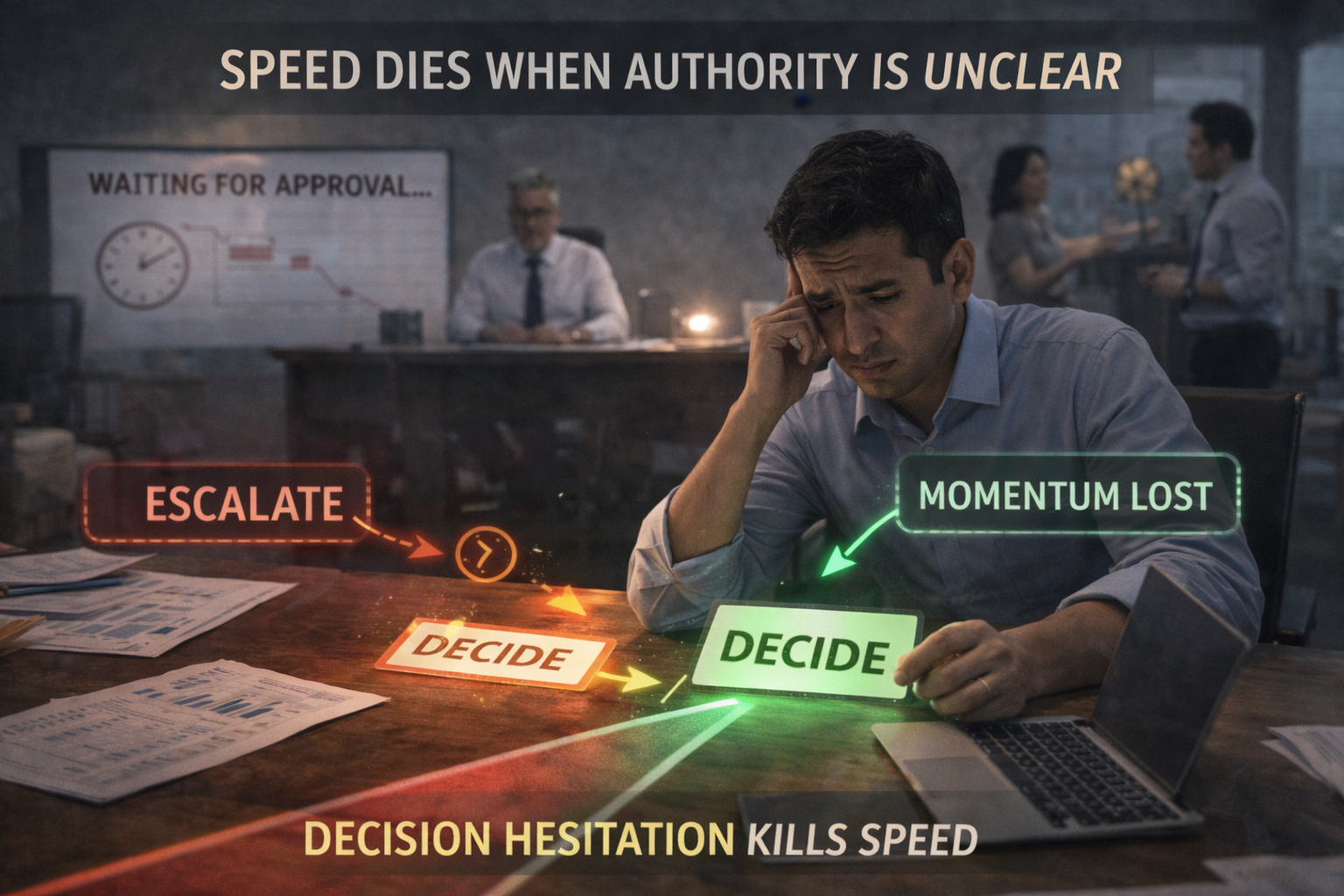
Speed Dies When Authority Is Unclear

Every company says it wants to move fast.

Fast execution.
Fast decisions.
Fast response to the market.

Speed sounds like a cultural issue. Leaders talk about urgency. They encourage initiative. They tell managers to “move quickly.”

But speed rarely dies because people are slow.

Speed dies because authority is unclear.

Look closely at most organizations that struggle to execute. The people aren’t lazy. The teams are usually working hard. Meetings happen. Reports circulate. Updates get delivered.

Activity is everywhere.

But the decisions that unlock momentum keep drifting upward.

Here’s how it usually happens.

A manager faces a decision that affects an important target. It might involve shifting resources, stopping an initiative, or changing direction. The manager could decide—but the boundary of authority isn’t fully clear.

Maybe past decisions were overridden.
Maybe similar calls were escalated before.
Maybe the risk feels too visible.

So the manager pauses.

“Let’s get leadership input.”

The decision moves upward.

Leadership reviews it. Maybe it sits in a queue of other escalations. Eventually the founder or senior leader decides. The team moves again.

On the surface, nothing is broken.

But speed just died in that moment.

Because when authority is unclear, decisions travel. And every time a decision travels, execution slows.

Managers learn quickly how the system works. If major decisions are usually finalized above them, escalation becomes the responsible move. No one wants to make the call that gets reversed later.

So hesitation spreads.

Managers start coordinating instead of deciding. Teams wait for confirmation. Projects advance cautiously because direction hasn’t fully hardened.

Eventually, founder bottlenecks appear.

Not because founders want control. Because the system trained everyone else to escalate.

At that point, the organization becomes structurally slower than it realizes. Founders spend time resolving operational issues that should have been handled two layers down. Leadership meetings fill with decisions that should have never reached that room.

And targets begin slipping.

Not dramatically. Just enough that the quarter feels heavier than it should.

That’s when leaders start asking why execution feels slow. They push for urgency. They encourage initiative. They remind managers to take ownership.

But urgency doesn’t create speed.

Authority does.

Speed exists when the person closest to the problem can decide without asking permission. When ownership is explicit, decisions land quickly. When decisions land quickly, execution adjusts early.

Targets become easier to hit—not because people work harder, but because the system moves faster.

If managers hesitate before deciding, speed is already gone.

And no amount of motivational language will bring it back.

Because speed isn’t cultural.

It’s structural.

Shared Responsibility Is Usually a Leadership Shortcut

It sounds mature.

“Let’s all own this.”
“This is a team target.”
“We win together. We lose together.”

It feels collaborative. Inclusive. Aligned.

It’s also one of the fastest ways to blur ownership beyond recognition.

Shared responsibility is often a leadership shortcut. It avoids the discomfort of assigning a single owner. It spreads risk across a group. It protects relationships. No one feels singled out. No one feels exposed.

But here’s what it quietly destroys: clarity.

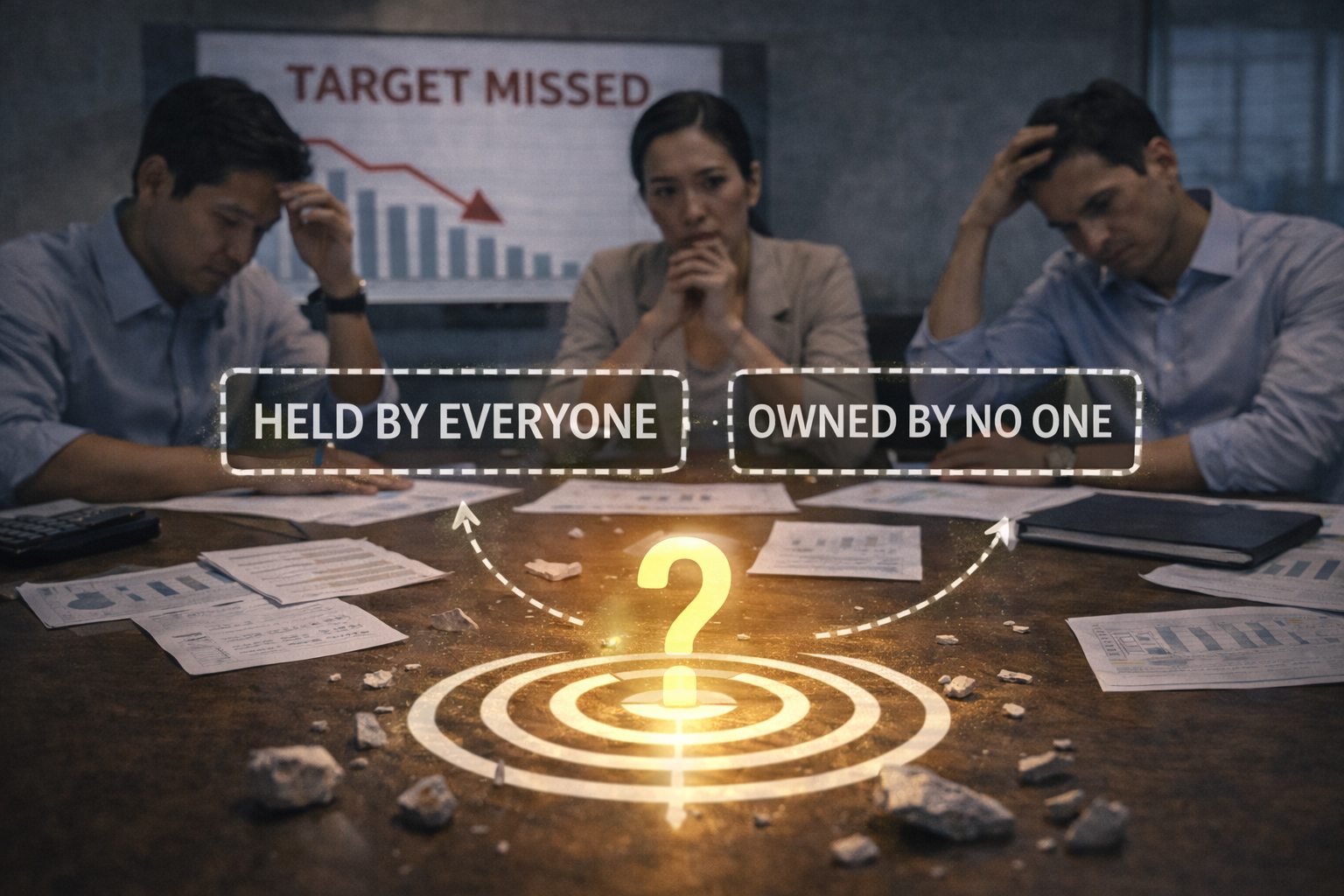
When everyone owns the outcome, no one fully owns the decision.

And when no one fully owns the decision, escalation becomes inevitable.

Let’s say revenue is behind target. Leadership announces it’s a “company-wide effort.” Sales pushes harder. Marketing launches more campaigns. Operations tries to support demand. Everyone works.

But ask a simple question:

Who owns the number end-to-end?

Not who contributes.
Not who influences.
Who decides what changes when it’s off pace?

If that answer isn’t sharp, performance becomes fragmented. Each function optimizes its part. The outcome floats in the middle. When numbers miss, explanations multiply.

Sales says lead quality.
Marketing says conversion rate.
Operations says capacity.

No one is wrong. But no one is fully responsible either.

This is where decision escalation quietly fills the gap.

Because when ownership is shared, authority is unclear. Managers hesitate to make trade-offs that affect other departments. So they escalate.

“Let’s get leadership input.”
“Let’s align first.”
“Let’s bring this to the founder.”

Escalation feels safe. It removes the burden of deciding alone.

And the founder becomes the tie-breaker.

Founder bottlenecks rarely start with ego. They start with shared responsibility. If no single leader is accountable for the outcome, the highest authority becomes the default owner.

Over time, this creates a predictable pattern.

Decisions move upward.
Ownership moves outward.
Execution slows inward.

Targets don’t miss dramatically. They drift.

Because when ownership is collective, accountability becomes theoretical.

The uncomfortable truth is this:

Shared responsibility is emotionally comfortable but operationally weak.

Clear ownership feels sharper. It creates tension. It forces one person to absorb risk. It makes it obvious who must decide when results are off track.

But that discomfort is exactly what creates speed.

If every meaningful outcome has multiple owners, it has none.

If every decision requires group consensus, it will land late.

If every trade-off needs escalation, authority is already diluted.

Leadership isn’t about distributing responsibility evenly.

It’s about concentrating ownership deliberately.

Because the moment you can’t point to one person and say, “This outcome belongs to them,” the target is already vulnerable.

And by the time it’s officially missed, the shortcut has already done its work.

You Don’t Have a Performance Problem. You Have an Ownership Gap

When targets are missed, the instinct is immediate.

Push harder.
Set clearer KPIs.
Increase accountability.
“Raise the bar.”

It feels logical. If performance is low, pressure must be low.

But here’s the uncomfortable reality most companies avoid:

Performance usually breaks after ownership breaks.

And ownership breaks quietly.

It doesn’t show up as rebellion. It doesn’t look like laziness. It looks like meetings. Alignment. Escalation. Professional caution.

That’s how you know it’s structural.

Let’s say a revenue target is behind. Sales says marketing didn’t generate enough leads. Marketing says sales didn’t convert fast enough. Operations says delivery constraints slowed deals. Everyone has a valid explanation.

But very few people can answer one simple question clearly:

Who owns the outcome end-to-end?

Not the activity.
Not the metric.
The outcome.

When ownership is fragmented, performance gets diffused. Each department optimizes its own slice. No one owns the full result. So when numbers slip, the system produces explanations instead of corrections.

This is the ownership gap.

Managers sit in the middle of it.

They are responsible for performance—but not always empowered to make the decisions that affect it. Authority is partial. Boundaries are vague. So instead of deciding boldly, they coordinate carefully.

They escalate trade-offs.
They request alignment.
They wait for final approval.

Escalation feels responsible. But every unnecessary escalation signals something deeper: ownership wasn’t clear enough to absorb risk.

And risk has to go somewhere.

So it travels upward.

Founder bottlenecks often form here—not because founders demand control, but because unresolved ownership creates vacuum pressure. If no one fully owns the decision, the highest authority becomes the default owner.

This creates a cycle.

Managers escalate because ownership is unclear.
Founders decide because someone has to.
Managers learn that decisions ultimately live above them.
Next time, they escalate faster.

Meanwhile, performance conversations get louder.

More reviews.
More dashboards.
More check-ins.

But none of that closes the ownership gap.

You cannot performance-manage your way out of structural ambiguity.

If a manager cannot say, “This outcome is mine—and I have the authority to decide what affects it,” then performance will always feel heavier than it should.

Targets won’t be missed because people don’t care.

They’ll be missed because ownership was split into pieces too small to carry the weight.

The hard truth is this:

Most performance problems are delayed ownership problems.

By the time numbers are reviewed, the real issue has already happened—weeks earlier—when a decision floated instead of landing.

You don’t need more pressure.

You need clearer lines.

Clear owners.
Clear decision rights.
Clear consequences.

Because when ownership is whole, performance sharpens.

When ownership is fragmented, performance fractures.

And no amount of motivation fixes a gap in structure.

The Middle Layer Is Quietly Disappearing

No one announces it.
No one restructures it.
No one votes on it.

But in many companies, the middle layer of management is slowly becoming irrelevant.

On paper, it still exists. Titles are there. Reporting lines are intact. Org charts look healthy.

In practice, decisions either stay too low—or jump straight to the top.

And that’s where targets begin to slip.

Here’s how it happens.

A frontline issue emerges. It requires judgment—not just execution. It lands with a manager. But the manager hesitates. Authority isn’t crystal clear. Past decisions were overridden. Risk feels personal.

So the issue gets escalated.

Leadership reviews it. Sometimes the founder decides. Movement resumes.

The system looks functional.

But the middle layer just lost a little authority.

Now multiply that moment across weeks, across departments, across quarters.

Gradually, the middle stops deciding. It starts coordinating. Instead of owning outcomes, it relays information. Instead of resolving tension, it forwards it upward.

And when that happens, execution loses its engine.

The middle layer is supposed to translate strategy into action. It absorbs ambiguity. It resolves trade-offs early. It protects the top from operational noise and the bottom from strategic confusion.

When that layer weakens, everything either stalls below or escalates above.

Founder bottlenecks are usually the visible symptom.

Leaders say, “Why am I involved in this?”
Because no one else fully is.

Managers aren’t incompetent. They’re operating inside unclear ownership. When decision rights aren’t explicit, it’s safer to escalate than to commit. Escalation becomes professional. Caution becomes culture.

And the middle layer becomes structurally thinner—without anyone intending it.

This creates a dangerous illusion.

From the top, it feels like the team just needs more accountability. From the bottom, it feels like leadership needs to be clearer. In reality, the structure quietly stopped supporting decision ownership.

And that shows up in missed company targets.

Not because strategy was wrong.
Not because effort was lacking.
But because decisions didn’t land where they should have—at the layer closest to the work.

When the middle layer weakens, everything becomes binary. Either frontline teams execute without authority, or founders absorb decisions that should never reach them.

There’s no buffer.

And without that buffer, speed disappears.

The uncomfortable truth is this: if your middle managers feel like messengers instead of decision-makers, your organization is already under strain.

If every significant decision requires upward validation, authority is concentrated. If authority is concentrated, execution slows. If execution slows, targets drift.

You don’t need to eliminate the middle.

You need to restore it.

Clear ownership.
Explicit decision rights.
Boundaries that don’t shift under pressure.

Because when the middle layer disappears—even quietly—the organization becomes top-heavy, cautious, and slower than it looks.

And by the time the numbers show it, the structure has already been teaching the wrong lesson for months.

The Real Cost of Escalation Is Invisible

“Let’s escalate this.”

It sounds responsible. Mature. Structured.

In most companies, escalation feels like good governance. You’re being careful. You’re looping in the right people. You’re making sure the decision is sound.

But here’s the uncomfortable truth: escalation is not neutral.

Every time something is escalated unnecessarily, ownership weakens somewhere below.

And that cost doesn’t show up on a dashboard.

Let’s walk through what actually happens.

A manager faces a decision. It’s within their functional area. It’s not catastrophic. It requires judgment. But instead of deciding, they escalate.

Maybe the boundaries of authority aren’t clear. Maybe they’ve seen decisions overturned before. Maybe it just feels safer.

So the issue moves upward.

Leadership reviews it. Discusses it. Makes a call. Execution resumes.

From the outside, nothing seems broken.

But something shifted.

The manager just learned that decisions at their level are optional. That final authority sits higher. That ownership, when risky, can be transferred.

Escalation feels safe in the moment. Over time, it changes behavior.

Managers start escalating earlier.
Teams wait instead of committing.
Decisions stretch across more layers.

And speed quietly disappears.

This is where missed company targets begin.

Not in dramatic failures. In small delays. When decisions that should have taken hours take days. When calls that should have stayed local get pulled into leadership meetings. When clarity gets replaced by consensus.

Each escalation adds friction. Not enough to trigger alarm. Just enough to compound.

And then something else happens.

Founders get involved more often.

They don’t mean to become bottlenecks. They’re solving problems. Moving things forward. Unblocking teams.

But repeated escalation teaches the organization a pattern: the real decisions live at the top.

Authority centralizes. Ownership thins out. The middle layer starts managing information instead of outcomes.

This is the invisible cost.

Escalation doesn’t just move a decision upward.
It transfers confidence upward.
It transfers risk upward.
It transfers accountability upward.

And once that pattern sets in, managers stop practicing decision-making altogether.

Leadership teams often say they want empowered managers. But empowerment doesn’t survive constant escalation. You can’t build authority in a layer that keeps passing its hardest calls upward.

Here’s the part no one likes to say:

Some escalations are necessary.
Many are habits.

And habits compound faster than leaders realize.

If every complex decision goes up, the organization becomes top-heavy. Strategy gets buried under operational approvals. Founders spend time deciding what others were hired to decide. Targets slip—not because people aren’t working, but because decisions land too late.

Escalation feels professional. But repeated escalation quietly redesigns the org chart.

The question isn’t whether escalation should exist. It’s whether it’s happening because of real risk—or because ownership was never made explicit.

If a manager cannot clearly say, “This decision is mine,” escalation will feel safer every time.

And every time it feels safer, the organization becomes weaker below.

The cost of escalation isn’t visible in the moment.

It shows up later—in slow execution, hesitant managers, and founders wondering why everything still ends up with them.

The Organization Isn’t Confused. It’s Protecting Itself.

At some point, leaders start asking the same question with growing frustration:
“Why is everyone so careful?”

Decisions move slowly. Conversations feel cautious. Managers hedge their words. Nothing seems outright broken—but nothing moves with confidence either. It’s tempting to assume the organization is confused.

It isn’t.

The organization is protecting itself.

Most teams don’t hesitate because they lack clarity or intelligence. They hesitate because the system taught them that deciding alone is dangerous. When ownership is unclear and decisions get revisited, people adapt in the only rational way available to them.

They become careful.

This is how it usually starts.

A manager makes a call. It’s reasonable. It’s informed. It’s made in good faith. Then it gets questioned. Softened. Escalated. Sometimes reversed—not maliciously, just “to be safe.”

The lesson lands quietly but permanently: decisions don’t really belong to you.

So next time, the manager slows down. They loop others in. They ask for alignment. They escalate earlier than necessary. Not because they’re unsure—but because they’ve learned the cost of ownership without protection.

Escalation becomes armor.

Over time, this behavior spreads. Teams watch what gets rewarded and what gets corrected. They see that bold calls create exposure, while careful consensus creates cover. The organization doesn’t need to tell people to be cautious.

The system already did.

This is where leaders misdiagnose the problem.

They think hesitation means lack of confidence.
They think escalation means weak leadership.
They think founder bottlenecks mean people aren’t stepping up.

But from inside the system, the behavior makes perfect sense.

If decisions are reversible, commitment is optional.
If ownership is unclear, risk becomes personal.
If founders intervene often, waiting becomes smart.

So people protect themselves by avoiding finality.

And missed targets follow—not suddenly, but predictably.

Work continues. Activity stays high. Meetings multiply. But outcomes don’t land cleanly because no one wants to be the last name attached to a call that might be undone.

Leadership often responds by pushing accountability harder. Stronger language. Tighter follow-ups. More reminders to “own the outcome.”

That only increases fear.

You can’t demand courage from a system that punishes decisiveness.

Real confidence comes from stable decision rights. From knowing which calls belong to you—and that those calls will stick. When people trust the system, they stop protecting themselves and start committing again.

Until then, caution will look like culture.
Escalation will look like collaboration.
And missed targets will look mysterious.

But the organization isn’t confused.

It’s doing exactly what it was trained to do.

The First Thing to Break Isn’t Execution. It’s Decision Rights.

The targets didn’t move.
The plan didn’t change.
The effort stayed high.

So leaders start asking the usual questions:
Why is execution so hard?
Why are teams hesitant?
Why does everything take longer than it should?

Most people assume execution broke first. It didn’t.

What broke was decision rights.

In many companies, decision rights are never clearly designed. They’re implied. Assumed. Inherited from old org charts and outdated job descriptions. People know they’re “responsible,” but they’re not sure what they’re allowed to decide without asking first.

So they play it safe.

They gather more input.
They seek more alignment.
They escalate “just to be sure.”

Not because they’re weak—but because the system punishes wrong decisions more than slow ones.

This is the quiet beginning of missed targets.

When decision rights are unclear, managers stop making calls and start managing optics. They don’t want to be the one who decided too early, too boldly, or without enough buy-in. So decisions stretch. Work continues. Time passes.

From the outside, it looks like diligence.
From the inside, it’s hesitation wrapped in professionalism.

Eventually, the founder steps in.

They decide quickly. They unblock things. They move the company forward. And in that moment, everyone feels relief. Progress resumes. The issue is “handled.”

But the system just learned something dangerous.

It learned that decisions don’t need to land where the work is.
They just need to survive long enough to reach the top.

That’s how founder bottlenecks form—not through control, but through default. When decision rights are vague, authority concentrates upward. Everything unresolved flows to the same place.

And when everything flows upward, execution slows everywhere else.

Leadership teams usually respond by pushing accountability harder. More KPIs. More follow-ups. More reminders to “own the outcome.” But accountability without decision rights is just pressure with no release valve.

You can’t hold someone accountable for something they weren’t allowed to decide.

That’s the part most organizations miss.

Decision rights are the foundation of execution. They determine speed, confidence, and ownership long before effort ever matters. If decision rights are unclear, people hesitate. If people hesitate, escalation becomes normal. If escalation becomes normal, founders get buried.

And when founders are buried, strategy dies quietly under operational noise.

The fix is rarely motivational. It’s structural.

Who decides this—without asking?
Which decisions should never reach the founder?
What happens if a manager decides and it doesn’t work?

Until those answers are clear, execution will always feel harder than it needs to be.

Because execution doesn’t fail when people stop working.

It fails when no one knows who’s allowed to decide.

Your Company Didn’t Miss Its Targets. It Followed Your Design.

The numbers came in.
They weren’t great. Again.

And just like every other quarter, the room filled with familiar questions:
What went wrong?
Why didn’t the team execute?
Where did we lose momentum?

As if the result was some kind of accident.

Here’s the truth most leaders avoid because it’s deeply inconvenient:
Your company didn’t miss its targets by surprise. It did exactly what it was designed to do.

Missed targets are rarely the result of sudden incompetence. They’re the natural output of unclear ownership, chronic decision escalation, and founders acting as the final safety net for everything.

Let’s break that down.

In many organizations, goals are ambitious but responsibility is abstract. Everyone agrees on what needs to happen. Fewer people are clear on who owns the outcome. Management roles exist, but authority is vague. Decisions are discussed, debated, and reviewed—but rarely owned cleanly.

So the system adapts.

Managers learn that deciding is risky.
Escalating feels safer.
Waiting feels professional.

Before long, decision escalation isn’t an exception—it’s the operating model.

Every unresolved issue floats upward. What starts as a small decision becomes a leadership conversation. What should have been resolved in a day becomes a meeting. What should have stayed in one department ends up with the founder.

And the founder, being responsible, steps in.

This is where leaders often misread the situation. They think the founder is being helpful. In reality, the organization is signaling a design flaw. When founders consistently catch what falls through the cracks, the system learns not to fix the cracks.

Founder bottlenecks don’t happen because founders want control. They happen because the organization quietly outsourced clarity to the top.

Over time, the consequences show up in the numbers.

Targets slip—not dramatically, but predictably.
Projects slow—not visibly, but steadily.
Teams stay busy—but not effective.

And leadership keeps asking why without noticing how consistent the outcome has become.

That consistency is the clue.

If managers hesitate, it’s because ownership isn’t explicit.
If decisions escalate, it’s because authority is unclear.
If everything lands on the founder, it’s because the system rewards waiting.

This isn’t a people problem. It’s a design problem.

Most organizations don’t need more motivation, more meetings, or stronger reminders about accountability. They need fewer gray areas. Fewer shared responsibilities. Fewer decisions without names attached to them.

Because systems don’t drift randomly. They behave exactly as structured.

If responsibility is shared, accountability dissolves.
If decisions are optional, hesitation wins.
If founders always catch the fall, the fall never stops.

So when targets are missed, the real question isn’t “Who failed?”
It’s “What behavior did the system reward?”

Because once you see the pattern, the outcome stops being surprising.

And if the same results keep repeating quarter after quarter, it’s not bad luck.

It’s design.