AI was supposed to give managers their time back. Instead, it gave them a longer list of things they’re expected to know.
This isn’t an AI adoption problem. It’s a readiness problem.
Companies bought AI tools for their teams and assumed managers would figure out the rest. Use it for meeting notes. Use it for reports. Use it for coaching prep. No one taught them what not to upload, where human judgment still matters, or how to review AI output without becoming dependent on it.
The result: managers are spending more time now, not less. They check AI’s work. They explain AI’s decisions to their teams. They carry a brand-new expectation — “AI-capable leadership” — with none of the training to match it.
This gap is showing up across almost every 2026 HR trend report. AI raises expectations around output and responsiveness. It does not automatically raise capability. That mismatch lands squarely on the manager’s desk, every single day.
The fix isn’t another AI tool. It’s a fourth pillar added to how managers are developed.
In the IMPACT Framework we use across LeadDaily — Identify, Measure, Prepare, Apply, Coach, Track — AI fluency now sits inside Prepare and Apply. Managers practice using AI for real meetings, real emails, and real coaching prep, on their own real work, with real feedback on what to trust and what to double-check.
That’s the difference between three kinds of managers: one who avoids AI out of fear, one who trusts it blindly, and one who uses it well. Only one of those three actually gets their time back.
AI can absolutely make your managers faster. But only after they’ve been trained to use it — not just given access to it.
Which of your managers is spending more time managing AI output than managing their people?
If your team is stuck in that gap, DM me — or see what a 90-day fix looks like at jordanimutan.com/services.
Half Your New Hires Won’t Last. Here’s the Real Reason Why.
Fifty-five percent of managers fired a recent college graduate last year.
Not because the hire was lazy. Not because they lacked talent. Because nobody taught them how work actually works.
Here’s the uncomfortable part. Most companies blame the graduate. “Kids these days.” “No work ethic.” “They expect too much, too fast.”
But almost 90 percent of employers also admit they hesitate to hire recent grads at all — even while 98 percent of them say they can’t find enough talent. That’s not a talent problem. That’s a contradiction. You need people. You don’t trust the people available. So instead of fixing the gap, you wait. Or worse, you turn to AI instead. Thirty-seven percent of employers already say they’d rather use AI than hire a young graduate.
Let that sit for a second.
It’s Not a Skills Gap. It’s a Behavior Gap.
Your new hire probably has the technical skills. They passed the interview. They have the degree. What they don’t have is the unwritten stuff — the stuff nobody puts in a syllabus.
They don’t know they’re supposed to speak up in a meeting instead of waiting to be asked. They don’t know silence reads as disinterest, not respect. They don’t know “I’ll get to it” sounds like “I don’t care” to a manager watching the clock.
Useful advice would tell them to “communicate better” and “take initiative.” Zero behavior change. Nobody becomes a professional by reading a slide about professionalism.
Behavior Changes Through Practice, Not a Slide Deck
A new hire doesn’t need one more orientation day. They need to practice the exact behaviors that get someone kept, trusted, and promoted — using real work, repeated until it feels normal.
That’s the whole idea behind a program I built called Hired to Delivering. It doesn’t start with “here are our values.” It starts with the real reason new hires fail, and works backward from there. Three phases. Twelve months. The company’s own managers are part of the system too — because a new hire’s performance was never their job alone.
Months 1 to 3 are about getting hired to ready: fitting in, communicating with clarity, using AI responsibly. Months 4 to 9 are about ownership and getting noticed for the right reasons. Months 9 to 12 get them ready for the review that decides if they stay.
No lecture does that. Only repetition does.
The Real Cost of Getting This Wrong
Replacing an entry-level hire costs roughly half their annual salary. A new hire spends three to eight months working at only 25 to 50 percent of full productivity before they even get up to speed. Structured onboarding improves 12-month retention by 82 percent.
The math isn’t complicated. Training the behavior costs less than replacing the person.
The Real Question
You already know your new-hire failure rate. You already know it’s expensive. The question isn’t whether you have a problem.
Which new hire on your team right now is quietly failing — not because they can’t do the job, but because nobody ever taught them how?
If you want to talk through what this could look like for your team, DM me.
Most executive coaching happens one person at a time, behind closed doors, and it is one of the most expensive ways to develop a group of managers I know of.
It is also, in most cases, not the fastest way to build better leaders. Group coaching usually is.
This is not the popular opinion in a market that loves the word “personalized.” But I have run enough coaching sessions with six to ten managers in a room, working through real problems together, to say this plainly: managers learn leadership faster from watching each other struggle with real problems than from a private conversation where they never see how anyone else handles the same situation.
Here is why. A manager who is quietly struggling with a poor-performing employee often assumes they are the only one facing it badly. Put them in a room with nine other managers, and within twenty minutes they discover that half the group is wrestling with a version of the same problem. That alone changes the conversation from “what is wrong with me” to “what is the actual pattern here, and how do we fix it.”
Group coaching also does something one-on-one advice cannot: it lets a manager practice explaining their own problem out loud, clearly, in front of peers who will ask direct questions. That is a leadership skill in itself. A manager who can articulate a messy real-world problem in two sentences, to a room that will push back if the explanation is vague, is building the exact communication muscle they need with their own team.
The structure matters more than the personalities in the room. I use a simple sequence: situation, problem, cause, options, action. Each manager brings one real issue — a difficult employee, a missed deadline, a delegation that went wrong, a conflicting priority. The group works through it using that structure, out loud, together. Nobody leaves with generic advice. Everybody leaves having watched a real problem get solved in front of them, which they can now apply to their own version of it.
Run this every two weeks, forty-five to sixty minutes, six to ten managers per group, and something compounds over a few months that individual coaching almost never produces: a group of managers who trust each other enough to ask for help before a small problem becomes a large one. That trust does not come from a private coaching relationship. It comes from watching your peers be honest about their struggles in a room where nobody got punished for it.
Companies often assume private coaching is more valuable because it is more expensive and feels more exclusive. In practice, for developing an entire layer of management at once, it is usually the slower, costlier option. Group coaching, structured well, builds both the individual skill and the peer network a manager will actually lean on after the program ends.
If this sounds like your team, send me a message. I’d like to hear about it.
If your managers are each quietly solving the same three or four problems alone, what would change if they finally solved them together?
Every company wants to fix how its managers lead people. Almost none of them start by fixing how those managers lead themselves.
This is the mistake behind most failed leadership programs, and it happens quietly. A manager cannot run a clear team meeting if they cannot run a clear calendar. A manager cannot hold someone accountable to a deadline if they cannot consistently meet their own. A manager cannot model composure under pressure if they have never learned to manage their own priorities under pressure.
We ask managers to lead others before we ever ask whether they can lead themselves. Then we act surprised when the leadership does not hold.
Build the muscle in the right order.
I put this at the very start of every leadership development sequence I design, before communication, before delegation, before anything about the team. Personal ownership first. Time management first. Knowing what actually deserves attention today, first. This is not a soft warm-up exercise. It is the foundation everything else stands on.
Here is what this looks like in practice. Before we ask a manager to delegate better, we ask them to audit their own week — honestly — and identify where their time actually went versus where it should have gone. Before we ask them to give clearer feedback to their team, we ask them to practice being accountable for their own commitments, out loud, to someone watching. The behaviors are almost identical. We are just asking them to apply the behavior to themselves first, where the stakes are lower and the habit is easier to build.
Managers who skip this step tend to lead in a very specific, very tiring way. They react to whatever is loudest. They say yes to everything, because they have never practiced protecting their own priorities, so protecting their team’s priorities feels impossible too. They burn out quietly, then wonder why their team seems disengaged — without realizing the team is simply mirroring a manager who never learned to manage themselves first.
This is not about becoming rigid or turning every manager into a productivity obsessive. It is about a manager being able to answer a simple question honestly: what deserves my attention today, and what can wait? A manager who cannot answer that for themselves will never be able to help their team answer it either.
Inside LeadDaily™, this is always week one, before anything about managing others even comes up. One behavior. Practiced on the manager’s own work first. Because a manager who cannot manage their own priorities has nothing stable to lead from when their team needs direction.
If your leadership program jumps straight into “how to manage your people” without first building this foundation, you are asking managers to give something they have never practiced having themselves.
If this sounds like your team, send me a message. I’d like to hear about it.
Before you ask your managers to lead their teams better, have you ever asked whether they can lead their own week?
If the main proof that your manager training worked is a group photo and a satisfaction score, you do not know whether your manager training worked.
You know people attended.
That is different.
Companies spend time and money developing managers because they want better results: stronger ownership, clearer communication, faster execution, better coaching, fewer avoidable escalations, improved employee performance, and more effective use of technology.
Yet many programs measure the easiest things.
Attendance.
Completion.
Reaction.
Certificates.
Those measures are not useless. They are simply far from the business outcome.
If you want to know how to improve manager performance, begin by defining what better management looks like in observable behavior.
Not “demonstrates leadership excellence.”
What does the manager actually do?
Assigns important work with a clear owner and deadline.
Runs a useful weekly check-in.
Escalates problems before the deadline.
Conducts coaching conversations.
Addresses poor performance early.
Makes decisions at the right level.
Uses AI to improve recurring management work.
Those behaviors can be seen.
They can be practiced.
They can be measured.
This is why I prefer a 90-day manager performance accelerator over a traditional training event.
Ninety days is long enough to practice repeatedly and short enough to maintain urgency.
The structure behind LeadDaily AI Powered Manager is straightforward.
Assess.
Learn.
Apply.
Reinforce.
Measure.
The first step is assessment.
Before development begins, managers complete a short assessment across five areas: ownership and accountability, communication, execution and follow-through, people leadership, and AI fluency.
The immediate supervisor rates the same areas.
Why both?
Because self-awareness is useful, but management is experienced by other people.
A manager may believe he communicates clearly. The supervisor may see repeated confusion.
A manager may believe she delegates well. The team may still depend on her for every important decision.
The difference between perception and observation becomes part of the development plan.
Now the program has a baseline.
The second step is focused learning.
Managers do not need a buffet of twenty leadership topics.
They need the skills connected to the problems they are responsible for solving.
Start with managing yourself.
Ownership.
Priorities.
Time.
Personal accountability.
Knowing what deserves management attention.
A manager who treats every request as urgent will eventually teach the team to do the same.
Then manage work.
Delegation.
Clear expectations.
Follow-up.
Problem solving.
Decision making.
Deadlines.
Early escalation.
A useful rhythm is Done → Next → Problem → Help Needed.
It creates a simple language for execution.
Then manage people.
Instructions.
Coaching.
Feedback.
Poor performance.
Motivation.
Conflict.
Psychological safety without lower standards.
This is where many managers need rehearsal, especially when a conversation is uncomfortable.
Then manage with AI.
Meeting preparation.
Clearer emails.
Report summaries.
Action plans.
Problem analysis.
Coaching preparation.
Document review.
Checklists.
Presentations.
Workflow improvement.
Responsible use.
The goal is not to make managers technical experts.
The goal is to make them better managers with better tools.
The third step is application.
This is where the program either becomes real or becomes another seminar.
Every manager completes workplace assignments.
Delegate one important task using outcome, owner, deadline, and checkpoint.
Conduct one structured coaching conversation.
Analyze one recurring work problem.
Use AI to reduce the time spent on one recurring management task.
Improve one team process.
No theoretical homework.
The assignment should matter to the manager’s actual job.
This does two things.
First, it creates immediate value.
Second, it exposes the real difficulty of the behavior.
Delegation sounds easy until the manager has to hand over a task that matters.
Coaching sounds easy until the employee becomes defensive.
Prioritization sounds easy until three senior leaders want different things by Friday.
AI sounds easy until the manager has to verify the output and decide whether it is safe and useful.
That is where learning becomes development.
The fourth step is reinforcement.
Most people forget training because the environment that created the old behavior is still waiting for them.
The manager returns to a full inbox.
A demanding boss.
A team with habits.
Deadlines.
Customer issues.
Meetings.
Pressure.
Without reinforcement, the old behavior wins.
That is why short development prompts every few days can be powerful.
One idea.
One question.
One action.
“If you are chasing the same task again, check the original delegation. Was the outcome clear? Was one owner named? Was the deadline specific? Was a checkpoint agreed?”
Read in thirty seconds.
Used in a real conversation.
Managers can also join group coaching every two weeks and bring actual problems.
A missed deadline.
A difficult employee.
A conflict with another department.
Too many meetings.
A delegation problem.
A client issue.
A priority conflict.
Use a simple structure:
Situation → Problem → Cause → Options → Action.
The coaching session becomes a working session.
Managers leave with a decision or action they can use.
The fifth step is measurement.
This is where HR and management should resist the urge to create a giant dashboard.
Track a few behaviors.
Tasks assigned with clear owner and deadline.
Weekly team check-ins completed.
Problems escalated before the deadline.
Coaching conversations conducted.
AI productivity use cases implemented.
Keep it simple enough that managers will actually use it.
Then review at 30, 60, and 90 days.
Day 30: are the target behaviors being adopted?
Day 60: are managers applying them to real work?
Day 90: what changed compared with the baseline?
The final HR report should show participation, behavior improvement, supervisor observations, AI productivity improvements, work problems solved, strong performers, and managers who need additional coaching.
Now leadership development produces management information.
That is valuable.
It also creates a more mature conversation about ROI.
Not every benefit of better management can be reduced to pesos immediately.
But many can be observed.
A reporting process takes less time.
A recurring problem is solved.
A manager delegates more effectively.
An employee performance issue is addressed earlier.
A team reduces missed deadlines.
A supervisor reports stronger ownership.
AI removes repetitive work.
These are signs of value.
The key is to define them before the program ends.
There is another reason a 90-day model works.
Behavior needs repetition.
Managers operate under pressure. Under pressure, people return to habit.
A manager may use a new coaching technique once after a workshop. That does not make it a habit.
The behavior becomes useful when the manager can use it repeatedly, with different people, under different conditions, until it feels natural.
Practice.
Feedback.
Repetition.
Real work.
That is the formula.
This is also why senior leaders must participate indirectly in manager development.
Not by attending every session.
By reinforcing the target behaviors.
If the program teaches managers to delegate but senior leaders continue bypassing managers and assigning work directly to employees, the system fights the training.
If the program teaches early escalation but leaders punish people for bringing bad news, problems will stay hidden.
If the program teaches prioritization but every request from the top is labeled urgent, managers will keep drowning.
Development succeeds faster when the operating environment supports the behavior.
For Philippine companies, the practical design matters.
Training budgets are not unlimited.
Managers cannot disappear from operations for days at a time.
Programs must respect work reality.
That is why shorter live sessions, workplace application, group coaching, micro-learning, AI support, and simple scorecards can be more useful than a long classroom event.
Thirty percent learning.
Seventy percent application.
The manager develops while doing the job.
That is the model.
The commercial logic is also better for organizations. Instead of buying isolated training hours, HR can invest in a cohort and evaluate improvement over a defined period.
The question changes from:
“How many training days are included?”
to:
“What should our managers be doing better by day 90?”
That is a much better buying question.
LeadDaily AI Powered Manager is built for newly promoted and middle managers who need stronger leadership behavior, execution discipline, and practical AI fluency. It is designed for HR leaders, heads of operations, presidents, GMs, and startup owners who need managers to level up—not merely attend.
If your current manager development efforts create enthusiasm but little visible change after people return to work, the issue may not be the quality of the content.
The design may be training for knowledge when the business needs behavior.
For a conversation about running the LeadDaily AI Powered Manager program for your organization, contact Carl at carl@axelgabemc.com or 0966.507-9136.
Ninety days from now, what three management behaviors would you need to see more consistently to say, with confidence, that your managers genuinely improved?
Middle managers live in the uncomfortable space between the two.
They translate priorities, make trade-offs, answer questions, solve problems, coordinate across departments, coach employees, manage deadlines, absorb pressure, and explain why the plan changed again.
Then, when execution breaks, middle management gets blamed.
Too bureaucratic.
Too slow.
Too operational.
Not strategic enough.
I think that diagnosis is often lazy.
Middle managers are not automatically the problem. In many organizations, they are the missing link that has never been properly developed.
Leadership development for middle managers matters because strategy does not execute itself.
A CEO can announce five priorities.
Someone still has to turn those priorities into work.
Who owns what?
What gets done first?
Which deadline moves?
What standard applies?
What problem needs escalation?
What decision can the team make without senior approval?
What does success look like this week?
That translation is management.
When it is done well, the organization feels aligned.
When it is done badly, employees experience strategy as noise.
The problem is that many middle managers reached their roles because they were strong specialists, reliable supervisors, or experienced employees. They learned the business through years of work.
Then the role expanded.
Suddenly they had to manage managers, influence peers, handle cross-functional conflict, coach people, interpret senior decisions, and keep execution moving.
The skills that earned the promotion were necessary.
They were not sufficient.
This is where traditional leadership training often misses the mark.
It gives middle managers more concepts when what they need is better behavior under real pressure.
How do you delegate when your team is already stretched?
How do you push back on a senior request without sounding uncooperative?
How do you address a peer department that keeps missing handoffs?
How do you coach a manager who keeps solving every employee problem personally?
How do you decide what deserves escalation?
How do you protect priorities when everything is labeled urgent?
These are not classroom questions.
They are Wednesday afternoon.
That is why the LeadDaily AI Powered Manager program is built around workplace application.
The first step is assessment.
Managers rate themselves across ownership and accountability, communication, execution and follow-through, people leadership, and AI fluency.
Then the immediate supervisor provides input on the same areas.
That creates useful tension.
A manager may see strong communication.
The supervisor may see unclear priorities.
A manager may believe the team has ownership.
The supervisor may see every decision climbing upward.
A manager may feel busy and productive.
The organization may see delayed decisions and too many meetings.
Development starts when the gap becomes visible.
Then managers learn a focused set of practical skills.
Managing yourself: priorities, time, ownership, attention.
Managing work: delegation, expectations, follow-up, decisions, problem solving, deadlines, escalation.
Managing with AI: faster preparation, clearer communication, analysis, action planning, document review, workflow improvement, and responsible use.
But the important word is not learn.
It is apply.
A middle manager should leave a session and use the behavior on real work.
Delegate an important responsibility using outcome, owner, deadline, and checkpoint.
Conduct a structured coaching conversation.
Analyze a recurring operational problem.
Improve one team process.
Use AI to reduce time spent on a recurring management task.
That creates evidence.
The manager is not simply becoming more knowledgeable.
The manager is changing how work gets done.
This is especially important because middle managers shape the behavior of the layers below them.
If a middle manager hoards decisions, supervisors learn to wait.
If a middle manager tolerates vague updates, teams learn to report vaguely.
If a middle manager avoids conflict, unresolved issues travel sideways through the organization.
If a middle manager coaches well, clarifies ownership, and rewards early escalation, those behaviors spread.
Middle management is a multiplier.
That is why organizations should develop it deliberately.
There is also a major opportunity around AI.
Executives may be excited about AI strategy. Employees may be experimenting with tools. Middle managers are the people who can turn experimentation into repeatable work.
They can identify recurring tasks.
They can set team standards.
They can compare before-and-after productivity.
They can reinforce responsible use.
They can decide where human judgment must stay in control.
They can share successful workflows across teams.
But only if they understand both management and AI.
AI fluency without leadership can create faster chaos.
Leadership without AI fluency can leave productivity on the table.
The two now belong together.
Imagine a middle manager responsible for weekly operations reporting.
The current process takes several hours: collecting updates, cleaning language, finding missing actions, preparing slides, and chasing owners.
AI can help summarize, organize, compare, and draft.
But the manager still needs to know what matters.
Which variance deserves attention?
Which problem needs escalation?
Which action lacks an owner?
Which claim needs verification?
Which recommendation is realistic?
AI can accelerate the mechanics.
Management judgment creates the value.
This is why the LeadDaily approach is not “teach ChatGPT.”
It is improve manager performance with practical AI support.
The same logic applies to leadership development overall.
Do not begin with a catalogue of competencies.
Begin with the business problem.
Execution is slow.
Decisions keep escalating.
Employees lack ownership.
Departments blame each other.
Managers avoid feedback.
Priorities change without clear communication.
Then identify the three to five management behaviors most likely to improve that problem.
Practice them.
Use real scenarios.
Apply them to actual responsibilities.
Reinforce them over weeks.
Measure whether the behavior changed.
This is the spine of practical development.
It also makes the investment easier for HR to defend.
Senior management should not have to accept “participants found the session engaging” as the main return on a leadership program.
Show behavior improvement.
Show supervisor observations.
Show work problems solved.
Show AI productivity improvements.
Show stronger execution.
Show which managers need more coaching.
That is useful information.
A 30-60-90 day review creates this discipline.
At day 30, check behavior adoption.
At day 60, check application.
At day 90, repeat the assessment and compare before and after.
Not every manager will improve at the same speed.
Good.
Now you know where to focus.
Development should reveal reality, not hide it behind certificates.
Philippine organizations have another opportunity here.
Many of our middle managers are deeply committed, hardworking, relationship-oriented, and technically capable. Those are strengths.
The development challenge is to add stronger management discipline without removing the humanity.
Be respectful with people.
Be uncompromising about agreed results.
Create psychological safety.
Keep standards high.
Listen.
Then decide.
Coach.
Then hold accountable.
That combination fits the realities of our workplaces far better than importing leadership language that sounds impressive but disappears the moment the meeting ends.
Middle managers do not need to become mini-CEOs.
They need to become excellent translators of strategy into execution and excellent developers of the people below them.
That is already a demanding job.
We should train for the actual job.
For HR leaders, heads of operations, presidents, GMs, and startup owners, this is the question I would ask:
Where does your strategy currently get lost?
Between senior leadership and department heads?
Between department heads and supervisors?
Between supervisors and employees?
The location of that breakdown tells you where manager development can create value.
LeadDaily AI Powered Manager is designed as a 90-day system for newly promoted and middle managers. It combines assessment, practical workshops, real assignments, group coaching, AI-supported reinforcement, scorecards, and measurable before-and-after review.
Not more training hours.
Better management behavior.
For a conversation about how the program can support your managers, contact Carl at carl@axelgabemc.com or 0966.507-9136.
If your strategy is clear in the boardroom but inconsistent on the frontline, which management layer is currently being asked to translate it without enough practice or support?
Families do not invest in college only for a graduation photo. They invest in the hope that education will lead to a meaningful future.
Universities have always carried a larger mission than employment alone. They develop knowledge, character, citizenship, and the capacity to think. But students and parents also ask a direct question: “Will this education help me succeed after graduation?”
That question is becoming harder to answer with general promises. Employers are changing roles, adopting AI, reorganizing work, and expecting new hires to contribute sooner. Universities that make the bridge from classroom to workplace visible can strengthen both student outcomes and institutional reputation.
A brochure can promise career readiness. The graduate’s first employer eventually tests it.
Can the new hire communicate clearly? Manage several priorities? Work with a difficult teammate? Accept feedback? Solve an unfamiliar problem? Use AI without exposing information or inventing facts?
If employers repeatedly receive graduates who need the same basic correction, the university’s reputation travels through quiet conversations. If graduates adjust quickly and contribute, that reputation travels too.
The strongest employability message is a pattern of graduates who perform well.
Career preparation should not weaken academic education. It should help students apply it.
A business student may understand strategy but struggle to write a clear executive update. An engineering student may solve a complex calculation but hesitate to raise a safety concern. A communication student may create content but fail to clarify the business goal. A computer science student may build a model but struggle to explain risk to a non-technical leader.
Workplace readiness connects knowledge to action.
It teaches students to ask, “Who will use this? What decision will it support? What does good look like? What risk must be raised? How should I communicate the result?”
These questions make academic knowledge more useful, not less serious.
Students can already access AI tools. The absence of a course does not create the absence of use.
Universities therefore face a choice. They can leave students to form habits through social media tips and trial and error, or they can teach responsible application.
Responsible AI fluency includes defining the task, providing context, checking output, protecting information, recognizing bias, citing reliable sources, and preserving the student’s own reasoning.
It also includes the courage to submit imperfect original thinking while learning, instead of outsourcing every difficult moment to a machine.
Universities can create safe practice environments where students examine both the value and limits of AI before workplace pressure arrives.
A practical elective can move beyond a one-time career talk. It allows students to build capability over several weeks.
One week may focus on the transition from school to work. Another on clarifying assignments. Others can cover communication, priorities, teamwork, feedback, initiative, problem-solving, professional reputation, AI-assisted productivity, verification, privacy, and a final workplace simulation.
Students practice, reflect, and improve. Faculty and industry practitioners can connect lessons to current employer expectations. The format creates room for mistakes that teach.
Career Launchpad is designed for this bridge. It combines the behaviors needed in the first job with practical AI fluency. It can support graduating students through a focused program or a multiweek elective, depending on the institution’s needs.
Students gain confidence grounded in practice. They enter interviews with better examples and enter work with a clearer playbook.
Employers receive new hires who understand basic professional expectations and can use modern tools responsibly.
Faculty gain a structured way to connect academic learning with workplace application without turning every subject into vocational training.
Career services gain a stronger offering than résumé preparation alone.
University leaders gain a credible story about graduate outcomes: not merely that students completed courses, but that they practiced the behaviors and AI judgment employers increasingly expect.
A career-readiness elective can produce practical evidence. Students can complete workplace simulations, write project updates, respond to feedback, explain a decision, and present an AI-assisted output with a verification record.
They can build a small portfolio showing how they approached a problem, what part AI supported, what they checked, and what they changed.
This gives employers more useful information than a certificate alone.
Universities can also collect feedback from internship supervisors and early employers. Which behaviors are improving? Where do graduates still struggle? The program can evolve with evidence.
Graduates will still need onboarding, coaching, and time. No elective can replace experience. The honest promise is better preparation, faster adjustment, and fewer avoidable mistakes.
That is already valuable.
A graduate who knows how to clarify work may save days of rework. One who raises a risk early may prevent a missed deadline. One who checks AI output may stop an error from reaching a client. One who receives feedback maturely may improve faster.
Small behaviors compound into professional reputation.
Universities compete through facilities, faculty, programs, partnerships, and brand. But beneath those features is trust.
Parents trust the institution with years of family sacrifice. Students trust it with a formative part of life. Employers trust the meaning of its credentials.
Making workplace preparation visible helps honor that trust.
This does not require chasing every trend. It requires listening carefully to how work is changing and giving students repeated opportunities to apply knowledge in realistic situations.
AI will continue to alter tasks. Some tools will disappear. New ones will arrive. The enduring role of education is to help people think, choose, communicate, and act responsibly amid change.
Bring together academic leaders, career services, alumni, and a small group of employers. Ask three questions: Where do graduates struggle during their first six months? Which behaviors help them gain trust quickly? Which AI practices are now expected or risky?
Turn the answers into a short capability map. Identify what existing courses already cover. Find the gaps. Pilot an elective with one graduating group. Measure student performance through realistic tasks and collect employer feedback.
Start small enough to learn and serious enough to matter.
The promise behind the diploma
A diploma should represent more than attendance. It should signal that a graduate can learn, think, and contribute.
Universities cannot control the economy or guarantee a career. They can make the transition less mysterious. They can prepare students for the behaviors that build trust and the technology that is reshaping entry-level work.
The institutions that do this well will not need to shout that they are future ready. Their graduates will demonstrate it.
When the next student asks, “How will this university prepare me for the work I will actually face?” what evidence will your institution be able to place on the table?
The workshop was excellent. The participants were engaged. The evaluation forms were glowing. Then everyone returned to work, opened an overflowing inbox, and behaved exactly as before.
This is the uncomfortable truth behind a great deal of corporate training: a successful event is not the same as successful development.
Companies often measure what is easy to count—attendance, satisfaction, certificates, and completion. None of these proves that a manager now delegates better, gives clearer feedback, handles conflict earlier, or uses AI responsibly.
Knowledge matters, but workplaces do not improve because managers heard a good idea. They improve because managers use a better behavior when pressure returns.
Training usually takes place in a protected environment. Participants have time to reflect. The examples are orderly. The facilitator can pause the discussion. Real work is less polite.
A customer complains while a deadline slips. A senior leader requests an urgent report. A capable employee resigns. A new system fails. Under pressure, people return to familiar habits because familiar habits require less thought.
This is not proof that the manager did not care. It is proof that one exposure rarely creates a new behavior.
The forgetting problem becomes worse when training is broad and application is vague. “Communicate better” sounds admirable but gives the manager no action to perform. “End every project meeting by confirming the owner, deliverable, and date” is observable.
Development becomes stronger when the desired behavior is small enough to practice and clear enough to notice.
Before the session, managers identify real situations, repeated problems, and performance needs. During the session, they learn and practice relevant behaviors. After the session, they apply one behavior at a time, receive reminders, reflect on results, and get support from their leaders.
Most organizations invest heavily in the middle stage because it is visible. The after-stage receives a thank-you email and perhaps a PDF. That is like buying exercise equipment and assuming fitness will follow from delivery.
Suppose the lesson is delegation. A weak follow-up asks managers to “delegate more.” A strong follow-up asks each manager to select one suitable task, explain the required outcome and decision limits, schedule a check-in, and record what happened.
Suppose the lesson is coaching. The manager prepares three questions, conducts a fifteen-minute conversation without immediately giving the answer, and notes the commitment made by the employee.
Suppose the lesson is AI fluency. The manager selects one low-risk repeated task, uses an approved tool, checks the output against defined criteria, and records the time saved and errors found.
Small assignments create evidence. Managers can see whether the technique works. Facilitators can identify misunderstandings. Supervisors can reinforce progress.
The human brain does not retrieve every lesson just because it once appeared on a slide. A short reminder before a common situation can be more useful than another hour of theory.
Before a one-on-one meeting: “Ask before advising.” Before delegation: “Explain the result, boundary, and check-in.” Before using AI: “Remove sensitive data and verify every important claim.”
This is the logic behind daily or weekly learning bites. They keep the behavior visible without pulling managers away from work for another full day.
The reminder must be brief, specific, and connected to action. If it becomes another long message, it joins the inbox museum.
Training struggles when the participant’s boss rewards the old behavior.
A manager may learn to delegate, but a senior leader continues to bypass the team and demand answers directly. A manager may learn to raise risks early, but the boss reacts angrily to bad news. A manager may learn to protect confidential data, but an executive asks for an AI-generated analysis using restricted information.
Leaders teach through consequences. People repeat behaviors that are rewarded and hide behaviors that are punished.
Supervisors should know what participants are learning and ask about application. A ten-minute conversation can make a difference: “Which behavior are you practicing? What happened? What will you adjust?”
This does not require a complicated coaching system. It requires attention.
Participant satisfaction is useful. Poor delivery can block learning. But satisfaction cannot be the final measure.
Choose a few indicators tied to the program’s purpose. If the goal is clearer management, review whether meetings have owners and dates, whether team members understand priorities, and whether problems are escalated earlier. If the goal is better delegation, observe whether managers retain every decision or distribute appropriate authority. If the goal is AI productivity, measure suitable time savings, output quality, and compliance with safeguards.
Avoid promising that one program caused every business result. Sales, retention, and productivity are influenced by many factors. Use a reasonable chain of evidence: managers applied the behavior; team practices changed; relevant work outcomes improved.
That is more credible than declaring victory because ninety-eight percent of participants enjoyed the snacks.
The best follow-through is not heavy. Managers already have demanding jobs. The rhythm might include one practical challenge each week, a short message twice a week, a peer exchange every two weeks, and a supervisor check-in once a month.
The content should follow the work cycle. At the start of a month, focus on priorities. Before performance reviews, focus on feedback. During planning, focus on decisions and risk. When AI pilots begin, focus on task selection and verification.
Learning becomes part of work instead of an interruption from it.
AI demonstrations can create false confidence because the output appears instantly. Participants watch a polished response emerge and assume competence has been achieved.
Real competence appears when the manager chooses the right task, provides context, recognizes an error, protects data, revises the output, and owns the final result.
Those skills grow through use. A manager needs repeated opportunities to compare weak and strong instructions, catch invented information, and judge whether the output fits the audience.
AI fluency is closer to learning judgment than memorizing buttons. The tool will change. The habit of questioning output remains valuable.
LeadDaily combines leadership behaviors with AI fluency and extends learning beyond the formal session. The follow-through matters because managers do not need more ideas sitting in a notebook. They need practical prompts that help them act differently during meetings, decisions, coaching conversations, and repeated administrative work.
The program name carries the promise: leadership is built daily.
No manager becomes clear, courageous, and technologically fluent in one dramatic afternoon. Capability grows through repeated choices: clarify the assignment, ask the better question, confront the issue early, test the assumption, check the AI output, and follow through on the commitment.
What workplace behavior should change? Can it be observed? What will participants practice using their real work? What happens during the first thirty days after training? What role will supervisors play? How will progress be reviewed? Which obstacles in the work system could punish the new behavior?
If those questions have no answer, the organization is planning an event, not development.
Training can still be enjoyable. It can inspire. It can provide a memorable shared language. But inspiration should open the door to application, not substitute for it.
The Friday test
The true test of Monday’s workshop is not Monday’s applause. It is Friday’s pressure.
When the deadline moves, does the manager clarify priorities or spread panic? When an employee makes a mistake, does the manager coach or take over? When AI produces a polished answer, does the manager verify it or forward it? When a risk appears, does the manager raise it or protect appearances?
Those moments reveal whether learning has become behavior.
Organizations do not need to abandon workshops. They need to stop treating workshops as the entire solution. The session can introduce the skill, provide practice, and create momentum. The workplace must carry the rest.
If your managers forget the lesson by Friday, is the problem their commitment—or the way your company designed learning to end when the workshop ended?
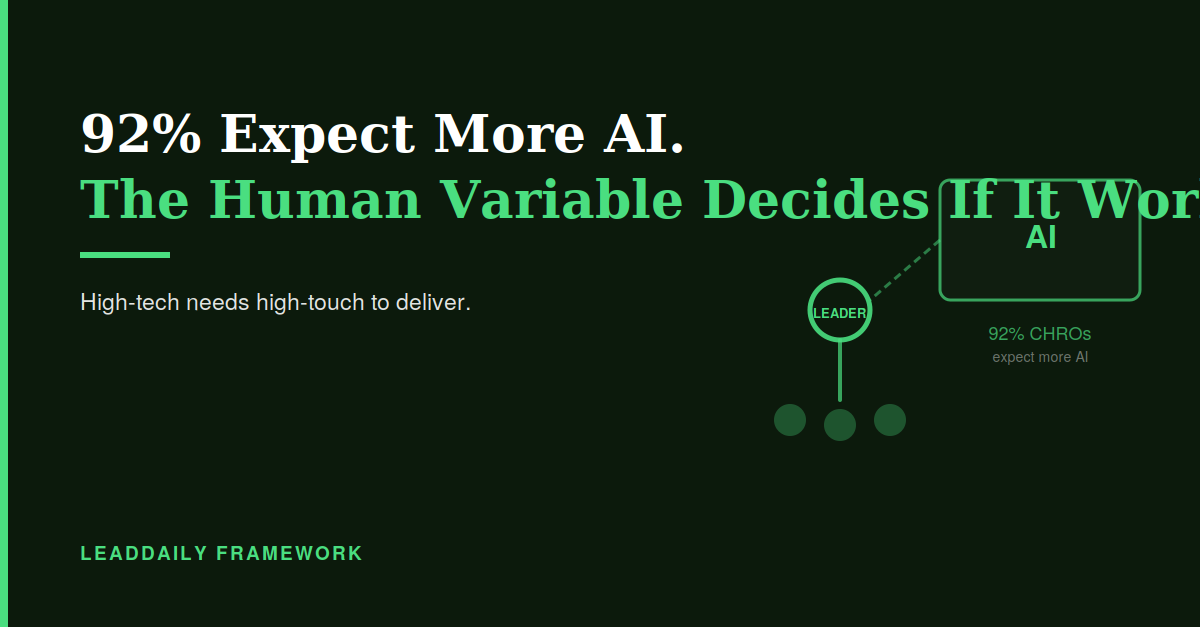
SHRM’s 2026 CHRO Priorities and Perspectives report found that 92 percent of CHROs anticipate greater AI integration in workforce operations, while 84 percent expect upskilling in AI-specific skills to increase. These are near-universal expectations. And they align with what every major technology vendor, consulting firm, and business publication is saying: AI integration is not a question of if, it is a question of how well.
The “how well” question is where the research diverges from the expectation. Because the evidence is consistent and specific: the variable that most determines how well AI integration produces the outcomes it was funded to produce is not the quality of the AI. It is the quality of the human leadership surrounding it.
What SHRM’s own data says about the human side
SHRM’s 2026 research is direct: the true engine of organizational resilience remains human leadership and culture, not the technology itself. By balancing high-tech tools with high-touch leadership, organizations can build the resilience to thrive. The phrase “high-tech needs high-touch” sounds like a slogan. In practice, it describes a specific organizational design challenge: deploying AI at scale requires a management layer capable of championing adoption, modeling use, setting quality standards, and supporting their teams through the behavioral changes that genuine AI integration demands.
Most organizations are investing heavily in the high-tech half of that equation. The high-touch half — developing the human leadership that makes AI integration actually work — is receiving a fraction of the same attention.
The specific ways human leadership determines AI outcomes
Three human leadership behaviors are the decisive variables in AI integration success. The first is manager-led adoption: as Gallup’s 2026 research shows, employees whose manager actively supports AI use are 8.7 times more likely to say AI transformed their work. No technology deployment produces an 8.7x multiplier. Manager behavior does.
The second is quality standard-setting: a manager who defines and enforces what good AI-assisted output looks like creates consistent, reliable adoption across the team. A manager who leaves AI use undefined produces the uneven, self-taught adoption patterns that generate inconsistency and risk.
The third is change communication: the employees most likely to resist AI integration are those who received the least clear communication about why it matters for their specific role and team. That communication is the manager’s job — not the organization’s town hall, not the CEO’s letter, the direct manager explaining in their own words what this means for this team on this floor.
The development gap that makes 92% expect more of the same outcome
If 92 percent of CHROs expect greater AI integration and the human leadership layer that makes it work has not been meaningfully developed, the 2026 AI integration push will produce the same outcome as the 2024 and 2025 ones: high license costs, moderate adoption, and a significant gap between the transformation the investment was supposed to produce and the actual change in how work gets done.
The development investment that closes this gap is not expensive relative to the AI infrastructure it is designed to unlock. It is smaller, more targeted, and more behavioral than the platform purchase it supports. But it requires the same intentionality: specific managers developing specific behaviors, practiced daily, measured for outcomes rather than attendance.
The business case
Ninety-two percent of CHROs expecting greater AI integration is a consensus that represents trillions in technology investment across the global economy. The return on that investment — in every single organization — is determined by whether the management layer was developed to make it work.
So for every organization heading into another AI integration cycle: are you building the high-touch leadership capability that makes the high-tech investment pay off — or are you buying the technology and hoping the leadership figure it out?
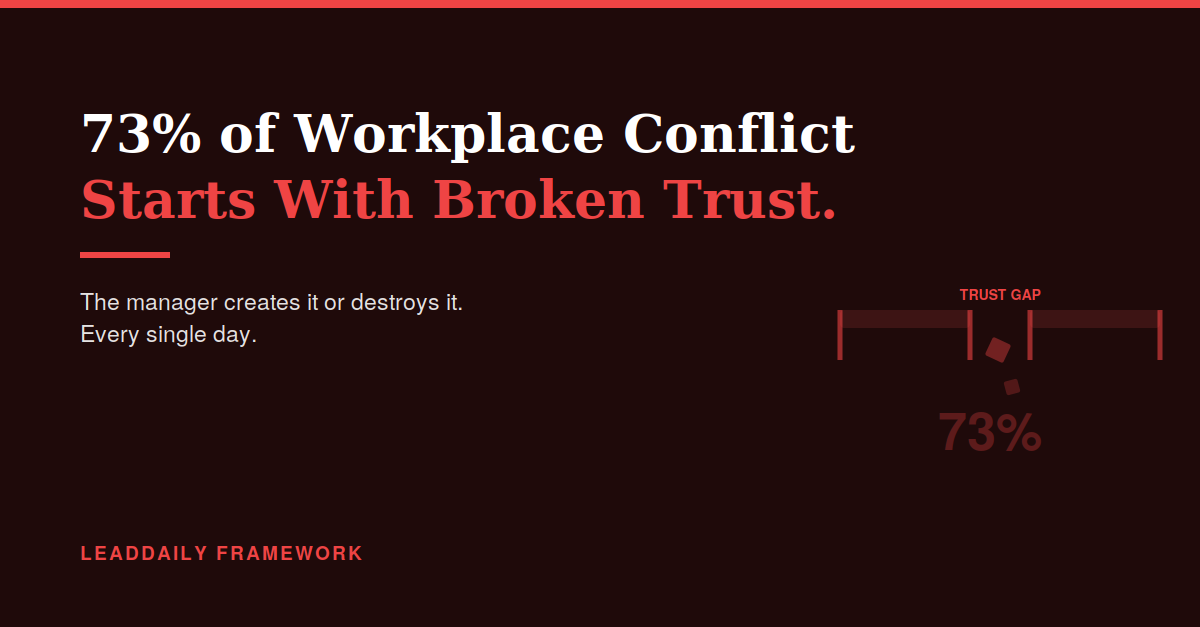
State of Conflict in the Workplace research, cited in 2026 leadership and mindfulness studies, found that 73 percent of employees identify lack of trust as the primary driver of workplace conflict — ahead of personality clashes, poor communication, and unclear expectations. Not behind those things. Ahead of them.
This means that for nearly three quarters of the employees in any organization experiencing significant workplace conflict, the root issue is not that people dislike each other or cannot communicate. It is that they do not trust each other — and specifically, that they do not trust the system, the decisions, or the manager who represents both.
Trust is the medium through which every other management behavior travels. Clear expectations delivered by a manager who is not trusted are resisted, not followed. Feedback from a manager who is not trusted is defended against, not absorbed. Accountability from a manager who is not trusted feels punitive, not developmental. The management skill set is only as effective as the trust relationship it operates within.
What trust actually is in a management context
Trust is not a feeling. It is a behavioral prediction. When an employee trusts their manager, they are predicting that the manager will do what they say, treat them fairly, use information they share appropriately, and advocate for them when it matters. Every one of these predictions is based on observed behavioral evidence, accumulated over time.
This means trust is not built through communication campaigns or values exercises. It is built through the accumulation of small, repeated behavioral moments in which the manager’s action matches their word: the deadline they said they would meet and did, the feedback they said they would give and gave, the person they said they would support and supported.
And it is destroyed through the same mechanism in reverse: the commitment made and quietly abandoned, the feedback promised and never delivered, the advocacy pledged and absent when it was needed. One broken commitment does not destroy trust. Ten broken commitments, each individually minor, erode it to a point where conflict becomes the default mode of the relationship.
The specific behaviors that build trust daily
Research across multiple studies identifies three behavioral patterns that build trust consistently in management relationships. The first is follow-through consistency: doing what you said you would do, specifically and on the timeline you committed to. Not approximately. Specifically.
The second is transparent reasoning: communicating the rationale for decisions, including the tradeoffs considered and the constraints operating, so that employees understand not just what was decided but why. Trust does not require that employees agree with every decision. It requires that they believe the decision-making process was genuine.
The third is advocacy under pressure: visibly supporting team members when it would be easier to distance from them. The manager who defends a team member’s decision when that decision is challenged above, rather than quietly allowing it to be overridden, builds a specific and durable trust that no other behavior can replicate.
Where AI fluency connects to trust
A manager who is AI-fluent and uses it visibly, who explains why AI is being used and what standards apply to its outputs, and who is transparent about the limitations of AI-assisted decisions builds trust with a workforce that is watching closely for whether AI is being used thoughtfully or as a shortcut that bypasses human judgment. Transparency about AI use is not just ethical practice. It is trust-building behavior.
The business case
Seventy-three percent of workplace conflict driven by lack of trust is 73 percent of conflict that is not primarily about the presenting issue. It is about a broken or absent trust relationship between the people involved and the systems they operate within. The most efficient conflict reduction strategy in any organization is not conflict resolution training. It is trust-building development for every manager in the organization, built into daily practice, measured for behavioral outcomes.
So the question for every leader whose team is experiencing more friction than performance right now: is the problem the conflict — or is it the trust that was never built?







 Most leadership training is forgotten after the seminar.