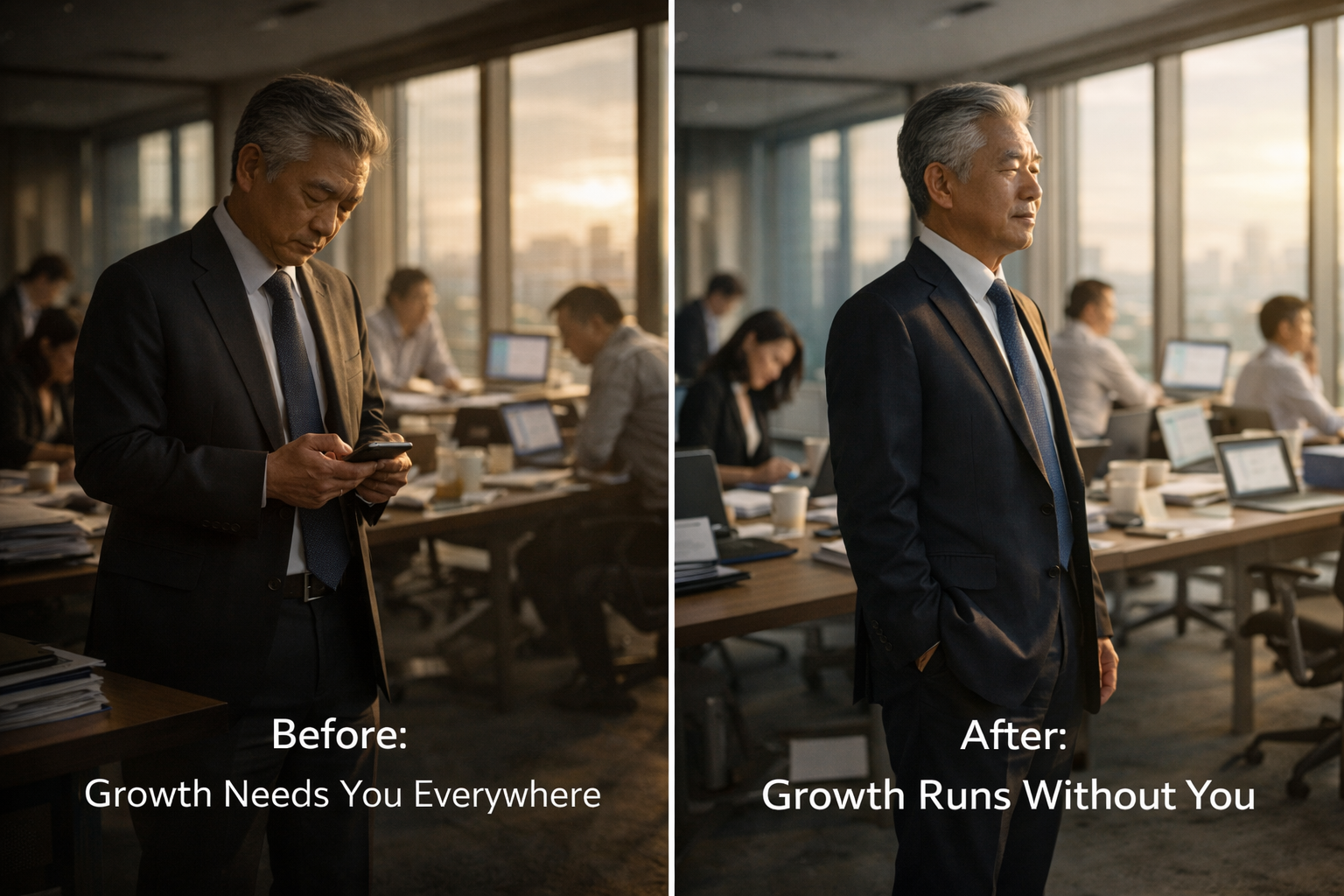
What Finally Happens When the Business Starts Running Without You

The first sign something changed wasn’t dramatic.

No big announcement.
No sudden jump in revenue.
No flashy new system.

It was quieter than that.

The leader noticed fewer questions landing on his desk. Fewer follow-ups. Fewer messages asking for clarification. Meetings started ending early—not because people rushed, but because there was nothing left to explain.

For the first time in a long while, the business moved without him pushing it.

That’s the “after” most leaders secretly want—but rarely experience.

Before that point, the business looked successful on the outside. Clients were coming in. The team was growing. Revenue was steady.

Yet inside, everything depended on the leader.

Decisions waited.
Work slowed when he was unavailable.
Small issues escalated quickly.
Everyone meant well—but nothing moved without direction.

This wasn’t control. It was dependence.

The leader didn’t plan it that way. It happened slowly, as businesses usually do. Small adjustments. Extra approvals. More check-ins. A few “just to be safe” steps added along the way.

The business kept growing.
The leader kept carrying more.

Until growth stopped feeling exciting and started feeling heavy.

That’s when the question changed.

Instead of asking, “How do we grow faster?”
He asked, “Why does everything still need me?”

That question changed everything.

The problem wasn’t effort. People were working hard.
The problem wasn’t trust. Everyone was capable.

The problem was that work had no clear flow.

Tasks depended on memory.
Updates depended on reminders.
Decisions depended on availability.

The business didn’t have a system. It had habits.

So instead of adding more people or more tools, the leader did something uncomfortable.

He started removing things.

Meetings that existed only for updates were cut.
Approvals that didn’t change outcomes were dropped.
Repeated tasks were simplified or allowed to move on their own.

Nothing fancy. Just fewer steps.

At first, the team was unsure.

“Are you sure we don’t need to check this?”
“Should we wait for approval?”
“What if something goes wrong?”

That hesitation was expected. The team had been trained to wait. But slowly, something changed.

Work stopped stalling.
People acted without asking.
Decisions were made once—and stuck.

The business became quieter—but more effective.

This is the “after” leaders rarely talk about because it doesn’t sound exciting.

No hustle.
No urgency.
No drama.

Just progress.

Clients noticed it first.

Responses were faster.
Mistakes dropped.
Deliveries were more consistent.

Then the team felt it.

Less chasing.
Less rework.
More confidence.

And finally, the leader felt it.

Time opened up.
Thinking replaced reacting.
Growth felt manageable again.

The business didn’t need him everywhere anymore—and that was the point.

This “after” state doesn’t come from working harder. It comes from letting go of work that shouldn’t exist.

When routine tasks stop depending on people pushing them forward, everything else speeds up naturally. Leaders stop being the engine. Teams stop waiting. Systems start doing their job.

This doesn’t mean leaders disappear. It means they finally lead where it matters.

The biggest shift is psychological.

Leaders realize that control doesn’t come from being involved in everything. It comes from designing work so things move correctly without constant attention.

That’s the real outcome most leaders are chasing—whether they say it out loud or not.

A business that grows without draining them.
A team that moves without waiting.
A system that doesn’t fall apart when they step away.

This is the “after” state that makes growth sustainable.

The irony is that getting here often requires doing less, not more.

Less checking.
Less approving.
Less fixing.

And more clarity.

If your business still depends on you to function, the problem isn’t leadership. It’s flow.

Fix the flow, and something powerful happens: the business finally starts working with you—not against you.

Now here’s the question worth ending on:

If the business could run well without you for a week, what kind of leader would you finally get to be?

Why Your Best People Are Always Busy—but the Business Still Feels Stuck

The problem didn’t show up overnight.

At first, it felt like growth.

More clients.
More messages.
More meetings.
More updates.

Your team looked busy—very busy. Everyone was working hard. Calendars were full. Tasks were moving. From the outside, the business looked successful.

But as the leader, you felt something wasn’t right.

Decisions took longer.
Small issues kept landing on your desk.
People waited instead of acting.
You were involved in things you shouldn’t even be seeing anymore.

The business wasn’t broken.
But it wasn’t moving as smoothly as it should.

This is the problem many company leaders face once they grow past a certain size. Not chaos. Not failure. Stuck momentum.

And it’s dangerous because it’s easy to ignore.

You tell yourself, “We’re just busy.”
You say, “This is part of growth.”
You assume, “Once we hire more people, it’ll get better.”

But it usually doesn’t.

Here’s the truth most leaders eventually realize: your people aren’t the problem. The way work moves is.

Let me tell you a familiar story.

A founder I worked with ran a growing professional services firm. Smart team. Good clients. Solid reputation. Revenue was climbing.

Yet every week felt heavier.

She was approving things that should’ve been decided lower down. She was asked the same questions repeatedly. Reports arrived late. Follow-ups were constant. She felt like the business couldn’t move unless she pushed it.

When we talked, she said something that stuck:

“I feel like I’m running faster just to stay in the same place.”

That’s not a motivation issue.
That’s not a talent issue.

That’s an efficiency issue hiding in plain sight.

As companies grow, work quietly becomes messy. Tasks pile up. Steps get added “just in case.” Updates are done manually. People double-check everything. Meetings exist because clarity doesn’t.

No one planned it that way. It just happened.

Over time, your best people spend more time coordinating work than doing meaningful work. And you, as the leader, become the safety net for every unclear step.

This is where many leaders make a common mistake: they push people harder.

They ask for faster replies.
They demand more accountability.
They add more meetings.

But pushing harder on a messy system only creates more noise.

The smarter move is to clean the system, not exhaust the people.

This is where a simple shift changes everything.

Instead of asking, “Why are people slow?”
You ask, “Why does this task need so many steps?”

Instead of asking, “Why do I need to approve this?”
You ask, “Why isn’t this decision already clear?”

Instead of asking, “Why does this take so long?”
You ask, “What part of this should not need a human at all?”

When leaders start asking these questions, something interesting happens.

They realize that a big chunk of the work their teams do every day is repeatable. Predictable. The same steps, over and over again. Copying information. Sending reminders. Updating lists. Preparing the same reports.

None of it requires deep thinking.
But all of it consumes time.

This is where simple automation makes sense—not fancy tools, not complicated systems. Just letting routine work move on its own instead of passing through people.

In that same firm, we started small.

We looked at how work came in.
How it was tracked.
How updates were shared.
How decisions were escalated.

Then we removed unnecessary steps.

Updates stopped being chased.
Reports stopped being manually prepared.
Simple decisions stopped going to the founder.

Nothing dramatic. Just cleaner flow.

A few weeks later, the founder said something unexpected:

“I feel lighter. The business finally moves without me pushing it.”

That’s the outcome every decision-maker actually wants.

Not more dashboards.
Not more tools.
Not more staff.

Just a business that runs without constant effort.

The real win isn’t saving time for the sake of time.
The real win is getting your thinking time back.

When routine work moves on its own, leaders stop firefighting. They focus on growth, relationships, strategy, and direction. Teams act with confidence instead of waiting. Clients feel faster service without extra cost.

This is how companies become competitive—not by working longer hours, but by removing unnecessary work.

The uncomfortable truth is this: most growing companies don’t need more people. They need less friction.

And friction hides in places leaders rarely look—between steps, between handoffs, between “this is how we’ve always done it.”

That’s why the smartest starting point isn’t buying another tool.

It’s stepping back and asking:

Where is time being wasted?
Where are people repeating the same work?
Where am I involved only because the process isn’t clear?

Once you see that clearly, the fixes become obvious—and often surprisingly simple.

So if your business looks busy but feels stuck, don’t assume something is wrong with your people.

Chances are, the system just needs to be cleaned up.

And once it is, you may find that growth finally feels the way it’s supposed to—lighter, calmer, and under control.

Now here’s the question worth sitting with:

If your best people got five hours back every week, what would your business finally be able to do?

9 Lessons I picked up along the way to my 50’s

My knowledge of the world and life has gradually changed. The world as I saw it in my 20’s, 30’s, 40’s are now more insightful. Growing up was not a walk in the park for me. Dozens of curveballs were thrown my way and I did not even have a proper glove to catch them.

This second lock-down has given me time to assess how I view life. I wrote down the lessons I learned along the way. I hope that these lessons are similar to yours if you are around my age. I hope that these lessons help the millennial readers in their quest for a meaningful life. I hope that my children also benefit from this and recalibrate the way they live their life.

The following lessons are not listed in any particular order.

1. Opportunities come from God through the people around you.
Growing up without a proper college degree was a challenge only to a certain degree. As I look back, a pattern emerges as I assessed the opportunities that opened up on my road to maturity.

When my dad left us and my mom kicked me out of our home at 18, it was a friend who took me in at 2 am. It was not easy for my friend to convince his controller father. Butch had to plead with his father to allow me to stay with them even for just a short while.

A few months later, a generous lawyer by the name of Atty. Antonio V. Agcaoili created a job for me even if he did not have an opening in his prestigious law firm. Atty. Agcaoili paid me to photocopy legal documents for the other lawyers in his firm. There was no job opening since it was the lawyer’s secretary’s job to do the copying. Atty. Agcaoili graciously created a job for someone he just met.

Years later, working for a Bank abroad, I was regularly promoted to a position where I did not know anything about. My direct manager and COO David Jones would always say I can always learn the technicalities of the work. He also gave me the time and resources to learn the ropes of my new role. He personally walked me through the major processes of the new function I am managing. He also advised me whom to reach out to for more technical details.

The CEO of a diversified retail company in the country gave me the opportunity to do my training and consulting work for one of his companies after meeting him twice. He is a remarkable Christian who grew his company from one to over a dozen businesses in less than 18 years.

There are still dozens of instances of opportunities presented by God through the people around me. The lesson? Be transparent and kind to the people around you. Who knows? They may be the source of your next opportunity.

2. Count your blessings.
Growing up I was allergic to nay-sayers or negative-minded people. They would always rant and complain about life. If you ask them what they are doing about it, the answer is ‘nothing.’ Life is already very challenging for me growing up. I did not want to get burdened by the negative thinking of these people. As the saying goes misery loves company.

When faced with difficulties, we always have two choices. Do we complain about it? Do we count our blessings and take it that it’s another blessing in disguise?

We do not have full control over the events of our lives. However, we have full control of how we will respond to it.

3. Value true friends.
I often hear others bragging that they have a lot of friends. It’s an interesting point of view. Do you really want to have a lot of friends? Do they really consider you as a friend? Friendship is an unwritten agreement from both parties to be there for each other through thick and thin.

I may not be as lucky as these people with lots of friends. In fact, I am lucky because I have a lot of acquaintances and a few really great friends. Friends that stick with me through the best and worst of times. Friends that I can count on. Friends drop by just to hand you a BFF Shake Shake fries from McDonald’s. Friends pray with you in times of challenges. Friends that laugh and have meals with you. Friends that reply to your messages.

For the rest. Well, they are acquaintances. Some of my good acquaintances show up now and then. Other acquaintances, you meet once and never see or hear from again.

4. Stay optimistic.
Optimism is not the denial of reality. It is okay to acknowledge that times are hard. However, believe that the future will be better. Optimism is anchored in hope. Hope for a better future. Hope chosen over fear is optimism.

The source of hope is faith. It is our faith in our God that He will never forsake us.

Be optimistic regardless of your situation. Stay hopeful and have faith in God.

5. Always be kind.
Huge egos and pride are the enemies of kindness. Sometimes, we allow our egos to get the better of us. Sometimes, in order for us to prove we are right, we run over others to prove they are wrong. At times, it’s even done publicly. In our quest to be right, the public has to see that someone else was wrong.

What we don’t see is the repercussion of our actions. The humiliated victim will start to fear expressing ideas and suggestions. They begin fearing the possibility of being publicly ridiculed for a question or a mistake. Respect is unfortunately replaced by fear.

Others who witnessed the event or even heard about it will start fearing for their reputations as well. After all, who wants to be at the center of a public verbal beating.

God has given us the ability to chose. Do we chose to be right and show others that someone else was wrong? Do we chose to be kind and possibly correct the situation in private. The correction can be done in a private setting. A gentle tone and a clear intention for development will go a long way. Respect is not replaced by fear. Actually, respect grows exponentially. Ideas are also shared more freely next time

Being kind is a choice.

6. Create memories.
After hitting my 50’s I came to realize that as we grow older the memories I have become more important. Recalling them makes my heart smile.

When I see Facebook memories popping-up in my timeline, I recall the day the picture was taken. I get a sensation of what I felt that day. I get to go back in time, if only for a few seconds. A photo of my family in Thailand, a photo of my son taking up archery six years ago, a photo of my son dancing while eating his Ramen.

Sometimes, I get a LinkedIn message from colleagues in my past corporate life. They would reminisce about the old days when we worked together for the same department. When I see my photos in a suit with the other executives of NCB, it makes me recall my discomfort. I was never comfortable in a suit. I also got a bit nervous talking to our CEO and CFO in those days.

7. Share your story.
Our lives are made up of stories. We are made up of good stories and the lessons we learned from not-so-good stories. It is in our DNA to share and listen to stories. Stories were the only way of passing on historical events and knowledge in the old days. This eventually became hardwired in us through the years.

It is our duty to share our stores with others. We need to pass on the lessons we learned so they would benefit from it as well. There is nothing more powerful than a lesson shared in the form of a story. Lessons that are embedded in a story have a tendency to stick. They are recalled even after years pass by.

I always make sure to wrap my workshop lessons in stories. The participants may not recall everything I talked about but they will definitely recall the stories.


Share your stories with your loved ones and your friends. That’s our simple way of leaving behind bits and pieces of our legacy.


8. Build up, people.
It does not matter if you are a leader, a manager, a husband, wife, colleague, father, child. It is our duty to build up others. The wider our influence, the more meaningful this responsibility gets.

Going back to Atty. Agcaoili. I tried to look for him upon returning to the Philippines after working 20 years abroad. I searched for him on LinkedIn. I did not find him. I found his son Atty. Agcaoili Jr. instead. I copied the office phone number and called his son.

It was unfortunate that lung cancer has taken his Dad in his 50’s. I shared with his son what his dad has done for me. I told him that I was truly grateful for his father’s kindness. His father was instrumental in helping me build my life. Atty. Agcaoili Jr was thankful.

His son was surprised that hundreds of people called in or visited their office after his father died. Literally, hundreds of people owe his father a debt of gratitude for the kindness he extended to them. His father made sure to build up the lives of his employees. He even went to the extent of helping build up the lives of people outside the firm. That is a legacy that his family will always remember him for.

9. Ask questions if you don’t know the answer.
A brief video clip of the famous author Simon Sinek was hilariously compelling. It’s titled ‘Be the idiot’. I recommend that you search and watch it on YouTube.

The lesson is that it’s okay not to know everything. It is okay to ask questions. It is okay to be an idiot. If people put you down for asking, do not mind them. You were silly only for 30 seconds. If you had not asked, you would have been silly for the rest of your life. You would not have known the answer to your question.

The former CEO of NCB hails from Harvard. He was the youngest CEO of the Bank. I was at a Microsoft presentation with him years ago. We also had several other Vice Presidents in the same room. Half an hour into the technical presentation of Microsoft executives, Abdulkarim our CEO, stood up. He politely asked a question to the Microsoft executive leading the presentation.

“What do you mean by Domain Server?” Abdulkarim asked. The Microsoft executive, sporting a blue suit, paused his slides. It took him a few seconds to process the question of our CEO. He then proceeded to explain what a Domain Server is in layman’s terms. As I glanced around the room, it was clear that most of the VP’s had the same question in mind. However, none of them took the risk of looking silly by asking a question. They all nodded throughout the presentation pretending they understood every single detail that came out of the presenter’s mouth.

After the workshop, I thanked Abdulkarim in private for asking the question. I mentioned that clearly, it was a question in everyone’s mind that nobody dared to ask.

Abdulkarim, in his steady slow voice, said that while he was studying at Harvard one thing he learned was that nobody knows everything. There was no shame in asking a question. Before you ask a question, you are silly for not knowing the answer. After you get the answer, you are not silly anymore. If you do not ask a question because your pride prohibits you then you are silly for the rest of your life.

Go ahead. Ask questions for things you don’t know. It does not matter what people think.

If you have questions regarding anything I shared here, go ahead and feel free to reach out to me.

Have a great day and stay safe.


Jordan Imutan
www.servantleadrsph.com
jordan@imutan.com
+63.917.518-3554