Why Good Leaders Burn Out — And How to Fix It Before It Happens

The Silent Crisis Behind the Desk

Have you ever met a good leader who suddenly burned out?

Maybe they were once passionate, hands-on, and deeply invested in the team’s success. But over time, something changed. They became reactive instead of proactive. They stopped showing up early. They avoided tough conversations. And eventually, they checked out—either emotionally or by quietly resigning.

This isn’t rare.

In fact, a Gallup study showed that 70% of the variance in team engagement is directly linked to the manager. And when the manager is burned out, the ripple effects can damage not just performance—but culture, trust, and retention.

But here’s the problem: most leadership training programs never address the inner rhythm of the leader. They focus on what leaders must do but rarely teach them how to sustain themselves while doing it.

That’s what we’ll fix in this article.


Why Leaders Burn Out (Even the Good Ones)

Burnout doesn’t start with bad leaders. It usually starts with the good ones.

They care. They go the extra mile. They carry the pressure for the team. But over time, they:

  • Take on too many tasks because it’s “faster if I just do it myself”
  • Have no time to reflect or step back because they’re “always needed”
  • React to problems constantly, instead of building rhythms to prevent them
  • Sacrifice their own development to attend to everyone else’s needs

The outcome? They stop growing. They lose clarity. And their motivation quietly drains away.


The Real Fix: Leading with Rhythm, Not Just Responsibility

What most leaders lack isn’t capability. It’s rhythm.

They need a new way to structure their leadership weeks and build micro-habits that sustain their energy, focus, and clarity. That’s what we teach inside LEAD360™ — a 2-day leadership training built for today’s challenges.

One of the most powerful tools we introduce is the Leadership Rhythm Map. It’s a simple system that answers this question:

“What must be on your calendar every single week to protect your energy and multiply your impact?”

Let’s break it down.


The 4R Weekly Rhythm Model

We train leaders to design a week that balances four types of leadership activity:

1. Review (Reflect + Reset)

  • When? 30 minutes every Monday morning or Friday afternoon
  • Purpose? To evaluate what worked, what didn’t, and what to adjust
  • Questions to ask:
    • What drained me last week?
    • What gave me energy?
    • What’s my single most important focus for this week?

⚡ Leaders who skip reflection are doomed to repeat burnout cycles.

2. Rhythm (Recurring Cadences)

  • When? Weekly team meetings, check-ins, or department huddles
  • Purpose? To set expectations, prevent fire-fighting, and ensure alignment
  • Tip: Make your recurring meetings sacred. Cancel them only in emergencies.

📌 Predictable rhythms reduce anxiety and increase clarity.

3. Recharge (Protect Energy)

  • When? One block of 60 minutes per week minimum
  • Purpose? To do deep work, journal, plan, or simply breathe
  • Ideas: Go for a walk. Write in a journal. Watch an inspiring video.

✨ Great leaders protect thinking time. They don’t fill it with noise.

4. Reach (Grow + Learn)

  • When? Once per week for at least 30 minutes
  • Purpose? To invest in your own growth
  • Options:
    • Watch a leadership video
    • Listen to a podcast
    • Read a chapter of a book
    • Join a leadership huddle or training

🚀 Growth must be scheduled. If you don’t reach out, you stagnate in.


Case Study: How a Burned-Out Manager Reclaimed Clarity

Maricel, a senior team leader in a logistics company, joined LEAD360™ with one clear symptom: she was always tired.

She wasn’t lazy. In fact, her team said she was the most hardworking manager they’d had. But she was doing everything. From solving conflicts to reviewing reports, even micromanaging tasks. Her calendar was packed—but her results were thinning.

After Day 1 of LEAD360™, she learned to design her week using the 4R Rhythm Model. She blocked out Monday mornings for review. She moved all team huddles to Wednesdays to reduce interruptions. And she began scheduling one lunch break a week as “Recharge Time” away from her screen.

After just 30 days, she told us:

“I’m no longer chasing the day. I’m leading the week.”

Her team began taking more ownership. Her energy improved. And her director noticed the change.


The Connection Between Rhythm and Retention

Let’s be clear: when a good leader burns out, the team suffers.

People start looking for jobs not because of salary or workload alone—but because they see their manager cracking.

That’s why investing in leadership rhythm training isn’t a luxury. It’s a culture safeguard.

When your leaders lead with rhythm:

  • Your people feel more stability
  • Meetings have purpose
  • Priorities get clearer
  • Emotional tone improves
  • Retention goes up

And here’s the big insight:

You don’t need more time. You need more rhythm.


LEAD360™: Where This Transformation Begins

LEAD360™ is our signature 2-day training designed for managers who are:

  • Great at execution, but exhausted
  • Stuck in reactive mode
  • Losing top performers because of unintentional habits
  • Ready to grow from manager to leader

We don’t just give you theories. We train you to build habits. Rhythms. Systems that you take back to your team immediately.

Each participant leaves with a 90-day SPRINT Plan™, accountability support, and a toolkit of frameworks like:

  • 3R Lens™: For self-awareness
  • C3 Feedback™: For building trust
  • STABLE™: For emotional control
  • CORE™: For leading with clarity, not control
  • 4R Rhythm™: For sustainable leadership

Your Next Step

If you lead a team, or if you want to protect your managers from silent burnout, there’s never been a better time to act.

Don’t wait until the signs are too clear. Don’t let your best people quietly check out.

Help them lead with rhythm. Help them stay in the game.

📩 Email Carl today to explore a session for your team: carl@axelgabmc.com | 0966.507-9136


What part of your weekly leadership rhythm needs to change first?

#LEAD360 #LeadershipBurnout #LeadershipRhythm #LeadWithEnergy #PhilippineLeadership #TeamRetention #SustainableLeadership #ManagerToLeader #LeadershipTrainingPH #LeadershipFrameworks

The Hidden Cost of ‘Pwede Na’: How Mediocre Marketing Hurts Your Brand More Than You Think

POC CLICK – your Agile Digital Marketing partner


The Problem: “Pwede Na” Isn’t Just Lazy—It’s Expensive

In Filipino culture, the phrase “Pwede na ’yan” is often used to settle for something that’s good enough—but not great. While this might work in casual situations, it’s a dangerous mindset when applied to your marketing.

Here’s why:
According to a study by Stanford University, people form a first impression of your brand within 50 milliseconds—that’s less than one blink.

Meanwhile, Adobe’s research shows that 38% of users will stop engaging with content if it’s unattractive or poorly designed.

So what happens when your posts, visuals, or ads look rushed, generic, or off-brand?

You lose:

  • Trust
  • Interest
  • And most importantly—business.

Let’s break free from “pwede na” and raise the bar with a better standard for your brand.


The CARE Framework™

A simple method to help you and your team remember what quality marketing should stand for:


C – Consistency Builds Trust

Inconsistent messaging, fonts, colors, or tone confuse your audience. And confusion leads to disconnection. People trust brands that show up the same way every time.

✅ Ask Yourself: Does every post reflect the same professional, polished voice and look?


A – Attention to Detail Matters

Sloppy captions, pixelated photos, and unbalanced layouts might seem small—but they scream “we don’t care.”
Every detail is a reflection of your standards.

✅ Ask Yourself: Would you buy from your own brand based on what you’re posting?


R – Relevance Keeps You Connected

Recycled templates and outdated messages won’t connect with today’s fast-moving market. Your audience wants content that feels current, intentional, and made for them.

✅ Ask Yourself: Is this content created with your audience’s needs in mind—or is it just filler?


E – Excellence Inspires Action

When something looks and sounds great, people respond. Whether it’s a share, a comment, or a sale—excellence moves people. Lazy marketing, on the other hand, gets ignored.

✅ Ask Yourself: Is this the kind of content your competitors would be jealous of—or would they laugh at it?


The Real Cost of Settling

Here’s what usually happens when you stick with “pwede na” marketing:

  • Your brand looks cheap even if your products or services aren’t
  • People stop engaging because your content looks like everyone else’s
  • You get low ROI from paid ads because poor creatives won’t convert
  • You work harder just to stand out because your visuals are pulling you down

And over time, this slowly erodes your credibility—especially if a competitor is doing it better, faster, and with more polish.


How POC CLICK Helps You Break Free from “Pwede Na” Marketing

At POC CLICK, we help brands look and sound like they actually care—because we do.

We offer:

  • Custom-made designs with your brand voice in mind
  • Timely execution so you don’t miss important marketing windows
  • High-quality copywriting that converts, not just fills space
  • Creative strategies tailored for results—not recycled from templates

You don’t need to spend millions to look premium—you just need a partner who refuses to settle for “pwede na.”


Training Exercise: Audit Your Last 5 Posts

Take a few minutes and check the last five marketing materials your brand has released. For each one, ask:

  • Is this content consistent with our brand look and tone?
  • Was it done with attention to detail or rushed just to meet a deadline?
  • Does it feel relevant to our target market right now?
  • Is this the level of excellence I want to be known for?

If even one post makes you uncomfortable, it’s time to take action.


Final Thought: You Deserve More Than “Pwede Na”

Your brand is the face of your business. And when your content doesn’t reflect your standards, people notice—even if they don’t say it.
If you’re tired of seeing underwhelming results from underwhelming execution, we’re here to help.


Is your brand silently suffering from “pwede na” marketing?

📩 Let’s talk about your marketing challenges.
Contact Carl at carl@axelgabemc.com | 📞 0961.595-0165

POC CLICK – your Agile Digital Marketing partner.

From Delays to Results: Why Speed Is the New Competitive Advantage in Marketing

POC CLICK – your Agile Digital Marketing partner


The Real Problem: Speed Isn’t a Luxury—It’s a Necessity

Did you know that the average human attention span is now just 8 seconds? That’s even shorter than a goldfish’s. In a digital world where people scroll through hundreds of posts daily, your message must show up fast—and hit hard.

Here’s a scarier number:
63% of marketers say their biggest problem is delayed campaign launches.
(Source: HubSpot, 2023)

Every delay hurts. You’re not just wasting time—you’re losing leads, visibility, and revenue. And worst of all, many businesses don’t even realize that their own marketing agency is part of the problem.


The FAST Framework™

A simple way to remember what great, timely marketing should look like


F – Focus on Results, Not Just Effort

It’s not enough for your agency to say, “We’re working on it.” They need to show how their work drives results—more traffic, more engagement, more sales. If all you’re seeing are nice designs with no performance, something’s wrong.

Ask yourself:
Are your current campaigns tied to real business goals?


A – Act With Urgency

In digital marketing, timing is everything. A campaign that launches next week may already be too late. Whether it’s a new product, a flash sale, or a trending topic—your brand needs to move quickly.

Ask yourself:
Are your campaigns going live when you need them—or always after?


S – Simplify the Process

You shouldn’t have to go through five revisions just to post a single ad. Endless back-and-forth and unclear communication drain your energy and delay progress. A good agency keeps things clear, simple, and moving.

Ask yourself:
Is your agency making the process easier—or slower?


T – Take Ownership

You’re busy running a business. You shouldn’t have to chase your marketing agency for updates or remind them about deadlines. A real partner takes initiative and keeps you updated, not the other way around.

Ask yourself:
Are you leading your agency—or are they leading you?


What Delays Are Really Costing You

Let’s break it down plainly.

When campaigns are late, you miss key moments in your market. If you’re slow to post, your competitors get the clicks first. If your content isn’t ready, you disappear from your customers’ feed. If your team is always fixing poor work, that’s energy taken away from growth.

Over time, these delays cost you:

  • Missed sales opportunities
  • Weaker brand presence
  • Lower trust from your audience
  • A drop in overall momentum

Marketing isn’t just a task on your to-do list—it’s the voice of your business. When that voice is late or off-brand, people notice. And they move on.


The Solution: Work With a Marketing Partner That Delivers Fast and Smart

At POC CLICK, we don’t believe in dragging timelines or vague promises. We believe in fast, agile, and results-driven marketing.

Here’s what makes us different:

  • We move quickly—most campaigns are built and launched in days, not weeks.
  • We hit the mark without needing constant revision.
  • We stay in touch and take initiative so you don’t have to follow up.
  • We create content that speaks to your customers and supports your goals.

You get speed, quality, and accountability—all in one team.


Let’s Train Your Mind to Spot the Bottlenecks

Here’s a simple 3-step activity:

  1. Think of your last three marketing efforts.
  2. Ask: How long did each one take to go live?
  3. Now ask: Did the result match the time and effort spent?

If those answers leave you feeling frustrated or unsure, it might be time to look for a better way to market.


Final Thought: You Can’t Afford to Be Slow Anymore

In today’s digital world, being late is the same as being invisible.

Speed is no longer just a nice-to-have—it’s the edge that sets you apart. You need a marketing team that not only understands this but is built around it.


Is your marketing moving you forward—or making you wait?

📩 Let’s talk about your marketing challenges.
Contact Carl at carl@axelgabemc.com | 📞 0961.595-0165

POC CLICK – your Agile Digital Marketing partner.

How to Turn Strategy Into Daily Action: The Power of 90-Day Plans and Weekly Rhythms

By Jordan Imutan
Leadership and Execution Consultant | Creator of STRIDES™


Great Strategy Means Nothing Without Movement

You’ve got the strategy.
You’ve got the leadership team aligned.
You’ve even defined your top goals.

So why does your team still feel stuck?

It’s a painful truth for many businesses: even with a solid plan, execution falls apart.
The excitement of strategic planning fades… and day-to-day work goes back to business as usual.

In fact, a report by The Economist Intelligence Unit found that 61% of executives struggle to bridge the gap between strategy and day-to-day operations.

Another study from Bridges Business Consultancy revealed that only 10% of organizations successfully implement their strategies—the rest get lost in the execution fog.

So, how do high-performing organizations make strategy real?

They break it down into simple, time-bound actions—and they stick to a steady rhythm.

That’s where the power of 90-Day Plans and Weekly Rhythms comes in.


The Real Reasons Execution Breaks Down

Before we dive into the solution, let’s identify why execution fails even after a strong strategy:

❌ No clear plan of action

Teams leave a strategy meeting excited but don’t know what to do the next day.

❌ No short-term targets

Goals are set for the year, but there are no checkpoints in between.

❌ No accountability rhythms

There are no regular check-ins, updates, or feedback loops.

❌ No early wins

Without fast results, momentum dies—and so does morale.

The solution isn’t more meetings or complex dashboards.
It’s simplifying the path from strategy to daily execution.


✅ The STRIDES™ Solution: 90-Day Execution Plans + Weekly Rhythms

In the STRIDES™ Framework, the phase called “Implement with Impact” is where things start to move.

This is where strategy shifts from a presentation into real, measurable action across departments.

We help organizations use two powerful tools:

  • The 90-Day Action Plan: to drive focused, visible progress
  • The Weekly Rhythm: to build accountability and team momentum

Let’s explore how you can apply these tools in your organization.


🗓️ Step 1: Build a 90-Day Action Plan

🎯 Why 90 Days?

90 days is long enough to achieve something meaningful—but short enough to stay focused.

Teams can handle a 3-month push much more easily than a vague annual goal.

📋 What Goes Into a 90-Day Plan?

  1. Top 3–5 Strategic Initiatives
    These come from your company’s OKRs or top priorities.
  2. Milestones Per Initiative
    Break down each goal into 2–3 key deliverables within 90 days.
  3. Owners and Teams
    Assign clear accountability for each initiative and milestone.
  4. Success Metrics
    Define how you’ll measure completion (e.g., launch, revenue, usage, etc.)
  5. Risks and Enablers
    Identify potential blockers and support resources early.

✅ Sample Format:

InitiativeMilestoneOwnerDue DateStatus
Launch New ProductComplete MVPProduct ManagerJune 15🟡 On Track
Run pilot testQA TeamJuly 1🟢 Complete
Customer feedback loopSales LeadJuly 15🔴 Delayed

STRIDES™ Tip:
We give our clients a 90-Day Planning Canvas that simplifies this entire process in one working session.


🔄 Step 2: Establish a Weekly Rhythm

Strategy doesn’t fall apart in the planning—it falls apart in the follow-through.
That’s why weekly check-ins are the backbone of execution.

🔁 What is a Weekly Rhythm?

It’s a short, structured meeting where teams do three things:

  1. Review progress on 90-day milestones
  2. Identify what’s off-track
  3. Align on next steps and support needed

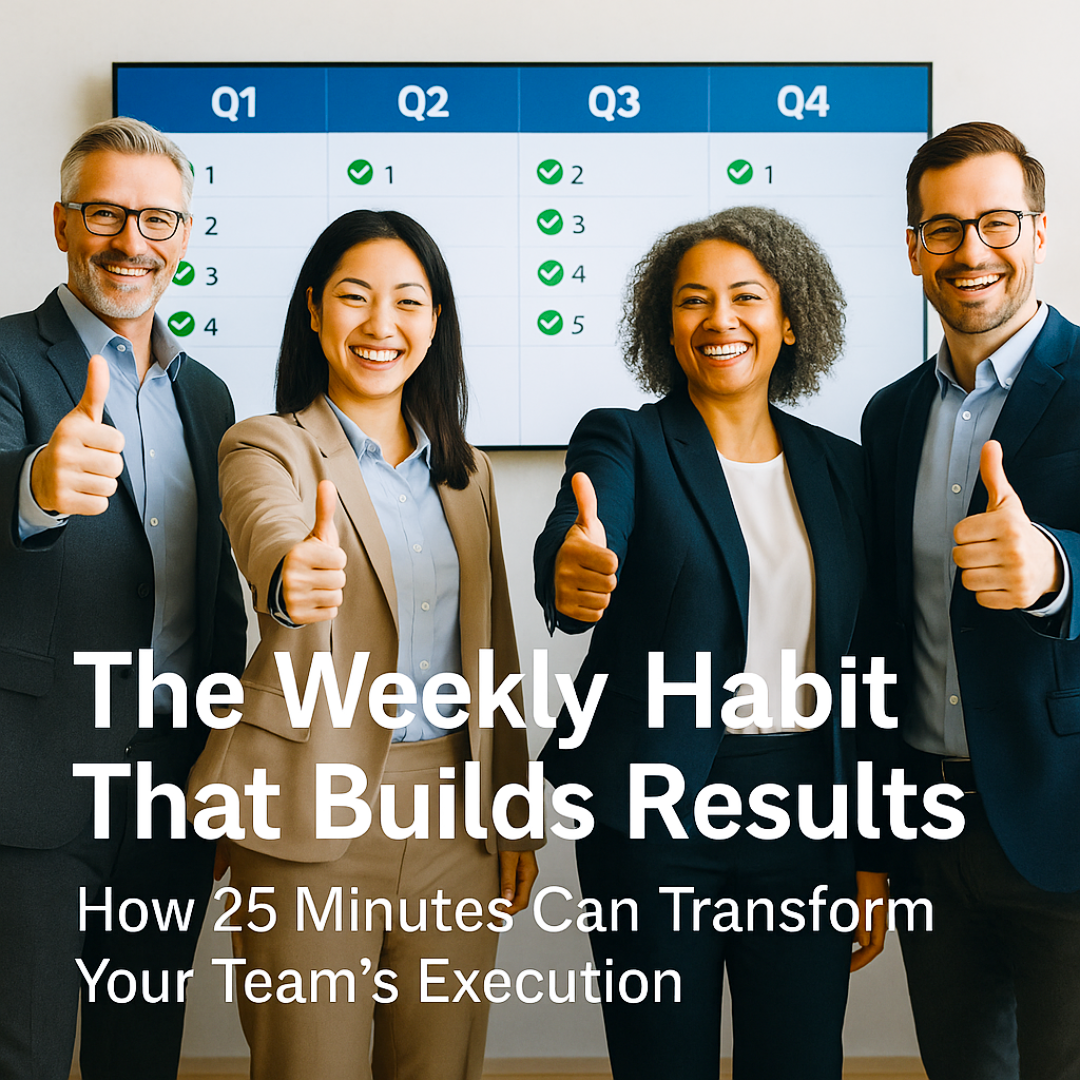
🕐 Sample Format: 25-Minute Weekly Execution Check-In

TimeTopicWho
0–5 minWins and progress updatesAll
5–15 minReview dashboard: What’s on-track, off-track, delayed?Team leads
15–25 minRemove blockers and agree on next week’s actionsProject heads

This meeting is not about firefighting.
It’s about keeping the strategy alive, week by week.

STRIDES™ Tip:
We help leadership teams install a Weekly Execution Board—digital or physical—so progress is visible and shared.


📈 Benefits of 90-Day Plans + Weekly Rhythms

Implementing these two systems leads to:

✅ Faster Wins

Teams hit short-term goals, which builds belief and momentum.

✅ Fewer Surprises

Regular reviews make problems visible before they explode.

✅ Real Accountability

Everyone knows what’s expected and who’s responsible.

✅ Better Team Alignment

Departments stay connected and avoid duplication or drift.

✅ Strategy That Actually Happens

Most importantly, your vision becomes reality—day by day.


📊 Client Example: Manufacturing Firm in Laguna

Problem:
Their leadership team had a great strategy to improve customer experience and reduce delays—but nothing moved for 6 months.

Solution:
We facilitated a STRIDES™ 90-Day Planning Session, followed by coaching the leadership team on weekly check-ins.

Within 90 Days:

  • Complaint resolution time dropped by 50%
  • Customer satisfaction rating improved from 3.4 to 4.2
  • On-time delivery rose from 70% to 92%
  • Employee morale visibly improved

“We didn’t realize how fast things could change until we started meeting every week with focus,” said their COO.


🧠 How to Get Started in Your Own Organization

You can begin applying this STRIDES™ principle today with these steps:

  1. Pick 3–5 priorities for the next 90 days
  2. Define specific milestones and success metrics
  3. Assign owners and build a simple progress board
  4. Set up a 25-minute weekly rhythm with your team
  5. Celebrate wins—and unblock challenges fast

🧰 What STRIDES™ Includes in This Phase

When you engage the STRIDES™ program, here’s what we provide in the “Implement with Impact” phase:

  • 90-Day Planning Workshop
  • Customizable Execution Playbooks
  • Weekly Rhythm Templates
  • Coaching for Managers to Run Productive Reviews
  • Progress Dashboards & Visual Boards
  • On-call support for blockers and escalations

The goal is to create a repeatable rhythm that drives results—with or without us in the future.


🛤️ Why This Works

We’ve seen over and over that teams don’t fail because they lack ideas.
They fail because they don’t know how to act consistently, together, and with focus.

The 90-Day + Weekly Rhythm combo turns strategy into something that:

  • Gets done
  • Builds momentum
  • And creates a culture of execution

And once a team experiences this kind of clarity and cadence, they never want to go back to the old way.


📞 Ready to Make Strategy a Daily Reality in Your Team?

If you’re tired of seeing strategies die in the planning phase…
If your team is unclear on what to do next…
If you want a rhythm that delivers results you can see…

Then let’s talk about how STRIDES™ can help.

📩 Email: carl@axelgabmc.com
📞 Call/Text: 0966.507-9136

What would your business look like 90 days from now if you started executing today?


#STRIDESFramework #StrategyExecution #90DayPlan #WeeklyRhythm #BusinessResults #LeadershipExecution #ConsultingPhilippines #ExecutionCulture #JordanImutanConsulting #FocusAndFollowThrough

From Overwhelmed to Aligned: How to Prioritize the Right Goals for Business Growth

By Jordan Imutan
Creator of STRIDES™ | Strategic Execution Consultant


When Everything Is a Priority, Nothing Gets Done

Have you ever sat in a leadership meeting where the whiteboard was full of “top priorities”?
Ten goals. Fifteen projects. Dozens of KPIs.

Everyone leaves excited… but a month later, nothing has moved.

This isn’t a rare case—it’s the norm in many businesses.
The problem? Too many priorities. Not enough focus.

And it’s hurting your growth more than you think.


The Hidden Cost of Having Too Many Goals

Here’s what happens when a team is juggling too many initiatives:

  • Deadlines are missed.
  • Resources are spread thin.
  • People get burned out or confused.
  • Results slow down—or never happen.

According to McKinsey, organizations that focus on a few clear strategic priorities are 2.5 times more likely to outperform their peers. Another study by the Harvard Business Review shows that teams working on fewer initiatives finish 30% more work, 25% faster.

Still, many companies believe that adding more goals means more progress.

In truth, growth comes from focus.


Common Signs Your Company Has Priority Overload

  • You have more than 5 strategic initiatives running at the same time.
  • No one is sure who owns what.
  • Projects are constantly delayed or half-done.
  • People work hard, but results don’t reflect the effort.
  • Employees feel busy—but not productive.

If you’ve seen even two of these signs, your team is likely overwhelmed.

It’s time to shift—from scattered execution to aligned, focused growth.


The Solution: Prioritize with Purpose

At the core of the STRIDES™ Framework is a powerful shift:
T – Target the Priorities.

It’s the second step in our 7-phase process, and it’s where overwhelmed organizations become aligned, focused teams.

We help companies cut through the noise, define what matters most, and commit to a few key goals that move the business forward.

Let’s walk through how you can do the same.


🔑 How to Target the Right Priorities for Business Growth

✅ Step 1: Look at the Big Picture

Before setting new goals, assess your business honestly.

Ask:

  • What are our biggest opportunities right now?
  • What’s slowing us down?
  • What do our customers need most?
  • Where are we leaking time, money, or talent?

Use strategy audits, performance data, and leadership insights. This isn’t about guessing—it’s about grounding your goals in facts.

STRIDES™ Tip:
We use a Strategic Audit and Opportunity Map to spot the best levers for growth.


✅ Step 2: Choose No More Than 3–5 Strategic Priorities

Yes, only 3 to 5.

This is the hardest part for most teams—but it’s also the most important.
Too many goals = zero clarity. Just a few = laser focus.

Each strategic priority must be:

  • Aligned with your business direction
  • Measurable (you’ll track results)
  • Owned by someone on the leadership team
  • Tied to real outcomes (growth, savings, innovation, etc.)

STRIDES™ Tip:
We use a tool called the Strategic Priorities Matrix to help teams compare, rank, and choose goals objectively.


✅ Step 3: Translate Priorities into OKRs

Setting goals isn’t enough—they need to be clear, measurable, and motivating.

That’s where OKRs (Objectives and Key Results) come in.

Here’s how it works:

  • Objective: The big thing you want to achieve
  • Key Results: 3–5 numbers or milestones that prove progress

Example:

  • Objective: Launch a new digital product
  • Key Results:
    • Develop MVP by June 30
    • Get 500 users by September
    • Achieve 80% satisfaction rating

OKRs give your team a shared language and direction.

STRIDES™ Tip:
We guide leadership teams through a 2-hour OKR Alignment Workshop that removes confusion and creates real commitment.


✅ Step 4: Assign Owners and Teams

A goal without an owner is just a wish.

Every strategic priority needs a clear leader—someone responsible for progress, decision-making, and communication. You’ll also need supporting teams with defined roles.

Make ownership visible. Review it regularly. Celebrate those who move the needle.

STRIDES™ Tip:
We help clients build OKR Scorecards where each initiative shows:
📌 Owner | 🗓️ Timeline | 📈 Progress Bar | 💬 Last Update


✅ Step 5: Communicate and Reinforce Weekly

A goal set in January but never mentioned again is forgotten by February.

To build momentum:

  • Review strategic priorities in weekly huddles
  • Tie team goals to company OKRs
  • Share progress visually (dashboards, leaderboards)
  • Give feedback and adjust as needed

STRIDES™ Tip:
We introduce simple governance cadences that take 20 minutes per week but create massive alignment and ownership.


📊 Before vs. After STRIDES™: A Real Example

Client: Mid-sized logistics company in Metro Manila
Challenge: 12 “top” goals, no progress, poor team alignment

After STRIDES™ Priority Workshop:

  • Reduced goals to 4
  • Created OKRs for each priority
  • Assigned executive owners
  • Tracked progress weekly using OKR dashboards

Results after 90 days:
✔ 3 projects launched
✔ 2 new partnerships signed
✔ 1M PHP in cost savings
✔ Team morale improved significantly

“We finally feel like we’re rowing in the same direction,” the COO said.


💡 What You Gain by Targeting the Right Priorities

Clarity – Everyone knows what to focus on
Confidence – Leaders feel in control, not overwhelmed
Momentum – Early wins build excitement
Results – Resources are used where they matter most
Culture – People feel productive, not just busy


⚙️ How STRIDES™ Helps You Prioritize and Execute

STRIDES™ isn’t a one-time workshop. It’s a full consulting program designed to walk with your team for 6 to 12 months. We guide you from planning to doing—and from doing to winning.

In the T – Target the Priorities phase, you get:

  • Strategy Audit
  • Leadership Interviews
  • Strategic Priorities Matrix
  • OKR Alignment Sessions
  • Goal Ownership Mapping
  • Execution Scorecards

You walk away with a focused roadmap—not just a list of ideas.


🎓 What You Can Do Now

If your team is overwhelmed with too many goals…
If people are working hard but not moving forward…
If strategy sessions aren’t turning into real action…

It’s time to Target the Priorities.

And if you want someone to walk with you step by step, that’s what STRIDES™ was built for.


📞 Let’s Talk About How STRIDES™ Can Help Your Team Focus and Win

Email: carl@axelgabmc.com
Call/Text: 0966.507-9136

What could your business achieve if your team was fully focused on the right goals?


#STRIDESFramework #BusinessFocus #OKRAlignment #LeadershipClarity #ExecutionMatters #ConsultingPhilippines #JordanImutanConsulting #SimplifyToSucceed #StrategicPriorities #GoalSettingDoneRight

Why Strategy Fails Without Execution: The Missing Link in Most Consulting Engagements

By Jordan Imutan
Founder | STRIDES™ Consulting Program


A Beautiful Strategy Isn’t Enough

It’s a familiar scene in many boardrooms: executives gather around a glossy deck of strategies, nodding at vision statements, target markets, and grand plans. But months later, little has changed. Projects stall. Priorities shift. The strategy ends up gathering dust in someone’s email folder.

If this sounds familiar, you’re not alone.

Many organizations in the Philippines and across Southeast Asia invest heavily in strategic planning—yet struggle to bring those strategies to life.


The Real Problem Isn’t the Strategy. It’s the Execution.

According to a Harvard Business Review study, 67% of well-formulated strategies fail due to poor execution. Another global survey by PwC revealed that only 2.5% of companies successfully complete 100% of their strategic initiatives.

In the Philippines, where companies are increasingly investing in digital transformation, customer experience, and leadership development, the pattern is the same:

Great plans. Weak follow-through. Limited results.

Here are some challenges most companies face:


Common Challenges That Break the Strategy-Execution Chain

1. Too Many Priorities. No Focus.

Most teams try to do everything at once. Without clear priorities, everyone is busy—but not aligned.

2. No Accountability.

Strategies often lack named owners. As a result, tasks fall through the cracks or land on overloaded managers’ desks.

3. Lack of Skills to Execute.

Even with clear plans, teams often lack the leadership, problem-solving, or communication skills to drive results.

4. Inconsistent Follow-Through.

Companies launch plans without setting up systems for tracking, evaluating, and adjusting based on feedback.

5. Consultants That Vanish After the Plan.

Many consulting firms stop after delivering the strategy, leaving clients to implement complex initiatives on their own.


So, How Do You Fix It?

The answer is simple but powerful:

Strategy must be tied to execution. Execution must be tied to people. And people must be supported continuously.

That’s exactly what the STRIDES™ Framework was built for.


Introducing STRIDES™: From Strategy to Sustained Success

STRIDES™ is a signature consulting program that helps businesses go beyond planning. We walk with our clients from strategy to execution, building systems, developing people, and embedding rhythms to keep progress on track.

The framework breaks down transformation into 7 key phases, each one with clear deliverables, workshops, and tools designed to create movement—not just meetings.

Let’s walk through the STRIDES™ Framework and learn how to turn strategy into results.


🔍 1. Scan the Landscape

The Challenge:
You can’t build a plan without understanding where you are.

What We Do:
We begin with deep listening. We gather insights through stakeholder interviews, strategic audits, and internal assessments.

Toolkits Used:

  • Strategy Audit Report
  • SWOT/GAP Analysis
  • Opportunity Map

Goal:
Get everyone on the same page. Reveal strengths, weaknesses, and opportunities.


🎯 2. Target the Priorities

The Challenge:
Most teams have too many priorities—and end up achieving none.

What We Do:
We help your leaders select 3–5 strategic priorities. Then we convert them into Objectives and Key Results (OKRs) so they’re measurable and trackable.

Toolkits Used:

  • OKR Alignment Sheets
  • Strategic Priorities Matrix

Goal:
Focus the team. Clarify what matters most.


🛠️ 3. Refine the Systems

The Challenge:
You can’t execute strategy with broken or outdated systems.

What We Do:
We analyze core processes, decision-making flows, and communication breakdowns. Then we work with teams to redesign them for speed, clarity, and accountability.

Toolkits Used:

  • Process Maps
  • Simplification Playbook
  • Quick Wins Deck

Goal:
Remove bottlenecks. Build systems that support execution.


🚀 4. Implement with Impact

The Challenge:
Many strategies stall because execution plans are vague or disconnected from daily work.

What We Do:
We create 90-Day Action Plans with clear deliverables, weekly rhythms, and progress reviews. We also coach managers on how to keep execution alive in team meetings.

Toolkits Used:

  • 90-Day Playbooks
  • Governance Templates
  • Weekly Rhythm Guides

Goal:
Create movement. Deliver early wins. Build team momentum.


📚 5. Develop the People

The Challenge:
Even the best plan will fail without people who can lead, think, and communicate effectively.

What We Do:
We offer customized leadership training, coaching, and capability workshops—all designed to support your actual strategic goals.

Toolkits Used:

  • Skills Development Tracker
  • Leadership Growth Plans
  • Coaching Playbooks

Goal:
Build internal capability. Turn managers into multipliers.


📊 6. Evaluate and Elevate

The Challenge:
Progress often fades when there’s no way to track or adjust it.

What We Do:
We help you run Monthly and Quarterly Reviews tied to your OKRs. We show you how to adjust strategies based on feedback—not guesswork.

Toolkits Used:

  • Results Review Deck
  • KPI Dashboard
  • Lessons Learned Summary

Goal:
Track progress. Learn and improve as you go.


🧰 7. Sustain the Momentum

The Challenge:
Many wins disappear after consultants leave.

What We Do:
We design systems to transfer knowledge, coach internal champions, and set up scorecards and rituals that keep execution alive.

Toolkits Used:

  • Internal Champion Toolkit
  • Continuity Plan
  • Execution Handbook

Goal:
Make success last—even after we’re gone.


How STRIDES™ Works as a Signature Consulting Engagement

This isn’t a one-off workshop or a strategy deck. STRIDES™ is a 6–12 month partnership designed to scale with your needs.

We offer five tiers, from basic advisory to full fractional executive support. So whether you need monthly guidance or a hands-on partner embedded in your team, there’s a version of STRIDES™ built for your growth.


📈 Results You Can Expect from STRIDES™

✔ Clear and aligned business priorities
✔ Simplified systems and better coordination
✔ Empowered managers with execution skills
✔ Visible momentum within the first 90 days
✔ Lasting practices that outlive our engagement


Case Snapshot: From Messy Strategy to Clear Execution

A mid-sized retail chain in the Philippines had an ambitious 5-year strategy, but after 18 months, they had barely started. There was no clear owner per initiative, no meeting cadence, and confusion about priorities.

After working with STRIDES™:

  • They trimmed 11 vague goals into 4 focused priorities
  • Built 90-day execution plans with weekly check-ins
  • Trained all department heads in accountability and strategic communication
  • Hit 3 out of 4 priorities within 7 months

The CEO said:

“This is the first time we’ve seen real traction behind our strategy. It’s not just PowerPoint—it’s movement.”


How to Bring STRIDES™ into Your Organization

If your team is busy but not moving forward…
If your strategies never seem to stick…
If your people are unclear, tired, or stuck…

It’s time to walk the STRIDES™.


Let’s start with a conversation.

📩 Email Carl at carl@axelgabmc.com
📞 Call or message: 0966.507-9136

Are you ready to stop planning and start winning?


#STRIDESFramework #StrategyExecution #LeadershipConsulting #BusinessTransformation #ExecutionExcellence #PhilippinesConsulting #OKRAlignment #SimplifyToSucceed #JordanImutanConsulting #StrategicPartnerships

From Chaos to Clarity: How Great Leaders Lead Without Micromanaging

Why Your Team is Stuck—and Why You Might Be the Bottleneck

Let’s be honest: most managers don’t want to micromanage.
But they do it anyway.

Not because they don’t trust their team—
But because they haven’t learned how to lead with clarity.

The result?
👉 Endless back-and-forth questions
👉 Missed deadlines
👉 Burned out managers doing all the heavy lifting

This isn’t a team issue. It’s a leadership systems issue.


The Reality: Most Leaders Manage Tasks, Not Context

When instructions lack context, employees wait for approval at every step.
When roles aren’t clearly defined, decision-making gets delayed.
When managers “just do it themselves,” team members stop trying.

The truth is, control-based leadership works in emergencies—but it collapses in growth seasons.

If you want your team to move fast, own outcomes, and solve problems without constant check-ins, you need to shift from control to context.


The Framework: CORE™ — A New Way to Delegate with Confidence

One of the most transformative tools we teach in the LEAD360™ program is the CORE™ Delegation Framework.

C.O.R.E. stands for:
Context – Share the big picture and why this matters
Ownership – Define what they own and the expected outcome
Rhythm – Set how often you’ll check in (not hover!)
Enable – Remove roadblocks and equip them to succeed


How to Use CORE™ in Real Life

Say you’re assigning someone to run the team’s monthly metrics review:

❌ Without CORE™:
“Can you lead next week’s metrics meeting?”

✅ With CORE™:
“We need the team to understand where we’re lagging and why. That meeting is your lead—you own the structure, slides, and insights. Let’s check in Friday, and I’ll support if you hit blockers. Sound good?”

What changes?
They see the why, the how, and they own the result.

And you?
You stop micromanaging. You start multiplying.


Want to Build Leaders, Not Just Task Managers?

This is exactly what we practice in LEAD360™, a 2-day leadership experience built for real-world application. Through frameworks like CORE™, STABLE™, and LEAD Coaching™, we equip managers to lead confidently, not constantly.

📩 Interested in helping your team scale without burnout?
Contact Carl: carl@axelgabmc.com | 0966.507-9136

Let’s build clarity-driven, context-powered leaders—together.


#LEAD360 #CORELeadership #DelegateWithClarity #MicromanagementFix #LeadershipFramework #PhilippinesLeaders #AsianLeadership #TeamOwnership #LeadershipTrainingPH #GrowthLeadership

Why Slow Brands Fade: The Psychological Cost of Inconsistent Marketing

Quality Digital Marketing at the Speed of Trust


Imagine seeing a brand once… then nothing for weeks.
No updates. No new offers. No stories. No posts.

Now ask yourself:
Would you trust that brand with your money?

Inconsistent marketing doesn’t just confuse your audience—it slowly erodes your credibility.
Worse, it opens the door for faster, louder competitors to replace you in your customer’s mind.

This article is a reality check for any business wondering why attention is down, engagement is low, or sales have slowed.

We’ll break down how slowness and inconsistency hurt your brand psychology—and more importantly, how to fix it using our C.A.D.E. Framework.


PART 1: ATTENTION FADES FASTER THAN YOU THINK

In today’s fast-moving digital world, silence feels like absence.

If your brand goes quiet for too long:

  • People forget you exist
  • Your competitors replace you
  • You become irrelevant—even if you have a great product

📉 According to a HubSpot study, brands that post inconsistently lose 38% of their engagement within two weeks.


🧠 The Science Behind “Out of Sight, Out of Mind”

Psychologists call it the Recency Effect—we remember what we’ve seen or heard most recently.

So if your competitor shows up in your customer’s feed more frequently than you, guess who they’ll think of when it’s time to buy?

Not you.


Real Case: The Silent Brand

A local skincare brand in Manila launched big.
Beautiful packaging, strong influencer partnerships, great launch week sales.
Then… silence.

No follow-up posts. No story updates. No reviews posted. Nothing for 3 weeks.

When they finally posted again, they had to rebuild trust from scratch.

Meanwhile, a smaller brand that posted short, consistent updates kept growing—and outsold them 3 to 1.


PART 2: THE PSYCHOLOGICAL COST OF BEING SLOW AND SILENT

1. You Look Unreliable

No matter how good your offer is, inconsistency signals instability.
Customers think:

  • “Are they legit?”
  • “Can they deliver on time?”
  • “Are they even still open?”

2. You Seem Outdated

Infrequent updates make your business seem… stuck.
While others adapt and evolve publicly, your silence suggests you’ve fallen behind.

3. You Break Trust

Trust is built through presence.
When you disappear, customers feel abandoned—and they remember that.


PART 3: SOLVING IT — THE C.A.D.E. FRAMEWORK

To help brands stay visible, credible, and top of mind, we use a trust-building system called the C.A.D.E. Framework:

  • C – Consistency
  • A – Attention Rhythm
  • D – Delivery Reputation
  • E – Engagement Signals

Let’s break each one down:


🔹 C — CONSISTENCY

The #1 driver of trust is showing up regularly.

It’s better to post three times a week consistently than ten times in one week and vanish the next.

This applies to:

  • Social media posts
  • Newsletters
  • Sales follow-ups
  • Product updates

📌 Example:
A local café posted coffee quotes and behind-the-scenes reels every Tuesday and Friday—rain or shine.
Customers started calling them “my Friday dopamine dose.”
Sales went up 28% after 6 weeks of consistent posting.

💡 Tip: Create a simple calendar you can sustain. Don’t overcommit.


🔹 A — ATTENTION RHYTHM

People crave rhythm.
We’re wired to feel comfort in predictability.

Your brand should feel like a reliable beat in your audience’s week.
Not a surprise pop-up they forgot about.

Ask:

  • Can people anticipate when I’ll show up?
  • Do I give them a reason to check in regularly?

📌 Example:
An HR consulting firm started a “Monday Mindset” series on LinkedIn.
In 2 months, their content views tripled—and clients said it was now part of their weekly routine.

💡 Tip: Tie your content to days or themes (e.g., #WellnessWednesdays, #ClientWinFridays)


🔹 D — DELIVERY REPUTATION

Speed of execution matters.
If your brand is slow to respond, deliver, or reply—you create doubt.

People won’t wait. They’ll switch.

📌 Example:
Two flower shops in QC offered same-day delivery.
One responded to orders in 10 minutes. The other replied after 4 hours.

Guess who got repeat business?
Not the one with better flower arrangements.
It was the one that moved fast.

💡 Tip: Use autoresponders, chatbots, and FAQ templates to maintain “delivery presence.”


🔹 E — ENGAGEMENT SIGNALS

Consistency isn’t just about frequency—it’s also about conversation.

Are you replying to DMs? Comments? Sharing stories from customers?
These signals tell your market that you’re alive and listening.

📌 Example:
A clothing store replies to every comment with a thank-you and product tag.
Their engagement rate doubled within 2 months.

💡 Tip: Respond like a person, not a brand bot. Emojis and first names go a long way.


PART 4: QUIZ — IS YOUR BRAND FADING FROM MEMORY?

StatementYes/No
We sometimes go 7+ days without any content or updates. (Yes/No)
Our customers don’t know what day we usually post. (Yes/No)
Our response time is often over 1 hour on DMs or chat. (Yes/No)
We don’t have a structured content or posting rhythm. (Yes/No)
We don’t highlight small customer wins or feedback publicly.  (Yes/No)

If you answered YES to 3 or more, your brand may be fading—and needs a visibility revival now.


PART 5: WHAT STRONG BRANDS DO DIFFERENTLY

✅ They’re not always loud—but always present

They don’t disappear. They keep the conversation going.

✅ They’re not always perfect—but always responsive

They reply. They fix issues. They stay reachable.

✅ They’re not always the biggest—but always memorable

Because they show up like a trusted friend, not a random ad.


PART 6: CASE STUDIES — COMEBACKS FROM INCONSISTENCY

🏋️‍♂️ Gym Studio: From Forgotten to Followed

A boutique gym lost momentum during the pandemic.
They went quiet online for 2 months.

We helped them launch:

  • Daily “Home Burn” workout reels
  • Weekly member shoutouts
  • Fast 15-min response on inquiries

In 6 weeks:
+230% engagement
+17% in new signups
+84% return rate for lapsed members


🧁 Pastry Brand: From Silent to Sold Out

They had great products, but no rhythm.
Their IG grid was empty for weeks at a time.

We gave them a “Content Recipe”:

  • Monday: Baking Behind the Scenes
  • Wednesday: Polls & Tasting Stories
  • Friday: Weekend Promo

In 3 months, they grew followers by 4x and started selling out every weekend.


PART 7: FIX YOUR VISIBILITY WITH A SIMPLE PLAN

Use the C.A.D.E. Quick Launch Plan below:

StepAction
CPost 3 times a week (even if simple)
AAssign a weekly theme (Motivation Monday, etc.)
DSet up autoresponders or quick-reply templates
EReply to every comment and DM within 1 hour

🎯 Do this for 30 days, and watch how your brand slowly returns to mind and builds trust.


PART 8: READY FOR YOUR VISIBILITY RESCUE?

If you feel like your brand is losing its presence…

If you’ve got a great product but people aren’t engaging…

If you’re tired of seeing your competitors everywhere while your content sits in drafts…

We created this for you.

✅ Our Free Rescue Plan for Stalled Marketing Teams includes:

  • An audit of your current visibility and rhythm
  • A 30-day “Stay Present” content calendar
  • Fast-response tools for delivery and engagement
  • A content vault of 20 post ideas you can use this week
  • Templates for autoresponders and weekly theme posts

Let’s help you rebuild brand presence at the speed of trust.


SLOW BRANDS DON’T JUST GET FORGOTTEN—THEY GET REPLACED

Marketing is no longer about who shouts the loudest.
It’s about who shows up with consistency, speed, and human engagement.

If you’re not in the feed, the inbox, or the mind—you’re not in the game.

So show up.
Reply fast.
Post consistently.
Engage sincerely.

And watch your brand stay remembered—and trusted.


✅ Get a Free Rescue Plan for Your Stalled Marketing efforts.

We’ll help you rebuild visibility, trust, and momentum.

📩 Email: carl@axelgabemc.com
📱 Mobile: 0961.595-0165
Quality Digital Marketing at the Speed of Trust


#MarketingConsistency #DigitalTrust #CADERhythm #SpeedOfTrust #MarketingPresence #ResponsiveBranding #SlowBrandsFade #BrandVisibility #CustomerEngagement #DigitalMarketingPHzz

The Hidden Cost of Emotionally Reactive Leadership

Why Your Best Performers Quit—and What to Do About It

You didn’t see it coming.

One day, your most reliable team member submits a resignation letter. No big conflict. No shouting matches. Just quiet burnout.

And when you dig deeper, the answer is painfully familiar:

“I don’t feel safe anymore.”

This is becoming more common across companies in the Philippines and Southeast Asia. The real danger?
It’s not toxic culture—it’s accidental emotional reactivity from leaders.


When Managers Lead from Emotion, Not Intention

Here’s what that looks like:

  • A team member makes a mistake, and the manager responds with sarcasm or cold silence.
  • Feedback becomes an emotional outburst instead of a growth conversation.
  • During meetings, non-verbal cues scream “I’m annoyed”—even when nothing is said.

Over time, even the best employees shrink, disengage, or walk away.

And no, emotional intelligence is not just “being nice.” It’s about knowing your emotional triggers and responding with clarity instead of control.


The Framework: STABLE™ – Leading with Emotional Intelligence

In the LEAD360™ program, we help leaders apply a powerful method we call the STABLE™ Framework. It’s a simple but transformative tool to self-regulate emotions, especially during high-pressure situations.

S.T.A.B.L.E. stands for:
Stop – Pause before reacting
Think – What’s really happening here?
Ask – What’s my role in this situation?
Breathe – Reset your body and tone
Listen – Actively understand the other person’s view
Empathize – Respond with insight, not impulse


How to Use STABLE™ in Daily Leadership

Instead of saying:

“You always drop the ball on deadlines.”

Try this:

“I noticed we missed the submission again. What’s going on? How can we address this so it doesn’t repeat?”

One comes from reaction.
The other comes from reflection.

The difference is trust.
And trust drives performance.


What Happens When Your Whole Team Learns STABLE™?

  • You reduce conflicts before they escalate
  • Feedback becomes growth-centered
  • Your managers earn trust instead of demanding compliance
  • Teams feel safe—and stay engaged

That’s the power of teaching emotional self-regulation—not just to individuals, but across departments.


Ready to Lead with Stability, Not Stress?

This is just one of the many frameworks we teach in LEAD360™—a 2-day immersive leadership experience that transforms managers from reactive taskmasters into intentional leaders people want to follow.

📩 To explore if this training is right for your team, contact Carl at
carl@axelgabmc.com | 0966.507-9136

Because how you respond… shapes how your team grows.


#LEAD360 #EmotionalIntelligence #STABLELeadership #LeadWithCalm #PsychologicalSafety #ManagerTrainingPH #LeadershipDevelopment #TrustedLeader #GrowthLeadership #LeadershipMatters

The Feedback Loop: How Fast Campaign Iteration Builds Brand Loyalty

Quality Digital Marketing at the Speed of Trust


In the old world of marketing, brands launched campaigns with a bang and waited months to see what worked.

In today’s world, that approach is a recipe for irrelevance.

The most successful brands today don’t just launch—they listen, learn, and iterate fast.

This article is your playbook on how to build brand loyalty not by being perfect, but by being responsive.
Because in the Attention Economy, speed wins—but feedback wins deeper.

You’ll learn our L.A.B. Framework—a simple but powerful model for launching faster, learning from your audience, and building campaigns they’ll trust, share, and buy from.

Let’s start with a core insight:


PART 1: PERFECTION IS OVERRATED — ADAPTABILITY IS KING

We’ve all seen it:
A team spends months building the “perfect” campaign.
Then they launch… and crickets.

No comments. No shares. No conversions.
And worse—no clue what went wrong.

What the best brands do instead is this:
They release early, monitor closely, and adjust quickly.

This builds loyalty, because your audience doesn’t just see a polished ad.
They see a brand that’s listening.


📉 Real Case: When Late Feedback Hurt a Brand

A startup e-commerce brand in the Philippines launched a luxury candle line.
They spent 2 months on production, branding, and packaging.

But when the product hit the market, sales were slow.

Why?
Because no one told them that customers found the scents too strong for small condos—a major target market segment.

If they had tested and iterated sooner, they could’ve avoided a stockpile of unsold inventory.


PART 2: WHY FAST FEEDBACK BUILDS LOYALTY

Customers are no longer just buyers—they’re co-creators.

When you open the loop for real-time feedback and act on it, they feel:

  • Heard
  • Valued
  • Invested in your brand

This creates emotional loyalty, not just transactional behavior.


PART 3: THE SOLUTION — THE L.A.B. FRAMEWORK

To help brands grow faster and build loyalty while avoiding delay, we use the L.A.B. Framework:

  • L – Launch Fast
  • A – Ask Often
  • B – Build Back Better

Let’s break it down.


🔹 L — LAUNCH FAST

The first step is getting something out there—even if it’s not final.
Don’t let fear of imperfection stop you from learning.

Launch:

  • A teaser
  • A pilot product
  • A soft promo
  • A first draft of your message

The faster you launch, the sooner you’ll learn what works and what doesn’t.

📌 Example:
A local bakery tested 3 flavors for their new croissant line using a 3-day IG poll.
They only baked more of what won. Sales increased 26% in 2 weeks.
Minimal waste. Maximum feedback.

💡 Tip: Use Stories, TikTok polls, Google Forms, or comment sections to gauge early reactions.


🔹 A — ASK OFTEN

After you launch, don’t disappear.
Engage your audience directly.

Ask:

  • What did you love?
  • What would you change?
  • Would you buy it again?
  • What should we do next?

Don’t wait for feedback to trickle in. Ask for it intentionally.

📌 Example:
A coffee shop asked customers to rate new drinks via QR code after purchase.
They got over 400 responses in 1 week and adjusted their recipe based on actual data—not assumptions.

💡 Tip: Reward feedback with discounts, features, or shoutouts.


🔹 B — BUILD BACK BETTER

Now take the feedback and improve publicly.

When you show people that their input matters, they feel connected to your growth.
They don’t just become buyers.
They become brand advocates.

📌 Example:
A local clothing brand launched shirts with tiny size labels.
Customers said they couldn’t read them.
The brand released an updated version with a note:
“You spoke, we listened.”
That post became their highest engagement of the quarter.

💡 Tip: Let your customers see their feedback in action.


PART 4: APPLYING THE L.A.B. FRAMEWORK TO YOUR CAMPAIGNS

Here’s how to plug L.A.B. into your content or product testing cycle:

StepAction
LAUNCH FASTShare a first version of your idea (even rough)
ASK OFTENCreate 2-3 ways to collect fast feedback (polls, chats)
BUILD BETTERHighlight the changes you made based on that feedback

🎯 Commit to iterating within 7 days of the first post or campaign.


PART 5: CASE STUDIES — HOW FAST FEEDBACK WON

📦 B2B SaaS: Iteration Saved a Feature

A software brand launched a new dashboard.
Clients said it looked great but was “too white and clinical.”

Instead of defending their design, the team rolled out a “dark mode” beta within 5 days.

Result: 92% usage rate and a 40% drop in support tickets.


🍔 Food Brand: Customer-Led Innovation

A burger chain posted a new veggie burger and asked for flavor feedback on Facebook.
They got over 300 replies—and 10 new menu suggestions.

One reply, “Try adding pickled mango,” went viral.
They launched the “Manggang Veggie Burger.” It became their #2 best-seller.


🛍️ Local Online Shop: Live Chat Loyalty

A fashion startup added live chat to collect real-time complaints and suggestions.
They fixed minor issues in under 24 hours.

Customers started sharing stories of how “this brand really listens.”
Referral traffic doubled within 30 days.


PART 6: WHY BRANDS RESIST FEEDBACK (AND WHAT TO DO)

Some brands avoid real-time feedback because:

  • They fear criticism
  • They worry it will derail their plan
  • They think it will be chaotic

But the truth is:

  • Silence is worse than criticism
  • Delaying change costs more than early fixes
  • Structure solves chaos

💡 That’s why we recommend setting feedback loops into your actual campaign calendar.


PART 7: QUICK SELF-CHECK — IS YOUR FEEDBACK LOOP WORKING?

Statement
We collect feedback during campaigns—not just after. Yes/No
We launch fast versions before the “official” ones.Yes/No
We highlight changes we made based on customer feedback.cYes/No
Our team can adjust content or product offers within 1 week. Yes/No
We receive repeat customers who cite our responsiveness. Yes/No

If you answered NO to 2 or more, your brand could be stuck in the perfection trap—and bleeding loyalty.


PART 8: YOUR NEXT STEP — BUILD YOUR LOOP THIS WEEK

Here’s a simple plan to start applying the L.A.B. Framework today:

DayAction
MondayPost a teaser or early version of an idea
TuesdayCreate a poll or ask a question related to the teaser
WednesdayCollect and summarize feedback
ThursdayAdjust product or content based on responses
FridayPublish a “You spoke, we listened” post

Consistency builds loyalty.
But responsiveness builds advocacy.


PART 9: OUR FREE RESCUE PLAN FOR STALLED BRANDS

If your brand has been quiet…
If your marketing feels slow, stuck, or disconnected…
If you need to build deeper trust with your audience…

We can help.

Our Free Rescue Plan for Stalled Marketing Teams includes:
✅ An audit of your last 30 days of content
✅ A roadmap to build your feedback loop
✅ 3 content ideas you can launch in 72 hours
✅ A branded “We Listened” campaign template
✅ Loyalty-building automation tools for micro feedback

Let’s get your loop running—this week.


SPEED + FEEDBACK = TRUST

You don’t need to launch a perfect campaign.
You need to launch, listen, and learn—fast.

In a noisy world, people trust brands that respond.

They stay with brands that make them feel heard.

And they buy from brands that act on what they say.

So don’t wait for the perfect moment.
Start the loop.

And watch how your audience not only responds—
—they stay.


✅ Get a Free Rescue Plan for Your Stalled Marketing efforts.

We’ll help you launch fast, listen smart, and build brand loyalty.

📩 Email: carl@axelgabemc.com
📱 Mobile: 0961.595-0165
Quality Digital Marketing at the Speed of Trust


#FeedbackLoop #FastMarketing #MarketingExecutionPH #LABFramework #BrandLoyalty #DigitalMarketingPH #CustomerCentric #LaunchListenLearn #MarketingMomentum #ResponsiveBranding